
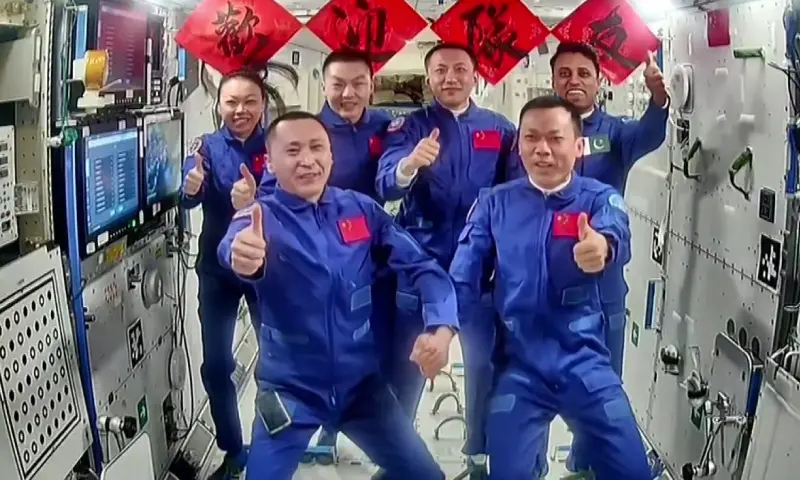
Islamabad, November 25,2026: Pakistan’s Zeeshan Ali on Wednesday made history by becoming the first foreign astronaut to enter China’s Tiangong space station, marking a significant milestone in Pakistan’s space programme and bilateral cooperation with Beijing.
Ali, 40, joined the three-member crew of China’s Shenzhou-24 mission, which entered the space station at 2:35pm Beijing time, around six hours after launching from the Jiuquan Satellite Launch Centre in northwest China aboard a Long March-2F rocket.
The Pakistani astronaut, serving as a payload specialist, is expected to remain aboard the station for five to 10 days, conducting scientific experiments alongside Chinese astronauts Tang Hongbo and Wu Yi.
According to China’s state broadcaster CCTV, Ali expressed excitement at becoming the first foreign crew member to board the Chinese space station, saying in Chinese: “As the first foreign crew member to board the China Space Station, I am incredibly excited. China Space Station here I come!”
The Shenzhou-24 spacecraft successfully docked with Tiangong three hours and 38 minutes after liftoff, the China Manned Space Agency (CMSA) confirmed.
Pakistani astronaut to conduct scientific experiments
During the mission, Ali will participate in scientific experiments, including cultivating microalgae as a potential source of food and oxygen for future space missions and studying the effects of spaceflight on quinoa seeds.
According to the CMSA, the crew will conduct around 90 experiments during the mission, alongside routine station operations, maintenance and scientific research.
Pakistan’s space agency, Suparco, said Pakistani scientific payloads would also be deployed in the Wentian and Mengtian laboratory modules of the space station.
Ali underwent seven months of intensive training in Beijing before the mission, including Chinese-language classes, cultural activities, calligraphy and physical preparation.
He was selected for the mission after Pakistan and China signed a cooperation agreement in February 2025. Two Pakistani candidates, Zeeshan Ali and Khurram Daud, began astronaut training in China in April 2026, with Ali eventually selected to join the Shenzhou-24 crew.
PM Shehbaz calls mission a journey beyond the stars
Prime Minister Shehbaz Sharif congratulated the nation on Ali’s historic journey, saying Pakistan had begun its journey “beyond the stars”.
In a statement issued by the Prime Minister’s Office, he said the mission represented not just the journey of one astronaut but the aspirations of 240 million Pakistanis, particularly young people, scientists and their dreams.
The prime minister said Ali and Khurram Daud had completed their training in China with hard work, discipline and dedication.
He thanked China for including Pakistan in the historic mission and said the two countries were now working together not only for peace and development on Earth but also in space.
Shehbaz also acknowledged the contributions of Suparco, universities and scientists involved in the scientific experiments being sent into space.
Deputy Prime Minister and Foreign Minister Ishaq Dar also congratulated the people of Pakistan and China, describing the successful launch as a significant milestone in their strategic partnership as the two countries mark 75 years of diplomatic relations.
He thanked Chinese President Xi Jinping and the Chinese leadership for their support, saying the mission would inspire Pakistani youth and advance the country’s ambitions in science and technology.
Military leadership, political figures congratulate nation
The military leadership also congratulated the nation, Suparco and the scientific community on the launch of Pakistan’s first astronaut to the Chinese space station, according to the Inter-Services Public Relations (ISPR).
Chief of Defence Forces and Chief of Army Staff Field Marshal Asim Munir, Chief of the Naval Staff Admiral Naveed Ashraf, Chief of the Air Staff Air Chief Marshal Zaheer Ahmed Baber Sidhu and Commander National Strategic Command General Syed Aamer Raza extended felicitations on behalf of the armed forces.
The ISPR described the mission as a defining moment in Pakistan’s scientific and technological advancement and commended Suparco’s scientists, engineers and technical teams for their efforts.
Planning Minister Ahsan Iqbal, who witnessed the launch in China, also described the mission as the beginning of a new era for Pakistan’s space programme.
He said the Pakistani flag had risen into orbit with Ali, carrying the hopes and aspirations of the nation for technological advancement and space exploration.
Zardari, Xi exchange congratulatory letters
Meanwhile, President Asif Ali Zardari and Chinese President Xi Jinping exchanged letters to congratulate each other on the milestone in Pakistan-China space cooperation.
According to the Presidency, President Zardari congratulated the Chinese government and people and expressed appreciation for selecting Pakistan as the first foreign partner in China’s manned space programme.
He acknowledged the support and professionalism of the China Manned Space Agency and the Astronaut Centre of China in making the mission possible.
President Xi also congratulated Pakistan, saying the participation of astronauts from both countries in space exploration represented a new achievement in bilateral cooperation.
He described the Chinese space station as a platform for peace, friendship and cooperation and reaffirmed Beijing’s commitment to expanding international collaboration in the peaceful exploration and use of outer space.
Ali hopes for wider Pakistan-China space cooperation
Speaking before the launch, Ali said he was deeply grateful to the Chinese government for helping him realise his dream of travelling into space.
He said he carried the hopes of millions of Pakistanis and believed that what followed the mission would be more important than the flight itself.
“This mission is not a finish line; it is a launch pad,” he said, expressing hope that Pakistan-China space cooperation would expand from a single astronaut and mission to multiple joint flights, including future exploration of the Moon and Mars.
Addressing Pakistani children, Ali urged them to look towards the sky and remember that he was in orbit with their dreams.
China’s Tiangong space station has been fully operational since late 2022 and can accommodate up to six astronauts during crew handovers. Beijing is also pursuing plans to send astronauts to the Moon before 2030 as part of its expanding space programme.