
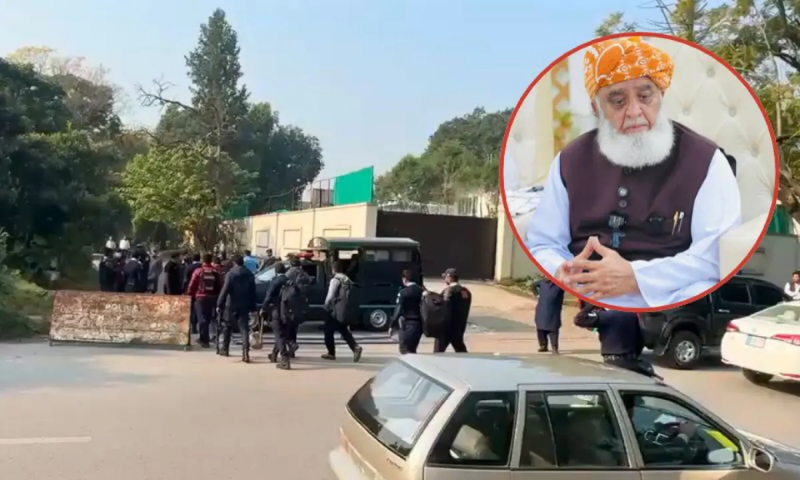
Islamabad, November 28,2026: The Capital Development Authority (CDA) on Saturday sealed the Islamabad residence of Jamiat Ulema-i-Islam-Fazl (JUI-F) chief Maulana Fazlur Rehman following the cancellation of the Pakistani identity card of the property’s registered owner.
The move comes amid escalating tensions between the JUI-F and the federal government, with the party alleging a series of actions targeting its leadership and workers.
According to a notice affixed to the property’s gate on Thursday, the CDA’s Building and Housing Control Department sealed the premises on account of the cancellation of ownership.
The action followed an order issued on November 27 by the deputy director of CDA’s Estate Management-I, who cancelled the change of title granted in favour of Amanullah, son of Muhammad Younus, after authorities identified him as a foreign national and his Computerised National Identity Card (CNIC) was cancelled.
The order stated that the cancellation had been made after examining the available record and following the prescribed process. It directed the director general of the CDA’s Building and Housing Control Department to seal the property, with assistance from other CDA formations and the Islamabad Capital Territory (ICT) administration if required.
The CDA said the ICT focal person for the Illegal Foreigners’ Repatriation Plan (IFRP), in a letter dated November 25, had confirmed the cancellation of Amanullah’s CNIC following verification by the National Database and Registration Authority (Nadra). The letter had also sought legal proceedings regarding immovable properties reportedly acquired by him in Islamabad.
According to the CDA, Amanullah was issued a show-cause notice on November 25 and directed to appear before the CDA member for Estate on November 26 to explain why the change of title should not be cancelled.
The authority said he could not be located at the property for personal service of the notice, which was subsequently pasted at the premises. It added that Amanullah neither appeared for the hearing nor produced a valid identity document or prior written permission from the competent government authority to acquire the property.
The CDA had also issued a notice concerning the same property on October 30 over the placement of a generator outside the building and alleged unauthorised construction.
The CDA order said the matter had been brought to its attention through official communications from various government agencies, including the Office of the District Magistrate, the ICT focal person for the IFRP and Nadra.
According to the order, Nadra had informed the authority that Amanullah originally obtained his CNIC on the basis of his parents’ identity documents, but discrepancies were subsequently identified in the family record, including the existence of two CNICs for his late father, Muhammad Younas.
The CDA said subsequent verification established that the identity document submitted by Amanullah to obtain the change of title was not a valid Pakistani CNIC and had been cancelled by the competent authority.
It maintained that furnishing an invalid identity document constituted a material violation of the transfer requirements under Chapter 6 of the CDA Property Manual, which requires a valid CNIC for property transfers.
The authority also cited Section 3 of the Foreigners Act, 1946, and a 1984 order under the law, which requires foreigners to obtain prior written permission from the federal or provincial government before acquiring land or any interest in property in Pakistan.
The CDA said no such permission had been produced or placed on its record, prompting the Estate Wing to initiate proceedings to cancel the change of title.
Separately, Islamabad police denied reports that JUI-F chief’s son, Maulana Asjad Mahmood, had been arrested.
In a statement, a police spokesperson described reports circulating on social media as “baseless and false”, clarifying that neither had Asjad been arrested nor had any action been taken against him.
The police urged the public not to believe or circulate unverified reports.
The clarification came hours after the JUI-F claimed that Asjad had been taken into custody. Senator Kamran Murtaza had earlier shared a picture from the Pak Secretariat police station, alleging that he and his lawyers were not being allowed to meet Fazlur Rehman’s son. Around 6pm, however, Murtaza posted that Asjad had been released.
In Swabi, Khyber Pakhtunkhwa, police detained several JUI-F leaders and workers, including party Vice President Maulana Fazli Ali and former provincial minister Ghafoor Khan Jadoon.
District police spokesperson Liaqat Ali told the media that the detained workers had been confined in a police lockup.
The arrests came after JUI-F leaders announced a protest at Karnal Sher Khan Chowk against the government’s actions. Police detained them before they could proceed.
Those arrested also included Swabi General Secretary Noorul Islam Khan, Information Secretary Qaiser Shah, Swabi Tehsil Emir Mufti Abdul Samad, Topi Tehsil Emir Maulana Taj Nabi Khan, General Secretary Javed, Razaar Tehsil Emir Maulana Anwar Zeb, Chhota Lahore Tehsil Emir Maulana Mushtaq Hussain, General Secretary Hafeezur Rehman and Advocate Rashid Sohail.
Meanwhile, a first information report (FIR) was registered on Saturday over an alleged incident at Jamia Qasimul Uloom in Multan, naming Fazlur Rehman’s other son, Maulana Asad Mahmood.
The complainant alleged that Asad and others forcibly entered the madrassah after he was removed from the post of its administrator.
According to the FIR, the complainant, who is the son of the new administrator, alleged that Asad had been aggrieved by the decision and was interfering in the madrassah’s affairs through different individuals and channels.
He further alleged that three people — Qari Moosa Sial, Qari Noorul Haq and Mufti Kaleemullah — entered the premises at the instigation of Asad and Mufti Aamir Mehmood and vandalised the building.
Multan police said a dispute between two parties over the madrassah’s administrative affairs and other matters was already under consideration before a court.
The police said that, in the presence of the district administration, officials had ensured compliance with court orders and fulfilled the required legal formalities. They added that all operations were being conducted within the law and without discrimination.
The JUI-F has also claimed that scores of its activists and workers were arrested and booked in Punjab and Khyber Pakhtunkhwa on Thursday and Friday as the party staged protests at various locations.
One FIR was registered at Ghallanai police station in Mohmand district over a protest on Friday. It nominated the party’s district chief, Mufti Mohammad Arif Haqqani, 16 other leaders and more than 200 unidentified people.
The FIR accused protesters of blocking the main Peshawar-Bajaur Road for nearly two hours. Those named included former Upper Mohmand nazim Hafiz Taj Wali, former Bazai nazim Maulana Bismillah Jan Rahimi, Arshad Bakhtiar, Qari Fazal Khaliq, Rohail Khan, Umairullah Khaksar, Maulana Gulab Noor, Samiullah and Qari Syed Alam Qari.
PPP, opposition alliance condemn sealing of residence
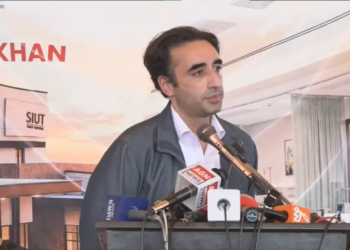
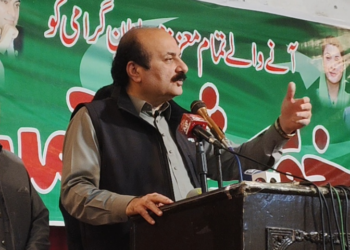
Pakistan Peoples Party Secretary General Humayun Khan visited Fazlur Rehman’s Islamabad residence to express solidarity with the JUI-F chief.
Speaking outside the property, Khan termed the manner in which it was sealed and Fazlur Rehman’s family was evicted inappropriate and condemnable, particularly the reported treatment of women and children.
He said PPP Chairman Bilawal Bhutto-Zardari had directed him to visit the residence and convey solidarity. Khan urged Prime Minister Shehbaz Sharif to order an impartial inquiry, noting that Fazlur Rehman was the head of a political party.
He also called for political stability and urged the government to focus on issues confronting farmers and underprivileged sections of society, particularly unemployment.
Leader of the Opposition in the National Assembly Mehmood Khan Achakzai also condemned the action.
In a statement shared by Tehreek-i-Tahafuz Ayeen-i-Pakistan, Achakzai said attacks on homes, humiliation of women and the use of state power over political differences were unacceptable in a democratic society.
He warned that political differences could not be resolved through state action and that such measures could further deepen political instability.