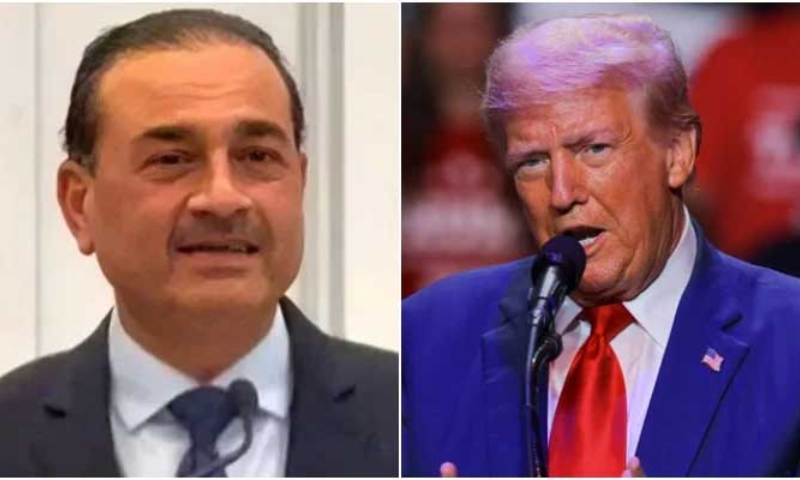
The Hague, June 25, 2025: U.S. President Donald Trump on Wednesday once again lavished praise on Pakistan’s Field Marshal Asim Munir, whom he hosted at the White House last week, while reaffirming his claim of playing a key role in preventing a full-scale conflict between Pakistan and India last month.
Speaking at a press conference following the annual NATO summit in The Hague, Trump described the Pakistan-India standoff as the “most important” among recent global conflicts due to the nuclear capabilities of both nations.
“I said, ‘Look, if you’re going to go fighting each other… it was getting very bad… then we are not going to do trade deals,’” Trump told reporters.
“We got them to reason, and you know what they said? ‘No, I want to do the trade deal,’ and we stopped a nuclear war.”
Referring to Field Marshal Munir, Trump said:
“I met the general from Pakistan last week in my office — a very impressive personality, a great man.”
The U.S. president also reiterated his admiration for Indian Prime Minister Narendra Modi, calling him “a close friend” and “a great gentleman.”
President Trump had previously stated that a ceasefire between Pakistan and India was reached following U.S.-mediated talks, and that he personally intervened by urging both sides to prioritize trade over conflict.
Islamabad has publicly acknowledged and praised Trump’s role in de-escalating the crisis. In fact, the Government of Pakistan recently recommended President Trump for the 2026 Nobel Peace Prize, citing his “decisive diplomatic intervention” and “pivotal leadership” during the crisis.
However, India has consistently denied any U.S. involvement, with Foreign Secretary Vikram Misri stating last week that the ceasefire resulted from direct military communication between Indian and Pakistani forces on May 7.
The heaviest fighting in decades between the two nuclear-armed neighbours erupted following a terrorist attack in Indian Illegally Occupied Jammu and Kashmir (IIOJK) on April 22, which killed 26 people, mostly tourists. India blamed Pakistan for the incident, an accusation Islamabad has strongly denied.
The conflict escalated rapidly, with India launching cross-border strikes, prompting Pakistan to retaliate with Operation Bunyan-um-Marsoos. The Pakistani military claimed it downed six Indian Air Force jets, including three Rafales, and destroyed several drones in response to Indian aggression.
The armed exchanges lasted for four days, before a U.S.-brokered ceasefire was declared on May 10, according to Washington and Islamabad. India maintains it was the result of direct bilateral military coordination.
President Trump has repeatedly offered to mediate the Kashmir dispute, a position also acknowledged in past statements by the U.S. State Department. While India has historically rejected third-party mediation, Pakistan has welcomed any neutral diplomatic engagement on the issue.
With this latest reaffirmation of his role, Trump appears keen to position his administration as a stabilizing force in South Asia amid broader geopolitical tensions.