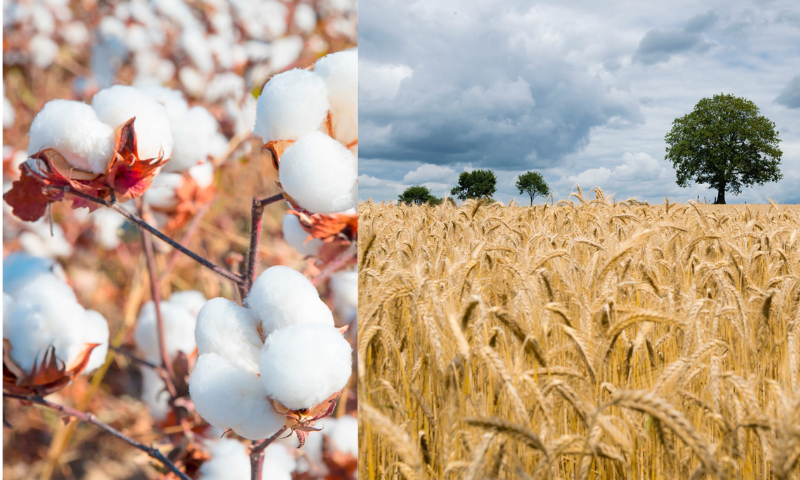
Multan, June 29, 2025: President of Pakistan Kisan Ittehad, Khalid Mahmood Khokhar, has announced that farmers will not cultivate wheat and cotton next year due to unbearable production costs and continued government neglect.
Addressing a press conference, Khokhar voiced strong criticism of the government, stating, “We are clearly telling you, there will be no wheat and cotton cultivation next year.” He lamented that the national and provincial assemblies have become centers of political bickering rather than problem-solving. “There will be no cotton in Pakistan because the dismal price of the crop has devastated farmers,” he added.
Khokhar noted that the price of potash fertilizer has surged to Rs10,000, while overall input costs have skyrocketed by several hundred percent. “Cotton accounts for 65% of our foreign exchange earnings, but today, the farmer is utterly disheartened. There is no crop that has brought profit to the cultivator,” he said. He emphasized that wheat, being a strategic crop, is also under threat, reiterating that both wheat and cotton cultivation may cease next year.
He criticized Punjab Chief Minister Maryam Nawaz for what he described as an “economic murder” of farmers, claiming that her statements have added insult to injury. “Food security is Pakistan’s second most critical issue, yet it is being ignored,” he warned.
Khokhar also highlighted the lack of agricultural research, pointing out that unlike the rest of the world where universities drive innovation, Pakistan has fragmented the process into underperforming institutions. “Nawaz Sharif Agricultural University is now financially bankrupt,” he said.
Raising broader concerns, Khokhar claimed that Pakistan is lagging far behind in education, with “speculation” running rampant in academic affairs. “Mango production has been completely destroyed this season. Farmers growing vegetables, wheat, and maize are in distress because they are not even recovering their input costs,” he said.
He stressed that farmers are not looking for handouts, but for fairness. “We don’t want charity from the government. We want them to calculate our actual production costs and ensure a 25% profit margin.”