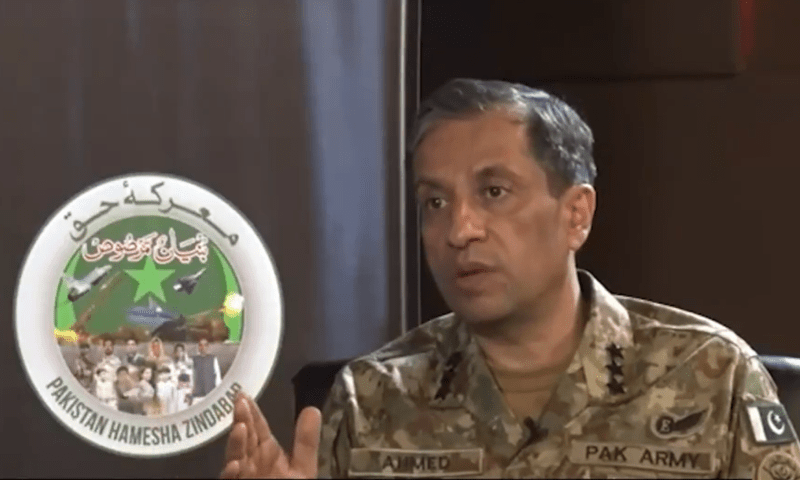
Islamabad, July 9, 2025: Director General of Inter-Services Public Relations (DG ISPR) Lieutenant General Ahmed Sharif Chaudhry has strongly accused India of orchestrating and supporting state-sponsored terrorism in Pakistan, particularly targeting regions like Balochistan through systematic subversion.
In an exclusive interview with Al Jazeera, General Chaudhry claimed that India has institutionalized terrorism as a policy tool against Pakistan, alleging that New Delhi’s security and political establishment have consistently sought to destabilize the country.
The remarks follow last month’s deadly bombing in Waziristan, which killed 16 Pakistani soldiers and injured over 20. The attack was claimed by the banned militant group “Fitna al-Khawarij”—a term increasingly used by Pakistan’s military and media to describe extremist outfits targeting the state and its institutions.
General Chaudhry emphasized that such groups operate on a distorted ideology that has no link with Islam, human values, or Pakistani traditions. Citing Islamic principles, he reiterated that only the state holds the authority to declare war or jihad—no individual or group can claim that right.
He also invoked the term “Fitna al-Hindustan” to refer to India-sponsored militant activities, alleging that Indian leadership has publicly admitted involvement in terrorist operations within Pakistan. The Indian National Security Advisor, Ajit Doval, was singled out as the chief architect of these covert networks.
The DG ISPR also pointed to alleged international acknowledgment of India’s role in state-backed terrorism, mentioning that countries like the United States and Canada have raised concerns about India’s destabilizing actions in the region.
On broader geopolitical issues, General Chaudhry reaffirmed Pakistan’s diplomatic and political support for Iran amid rising tensions with Israel. He also assured that Pakistan’s nuclear arsenal remains secure, emphasizing that the country’s nuclear capability serves as a credible deterrent and a cornerstone of regional strategic stability.
“Pakistan is a responsible, declared nuclear power,” he said, “and no external force can compromise our strategic assets.”
The wide-ranging interview highlights Pakistan’s ongoing concerns about cross-border terrorism and regional security, while reinforcing its stance on sovereignty, deterrence, and global diplomacy.