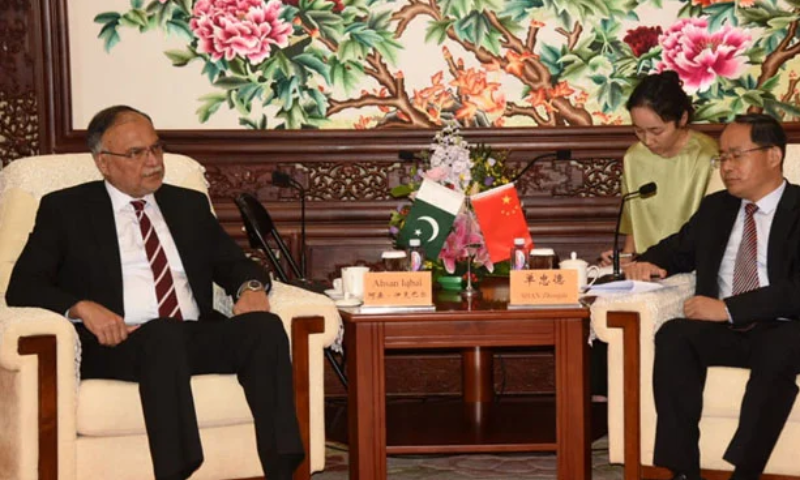
Beijing, August 4, 2025: In a bold leap towards space exploration, Pakistan plans to launch its first lunar mission by 2035, Minister for Planning, Development and Special Initiatives Ahsan Iqbal announced during a high-level meeting in Beijing on Monday.
Speaking alongside Shan Zhongde, Chairman of China’s Atomic Energy Authority and Space Agency, Iqbal said that Pakistan’s national space agency SUPARCO has been officially tasked with executing the country’s first mission to the moon—marking a historic milestone in Pakistan’s space ambitions.
The announcement came during bilateral discussions focused on deepening cooperation in space technology and peaceful nuclear energy, part of broader efforts to align scientific innovation with Pakistan’s long-term development goals.
Under the umbrella of “Uraan Pakistan”, a flagship initiative to promote space sciences, Iqbal said the sector has gained significant momentum under the leadership of Prime Minister Shehbaz Sharif.
The minister highlighted Pakistan’s recent launch of three satellites in collaboration with China, and revealed that the country aims to send its first astronaut to China’s space station by 2026. These milestones reflect Pakistan’s growing engagement with the global space community and its commitment to cutting-edge scientific progress.
Iqbal also underscored the role of advanced technology in addressing Pakistan’s growing climate vulnerabilities, calling for greater collaboration with China in areas such as nuclear energy, quantum computing, and renewable energy systems.
“The K-2, K-3, and C-5 nuclear power plants are shining examples of strategic cooperation between China and Pakistan,” Iqbal noted, stressing the importance of peaceful nuclear technology in securing the country’s energy, food, and health systems.
He added that Pakistan has now established a Quantum Computing Center, and is actively integrating science and technology with economic development priorities. He urged China to expand academic exchange opportunities for young Pakistani scientists and engineers.
Chairman Shan Zhongde commended Pakistan’s progress under the China-Pakistan Economic Corridor (CPEC), particularly in overcoming long-standing infrastructure and energy constraints. He reaffirmed China’s full support for Pakistan’s advancements in space science and peaceful nuclear capability.
“China will continue to work closely with Pakistan to deepen strategic, technological, and economic collaboration,” he assured.
As Pakistan sets its sights on the moon, this ambitious step underscores a broader shift in its development agenda—one driven by innovation, international cooperation, and scientific aspiration.