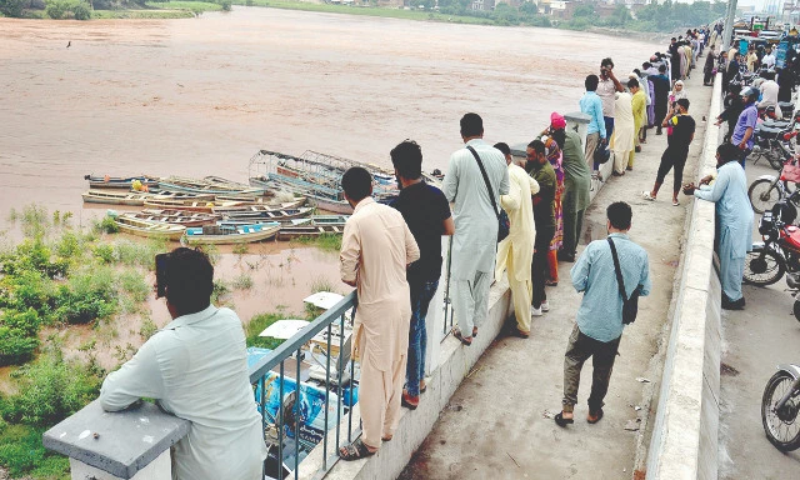
Rahim Yar Khan, August 28, 2025: Authorities have sounded a red alert as a massive flood wave of up to 1.2 million cusecs is expected to pass through the Indus River near Rahim Yar Khan within the next 36 hours — the largest surge since the catastrophic 2010 floods.
Deputy Commissioner Khurram Pervaiz confirmed that a flood emergency has been declared in the district, with Section 144 imposed to ensure evacuation of vulnerable katcha (riverine) areas. Around 95 settlements face imminent danger — 44 at risk of complete inundation and 51 partially submerged — putting an estimated 325,000 people and 557,000 livestock in harm’s way.
“All assistant commissioners and police officials have been instructed to immediately shift residents to safety,” the DC said, adding that rescue camps have been established.
Flooding in the Chenab, Sutlej, and Ravi rivers has already devastated nearly 1,400 villages across Punjab, displacing more than 1.2 million people. According to the NDMA, over 210,000 people have been moved to safer locations, including 25,000 accommodated in relief camps. More than 148,000 livestock have also been shifted, while 234 veterinary camps are operating in flood-hit districts.
Casualties are rising:
- Along the Chenab River, over 50 villages in Sambrial have been submerged, with at least eight people drowned.
- In Shakargarh, dozens of houses collapsed, killing three more residents.
- Rescue teams report scores of injuries from house collapses, snake bites, and waterborne diseases.
Rivers at dangerously high levels
- At Head Qadirabad, the Chenab’s discharge has surged to 996,000 cusecs, nearly 200,000 cusecs above design capacity.
- At Head Khanki, flows have reached 859,000 cusecs.
- The Ravi at Shahdara has swelled to 189,000 cusecs, spilling into surrounding settlements. Mosques in Lahore suburbs have been issuing evacuation calls as water enters villages.
- At Ganda Singh Wala, the Sutlej is witnessing an extremely high flood with flows at 261,000 cusecs, while protective embankments in Vehari and Bahawalnagar have collapsed, flooding dozens of villages.
Prime Minister Shehbaz Sharif, after visiting flood-hit Narowal and Lahore, called for “collective and long-term solutions” to recurring flood disasters. He stressed the urgent need for new reservoirs and enhanced water storage capacity, citing Diamer Bhasha and Mohmand dams as critical projects.
Punjab Chief Minister Maryam Nawaz, who inspected Shahdara by boat, said the province was facing a “flood emergency not seen in 38 years.” She praised timely evacuations, saying they had prevented “far greater devastation,” but acknowledged deep regret over the lives already lost.
Meanwhile, the PMD has warned that the next 12–48 hours are critical, with further heavy rainfall forecast in Lahore, Gujranwala, Sialkot, Jhelum, Rawalpindi, Murree, Azad Kashmir, and Gilgit-Baltistan.
NDMA Chairman Lt Gen Inam Haider Malik briefed that this year’s monsoon has been more prolonged and intense than usual, pushing flood levels in Punjab’s rivers to their highest in over a decade.