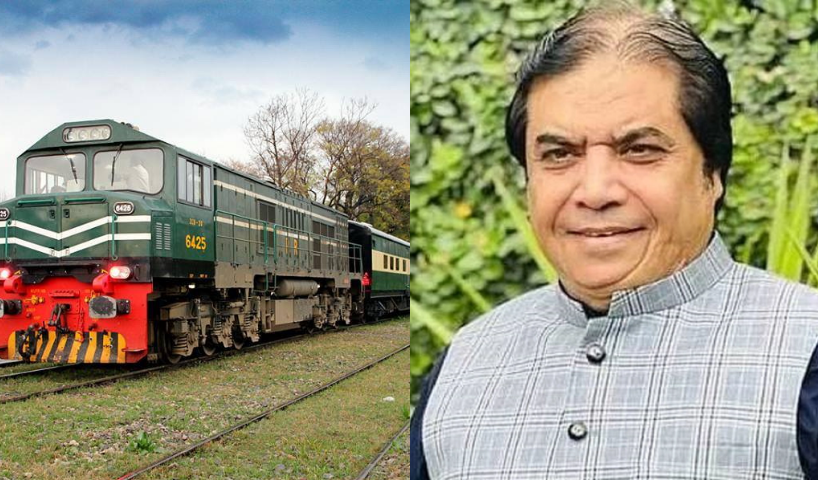
Islamabad, September 18, 2025: Pakistan has obtained Chinese approval to move forward with a $2 billion Asian Development Bank (ADB)-financed upgrade of the Karachi–Rohri railway line, Railways Minister Hanif Abbasi confirmed this week. The project is seen as vital for transporting copper and gold from the giant Reko Diq mine to export hubs.
Abbasi told media that Islamabad sought Beijing’s consent before advancing with ADB financing, as the Karachi–Rohri section forms part of the $7 billion Main Line-1 (ML-1) project, the largest infrastructure scheme under the $60 billion China-Pakistan Economic Corridor (CPEC).
“Yes, of course. Chinese are our brothers. We could not have moved forward without asking the Chinese first,” Abbasi said. “No matter where the funding comes from, it is the Chinese who will execute the project.”
China originally pledged $6.67 billion for ML-1 in 2016, but financing stalled for nearly a decade. Earlier this month, Planning Minister Ahsan Iqbal said Pakistan and China had agreed to form a consortium — including ADB, the Asian Infrastructure Investment Bank (AIIB), and both governments — to revive the project. Reuters also reported in August that ADB was in advanced talks to lead the Karachi–Rohri section.
The 500-km Karachi–Rohri stretch, described by Abbasi as “the main artery of Pakistan Railways,” is currently in poor condition with trains crawling at 40 km/h. The upgrade will raise speeds to 120 km/h, making it essential for transporting output from Reko Diq — a joint venture between Canada’s Barrick Gold and Pakistan’s federal and Balochistan governments — to Karachi’s Port Qasim.
The Reko Diq Mining Company (RDMC) has also agreed to provide $390 million in bridge financing for a 780-km stretch from Rohri to Nokundi in Balochistan. The project aims to move one million tons of copper annually, eliminating the need for more than 28,000 truckloads. Abbasi said the deal is expected to be signed by October 10.
Feasibility studies for the Karachi–Rohri section are due by December 2025, with groundbreaking targeted for mid-2026. While ADB prefers December 2026, Abbasi said the government is pushing for June.
Acknowledging security risks in Balochistan, where separatist and militant groups frequently attack infrastructure, Abbasi said safeguards would be put in place. He noted that earlier this year militants hijacked the Jaffar Express, killing at least 25 people.
“As far as security is concerned, we have an agreement with RDMC as well. Track security will be the responsibility of the state. The Federal Constabulary will be deployed on these trains,” he said.
Abbasi said Pakistan also plans to revive and expand regional rail links. The Islamabad–Tehran–Istanbul (ITI) freight service, suspended since 2019, is scheduled to resume in December. It was previously used to export rice and pink salt to Turkiye and Europe.
In addition, Pakistan is advancing the proposed $10 billion Uzbekistan–Afghanistan–Pakistan (UAP) railway project to connect Termez in Uzbekistan with Kabul and Pakistan’s Kurram district. Local reports suggest China may finance the 640-km line.
“If we succeed in doing this, then we will gain market access for the whole of Europe, Russia, and Central Asia,” Abbasi said. “Landlocked countries like Afghanistan and Uzbekistan will also get access to the port.”