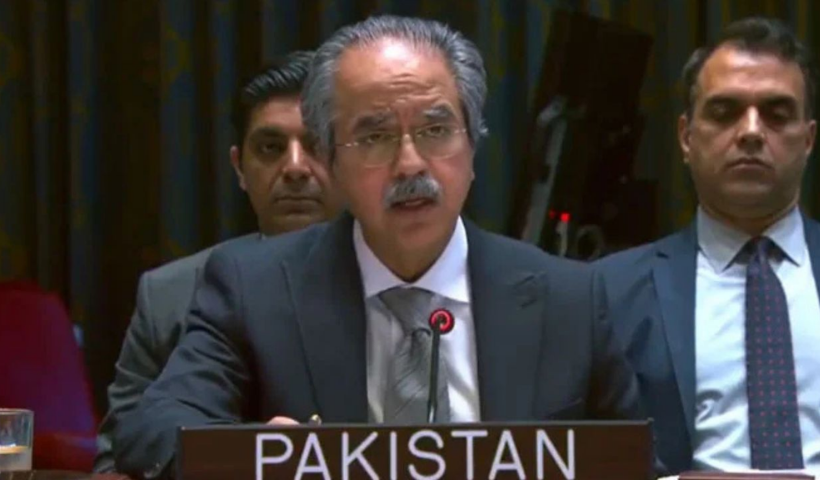
United Nations, September 18, 2025: Pakistan has cautioned the UN Security Council (UNSC) that terrorism originating from Afghanistan remains the “gravest threat” to its national security, urging the Taliban authorities to fulfill their counterterrorism commitments.
Speaking at a UNSC debate on Afghanistan, Pakistan’s UN envoy, Ambassador Asim Iftikhar Ahmad, said the banned Tehrik-e-Taliban Pakistan (TTP), with nearly 6,000 fighters, is the largest UN-designated terrorist group operating from Afghan soil.
He revealed that Pakistan had foiled multiple infiltration attempts by TTP and Balochistan Liberation Army (BLA) militants, seizing sophisticated weapons and equipment left behind by departing international forces. These operations, he said, came at a “heavy price,” citing the recent martyrdom of 12 soldiers in a single incident.
The envoy warned that more than 60 terrorist camps were active in Afghanistan, serving as hubs for groups including ISIL-K/Da’esh, Al-Qaeda, TTP, BLA and its Majeed Brigade. He said Pakistan had “credible evidence” of collaboration among these outfits through joint training, illicit arms trafficking, and coordinated attacks designed to destabilize Pakistan.
Calling the situation “intolerable,” Ambassador Ahmad urged swift action on Pakistan and China’s proposal to list the BLA and its Majeed Brigade in the UNSC’s 1267 Sanctions Committee, noting that the United States had already designated them as terrorist organizations.
While stressing Pakistan’s commitment to “sustained engagement” with Kabul, he said the Taliban sanctions regime should not “fall prey to political considerations” of Council members. He also emphasized the need for reciprocal steps and a “realistic roadmap” guided by dialogue and diplomacy.
The envoy reiterated Pakistan’s concern over Taliban restrictions on women and girls, describing them as inconsistent with Islamic traditions. He also highlighted Pakistan’s continued hosting of Afghan refugees under a liberal visa regime, while urging international partners to equitably share the humanitarian and resettlement burden.
“No country desires peace and stability in Afghanistan more than Pakistan, and no country has suffered more from the consequences of decades of conflict,” he said. “We remain committed to supporting a peaceful, prosperous Afghanistan for the sake of our region and the world.”
Earlier, the UN’s outgoing envoy for Afghanistan, Roza Otunbayeva, warned that the country was facing “a perfect storm” of overlapping crises, citing severe humanitarian and economic challenges compounded by Taliban restrictions on women and girls.