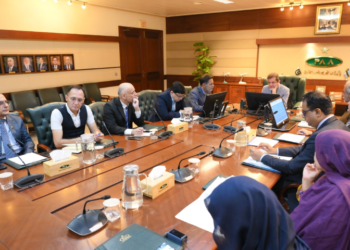
Islamabad, October 7, 2025: The Supreme Court on Tuesday permitted live streaming of proceedings in the high-profile case challenging the 26th Constitutional Amendment, marking a significant step toward judicial transparency.
An eight-member Constitutional Bench, headed by Justice Amin-ud-Din Khan, resumed hearing the petitions after a nine-month hiatus. The bench unanimously agreed to broadcast the proceedings on the Supreme Court’s official YouTube channel.
“Things have to be managed; we are all serving the nation,” remarked Justice Amin-ud-Din Khan during the hearing. Justice Jamal Khan Mandokhail added, “It is a big case, and we will handle it in an orderly manner.”
The bench includes Justices Jamal Khan Mandokhail, Muhammad Ali Mazhar, Ayesha A. Malik, Syed Hasan Azhar Rizvi, Musarrat Hilali, Naeem Akhter Afghan, and Shahid Bilal Hassan.
Multiple political parties and legal bodies — including Pakistan Tehreek-e-Insaf (PTI), Jamaat-e-Islami (JI), Sunni Ittehad Council (SIC), various bar associations, and former presidents of the Supreme Court Bar Association (SCBA) — had filed petitions in October 2024 challenging the constitutional changes introduced under the 26th Amendment.
The amendment, now in effect, brings key reforms to the judiciary’s structure and powers.
Key Provisions of the 26th Constitutional Amendment:
- The Chief Justice of Pakistan’s tenure is fixed at three years.
- Constitutional benches are to be established at both the Supreme Court and High Courts.
- The senior-most judge of each bench will act as its presiding officer.
- A parliamentary committee will nominate a new Chief Justice from among the three most senior judges.
- The Prime Minister will forward the selected name to the President for final approval.
- The Judicial Commission of Pakistan (JCP), headed by the Chief Justice, will oversee the appointment of Supreme Court judges.
- The JCP will also monitor judges’ performance and report to the Supreme Judicial Council.
- The amendment also calls for the complete eradication of Riba (interest) from Pakistan by January 1, 2028.
During Tuesday’s proceedings, Shahid Jamil, representing former lawmaker Mustafa Nawaz Khokhar, requested the court to decide on their pending chamber appeal, stressing that objections had delayed the process. The court subsequently ordered the petition to be allotted a number for hearing.
Meanwhile, lawyer Khawaja Ahmed, representing former Chief Justice Jawwad S. Khawaja, urged the bench to live stream arguments regarding the formation of the full court, asserting that the public had a right to be informed.
Justice Amin-ud-Din Khan, however, remarked that the issue of the bench’s composition was an internal court matter. Responding to further debate on the subject, Justice Mandokhail observed that the court’s aim in live streaming was to “educate the public” but added that “it sometimes ends up exposing itself.”
Additional Attorney General Amir Rehman termed the live streaming decision an administrative matter.
After hearing all arguments, the Supreme Court approved the live streaming of the case and adjourned the proceedings until 11:30 a.m. on Wednesday (October 8).