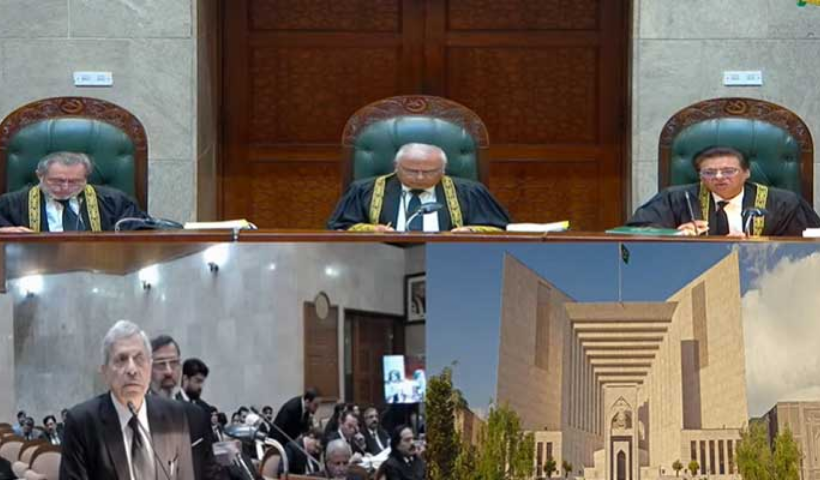
Islamabad, October 8, 2025: Supreme Court Justice Amin-ud-Din Khan on Wednesday remarked that the judiciary must rely on the existing 26th Constitutional Amendment unless and until fresh changes are made to the Constitution.
Justice Amin’s comments came during the hearing of petitions challenging the October 2024 constitutional amendments, which are being reviewed by an eight-member larger bench led by him. Other members of the bench include Justice Jamal Khan Mandokhail, Justice Muhammad Ali Mazhar, Justice Ayesha A. Malik, Justice Syed Hasan Azhar Rizvi, Justice Musarrat Hilali, Justice Naeem Akhtar Afghan, and Justice Shahid Bilal Hassan.
The proceedings were live-streamed on the Supreme Court’s official YouTube channel, following the apex court’s recent decision to broadcast significant constitutional hearings. The case was taken up on Tuesday after a gap of nine months.
Multiple political parties and legal bodies, including the Pakistan Tehreek-e-Insaf (PTI), Jamaat-e-Islami (JI), Sunni Ittehad Council (SIC), several bar associations, and former presidents of the Supreme Court Bar Association (SCBA), had filed petitions last year challenging the constitutional tweaks introduced through the 26th Amendment.
The amendment, which is currently in force, altered the process of appointing the Chief Justice of Pakistan, fixed the tenure for the top judicial post, and modified the composition of constitutional benches.
During Wednesday’s hearing, Hamid Khan, counsel for the Lahore High Court Bar Association (LHCBA), argued that the 26th Amendment was “passed in the dead of the night” and urged the court to constitute a full court to hear the matter.
He recalled that all eight sitting judges of the current bench were serving in the Supreme Court when the amendment was passed and suggested that the remaining judges also be included to form a full court.
In response, Justice Amin-ud-Din observed, “The existing 26th Constitutional Amendment will have to be relied upon until there are any further tweaks to the Constitution.”
Justice Musarrat Hilali concurred, noting that irrespective of the amendment’s legality, it has not been suspended by the court.
Hamid Khan further contended that the amendment had reduced the judiciary’s representation in the Judicial Commission of Pakistan (JCP), where judges previously held a majority.
“The majority in the JCP has shifted to the administrative side after the amendment, affecting judicial independence,” he claimed.
Justice Muhammad Ali Mazhar questioned whether a bench formed under the amendment could itself decide on a request for a full court. Hamid Khan responded that the present bench must determine the matter since it is directly linked to the constitutional changes.
Justice Amin-ud-Din then asked the counsel on what grounds he believed the current bench could not hear the petitions.
“It is not within our power to go back on the 26th Constitutional Amendment,” he remarked.
Hamid Khan, however, maintained that nothing in the amendment prevents the formation of a full court, suggesting that the matter should be referred to the Chief Justice of Pakistan (CJP).
Justice Jamal Khan Mandokhail remarked that the 26th Amendment remains a valid part of the Constitution “as of the moment.”
Justice Ayesha A. Malik also weighed in, noting that there was no explicit bar on forming a full court through a judicial order.
“Where is it written in the 26th Amendment that there can’t be a judicial order? Why can’t this be done as in other cases?” she asked.
After hearing arguments from all sides, the bench adjourned proceedings until 11:30 a.m. on Thursday (October 9).