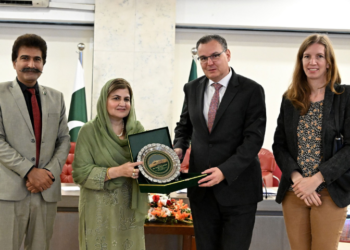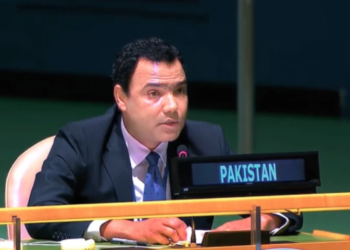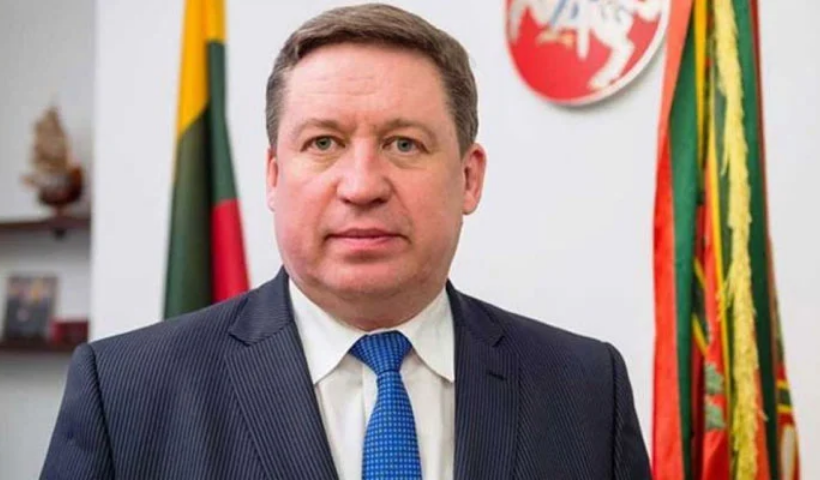
Islamabad, November 19, 2025: The European Union’s ambassador to Pakistan has voiced support for Islamabad’s position that Afghan-based militants are behind the recent surge in terrorist attacks, while underscoring that Pakistan’s security expectations must be matched by progress on human rights and democratic commitments.
In an interview with an English-language newspaper, Ambassador Raimundas Karoblis termed Pakistan’s call for the Afghan Taliban to prevent the Tehreek-e-Taliban Pakistan (TTP) from operating on its soil as “legitimate,” noting that the threat posed by the group is “real and serious.”
“We condemn terrorism in every form,” he said, adding that Pakistan’s concerns regarding TTP sanctuaries in Afghanistan were justified. However, he stressed the importance of continued diplomacy, pointing to Türkiye’s ongoing efforts to mediate between Islamabad and Kabul.
Regarding the Taliban’s adherence to the Doha Agreement, particularly the pledge not to allow Afghan territory to be used against neighbouring states, Karoblis said he did not have independent intelligence to assess compliance. “It is too early for a definitive conclusion,” he remarked.
The ambassador confirmed that a high-level Pakistan–EU Strategic Dialogue is scheduled in the coming weeks, to be led by EU foreign policy chief Kaja Kallas and Pakistan’s Deputy Prime Minister Ishaq Dar. The discussions will focus on Afghanistan, regional security, the Russia–Ukraine conflict, and Pakistan’s role at the United Nations. Trade, migration, and counterterrorism cooperation will be addressed through separate frameworks.
The dialogue comes as Islamabad seeks to retain its GSP+ preferential trade status, under which Pakistan enjoys duty-free access to European markets in exchange for compliance with core UN human rights conventions. Karoblis said enforced disappearances—historically linked to Balochistan but now increasingly reported from Punjab and Sindh—would rank among the EU’s “top priorities” during its upcoming monitoring review. The bloc will also examine the performance of Pakistan’s Commission of Inquiry on Enforced Disappearances.
Commenting on Pakistan’s last two general elections, criticised by opposition parties for irregularities, the envoy refrained from declaring them illegitimate but acknowledged that “problems exist.” He said the EU recognises the current parliament and government but is closely monitoring electoral transparency. “No system is perfect, but irregularities must be addressed so they are not repeated,” he added.
Karoblis also avoided taking a position on recent constitutional amendments related to judicial powers, saying Brussels was listening to critics while evaluating Pakistan’s compliance with international conventions.
Asked about the detention of former prime minister Imran Khan, he declined to comment directly. “I may have personal views, but this is a matter for Pakistan’s judicial authorities,” he said. “Political pluralism is essential, but it must operate through the rule of law.”
The envoy noted that the EU and its member states have mobilised nearly €1 billion in support following the 2022 floods, including an initial €1 million for emergency relief. He said climate adaptation and resilience would remain priority sectors for cooperation under the EU’s Global Gateway strategy.