Islamabad, November 28, 2025: Special Investment Facilitation Council (SIFC) National Coordinator Lt Gen Sarfraz Ahmad on Thursday presented a comprehensive roadmap aimed at making Pakistan’s economy competitive, calling for sharp reductions in the corporate tax burden, lower interest rates, and a more pragmatic exchange rate policy.
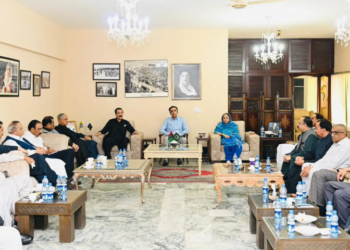
Speaking to top business leaders during the second day of the Dialogue on Economy organised by the Pakistan Business Council (PBC), Ahmad said Pakistan’s “growth plan is missing” and urged all stakeholders to move towards an export-led growth model to reduce reliance on protectionist measures and subsidies.
Ahmad criticised the country’s current taxation structure, saying businesses were unfairly targeted because they were already within the tax net.
“We have made a mess of our fiscal situation. The only thing we can think of is taxation, and you are the easiest prey because you are already in the net,” he said. He confirmed that the government was seriously considering major tax reforms, including:
- Reducing corporate tax from 29% to 25%
- Abolishing the 10% super tax
- Ending the 15% inter-corporate dividend tax
- Eliminating inter-corporate income tax
- Bringing the effective tax burden, currently above 50%, to a sustainable level
- Cutting sales tax from 18% to 15%
His remarks echoed recent reporting that the government may also reduce the maximum individual income tax rate from 45% to 25%. Calling the current 11% interest rate “unsustainable,” Ahmad urged monetary authorities to align policy with the declining inflation trend.
“Interest rate must also be reduced. Monetary policy must reflect ground reality,” he said. He warned that Pakistan’s shrinking fiscal space, circular debt in the energy sector, and exchange-rate misalignment had created a “pain cycle” that must be broken.
The SIFC official stressed the need for a market-oriented exchange rate, saying artificial interventions distort the economy. “We need a pragmatic, competitive, market-oriented framework — while keeping our vulnerabilities in mind,” he said.
Ahmad warned that Pakistan’s consumption-driven and debt-reliant model had repeatedly forced the country to seek external bailouts. “The choice is between an export-led and an import-substituting model. Everybody understands that the export road is the solution,” he said.
He urged the business community to shift focus towards exports instead of depending on protection and fiscal incentives. “If we want export-led growth, we must prioritise incentives that support exports, not protections that distort the economy.”
Ahmad criticised Pakistan’s business elite for investing their profits abroad rather than reinvesting locally. “Pakistani capital earned from Pakistan finds its final destination in the UAE, London, Singapore and New York,” he said. “Hardly anything earned here is reinvested here.”
He added that foreign direct investment (FDI) remained stuck at around $1.2 billion, partly because local investors were not confident enough to invest domestically. “Until our own business community invests in Pakistan, foreign investors will not.”
He said FDI should be doubled to $2.5 billion, but stressed that Pakistan should welcome investment only in export-oriented sectors.
Investment in consumption-heavy sectors — particularly power — had led to profits being repatriated abroad rather than strengthening Pakistan’s economy, he said.
Ahmad said Saudi Arabia sought a single-window mechanism for investment, leading to the formation of a dedicated forum under the government-to-government framework. The SIFC, he said, had since narrowed its mandate to identifying foreign investment projects, steering policy corrections, and facilitating businesses.
He also pointed out that Pakistani investors were increasingly investing in Egypt and Saudi Arabia, noting that footballs made by Pakistani companies for the FIFA World Cup would soon bear the label “Made in Saudi Arabia.”