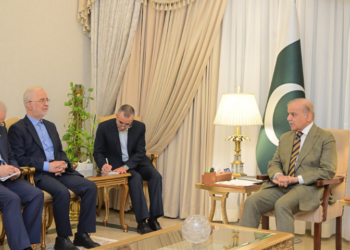
Islamabad, December 5, 2025: The Ministry of Defence on Friday formally notified Chief of Army Staff (COAS) Field Marshal Asim Munir as Pakistan’s first Chief of Defence Forces (CDF), marking the most sweeping reorganisation of the country’s military command structure in five decades.
The notification came a day after President Asif Ali Zardari approved the appointment on the advice of Prime Minister Shehbaz Sharif.
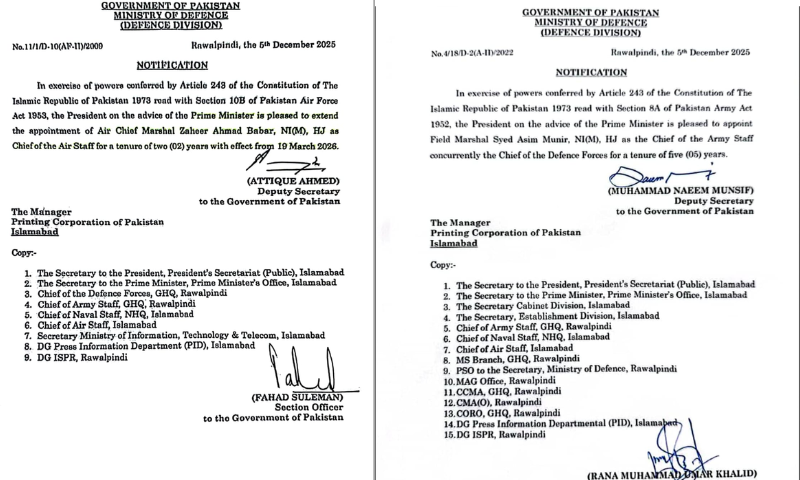
According to the notification, “In exercise of the powers conferred under Article 243 of the Constitution of the Islamic Republic of Pakistan, 1973, read with Section 8A of the Pakistan Army Act, the president on the advice of the prime minister, is pleased to appoint Field Marshal Asim Munir (NI) M as the chief of army staff, concurrently the chief of defence forces for a tenure of five years.”
A separate notification also confirmed the president’s approval of a two-year extension for Air Chief Marshal Zaheer Ahmed Babar from March 19, 2026, following his current five-year term’s completion, extending his service until March 2028.
Historic command overhaul
Field Marshal Munir becomes the inaugural CDF under structural changes instituted through the 27th Constitutional Amendment, which consolidated operational, administrative and strategic authority under a single office.
The amendment revised Article 243, stipulating that the president, acting on the prime minister’s advice, shall appoint the COAS, who will concurrently serve as the CDF. It also abolished the office of the Chairman Joint Chiefs of Staff Committee (CJCSC), ending the tri-service coordination system in place since 1976. Its functions now shift to the CDF.
To align military laws with the constitutional changes, the government has amended the Pakistan Army Act (PAA) 1952. A new clause under Article 8A resets the tenure of the first COAS-plus-CDF to commence from the date of notification, effectively restarting Field Marshal Munir’s five-year term from Friday.
These amendments also empower the president, on the PM’s advice, to reappoint or further extend the tenure of a CDF or service chief by up to five years, creating legal room for Munir to remain in office until December 2035.
PM, ministers hail appointment
Prime Minister Shehbaz Sharif congratulated Field Marshal Munir on his “historic” elevation, calling him “the sentinel of the nation’s security” and crediting his leadership for unifying the armed forces and securing a “decisive victory in the battle for truth.”
He also congratulated Air Chief Marshal Babar, praising the Pakistan Air Force’s role in shooting down seven enemy aircraft and destroying missile defence systems during the May conflict with India.
Defence Minister Khawaja Asif took to X to laud both officers, saying the nation was honouring those who “gave Pakistan a historic win.”
Information Minister Attaullah Tarar told reporters that Pakistan’s defence “has strengthened” after the CDF notification, remarking that those spreading rumours over the delay “should feel ashamed.”
The notification’s delay—particularly after Gen Sahir Shamshad Mirza’s retirement on Nov 27 and the abolition of the CJCSC office—fueled political and media speculation. The absence of a new appointment on Nov 29, when Munir’s original three-year term expired prior to last year’s tenure amendment, added to the uncertainty.
Political circles speculated the government might be negotiating future four-star appointments, including the Commander National Strategic Command (CNSC) and a potential vice chief of army staff (VCOAS). The army had already clarified that no VCOAS post was being created.
Government officials rejected suggestions of civil-military friction, attributing the delay to procedural steps and the prime minister’s foreign travel. Still, the silence was widely perceived as unusual, especially following the speedy passage of the 27th Amendment.
New military organogram underway
Law Minister Azam Nazeer Tarar said on Thursday the Ministry of Defence was finalising a new command organogram for the CDF and had shared a draft with the Prime Minister’s Office. He dismissed notions of disagreement over the notification, asserting that the delay was administrative.
The organogram will define command relationships among the CDF, the three service chiefs and the newly established strategic command, completing Pakistan’s transition to a unified defence structure.