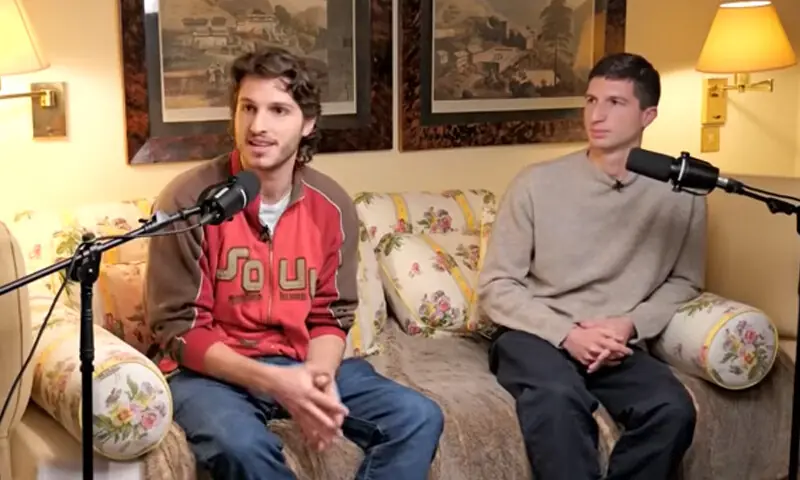
Islamabad/London, December 17, 2025: Pakistan Tehreek-e-Insaf (PTI) founder and former prime minister Imran Khan’s sons, Kasim Khan and Suleiman Khan, have said they are planning to visit Pakistan in January after applying for visas, while raising serious concerns over their father’s prison conditions and claiming he is being kept in a “death cell”.
The remarks were made during an interview with journalist Yalda Hakim on Sky News, aired early Wednesday, amid renewed tensions outside Adiala Jail where Imran Khan is incarcerated. The interview coincided with another sit-in by Imran’s sisters outside the jail over being denied meetings, which was dispersed by authorities using water cannons. PTI alleged that “chemical-laced” water was used, a claim not officially confirmed.
As court-ordered prison visits remain restricted, Imran Khan’s family and party have repeatedly expressed concern about his detention conditions. A United Nations special rapporteur has also warned that the former prime minister may be held in conditions amounting to inhuman or degrading treatment.
During the interview, Kasim and Suleiman, who live in London, were asked whether they had sought permission from the Pakistani government to visit their father. Hakim noted that they had previously spoken of being “warned not to come”, despite Defence Minister Khawaja Asif publicly stating that they were welcome to visit.
Responding, Kasim said they were now planning the visit. “We have applied for our visas. It hasn’t come through yet, but we are expecting it to. So we are planning a trip in January,” he said.
Asked whether they would urge Imran Khan to “cut a deal” for his release, Kasim rejected the idea, saying politics was his father’s life’s purpose.
“He calls it his life’s goal to rid Pakistan of corruption. If he took a deal and left, I know he would be depressed. You can only respect that,” he said.
Kasim said the family felt helpless and wanted to know how they could help secure Imran Khan’s release. He also said his father consistently avoided discussing his own prison conditions during rare interactions, instead asking about his children and family, including their grandmother Lady Annabel Goldsmith, who passed away in October.
“We haven’t spoken to him since she died. Their relationship was very close. I would love to speak to him about that,” he said.
When asked whether they believed Imran Khan would ever be released, Kasim said the outlook appeared bleak. “The conditions are getting worse, and people in power are becoming more entrenched. We’re now worried we might never see him again,” he said.
Suleiman added that international pressure appeared to be the only viable route. “He’s not the sort of person who will cut a deal. International pressure is often the only way change happens,” he said.
‘Awful conditions’
Describing Imran Khan’s incarceration, Kasim said the conditions were “awful”, while Suleiman claimed the cell had been described to them as a “death cell”.
“There are barely any lights, sometimes electricity is cut off, dirty water — completely substandard conditions that don’t meet international laws,” Suleiman alleged.
Both brothers also described the stress of encountering social media rumours about Imran Khan’s possible death, calling the experience “jarring” and “incredibly stressful”.
They also referred to a meeting earlier this month between Imran Khan and his sister Uzma Khan, after which a strongly worded message attributed to Imran was posted on his X account, prompting a sharp response from the military’s media wing.
Suleiman said Uzma told them that Imran Khan was physically well but furious about his conditions and isolation. He suggested that the message issued after the meeting had led to further restrictions on Imran’s access to the outside world.
Appealing to the international community, Suleiman called for independent monitoring of Imran Khan’s detention and urged that basic human rights standards be upheld. Kasim stressed the need to implement court orders allowing family visits and access to Imran Khan’s personal physician.
Commenting on recent constitutional amendments, including immunity provisions related to the army chief, Kasim said Imran Khan would not be surprised.
“It’s essentially a military dictatorship in everything but name,” he said, adding that Imran was being isolated because of his popularity.
Asked what authorities feared most, both brothers replied in unison: “Popularity.”
Government rejects solitary confinement claims
Meanwhile, Mosharraf Zaidi, Prime Minister Shehbaz Sharif’s spokesperson for foreign media, also appeared on the programme and rejected claims that Imran Khan was being held in solitary confinement.
Zaidi said Imran Khan had been incarcerated for around 860 days and had held approximately 870 “interviews” during that period, including 137 meetings with his sisters and more than 450 with his lawyers.
“This doesn’t sound like solitary confinement to me,” Zaidi said, adding that Imran Khan’s personal physician had been allowed access. He said meetings were temporarily suspended only due to security concerns, arguing that each interaction turned into a political engagement.
Responding to questions about the UN special rapporteur’s concerns, Zaidi said he did not believe anyone was lying but suggested that conclusions were being drawn from “bad information”.
When asked directly whether Imran Khan posed a threat, Zaidi replied, “Absolutely,” citing Pakistan’s security challenges and regional tensions.
Zaidi also pointed out that prison rules prohibit political discussion during jail interviews, noting that hundreds of posts had appeared on Imran Khan’s social media accounts since his incarceration.
The contrasting claims by Imran Khan’s family and the government continue to fuel an intense debate over the former prime minister’s detention, treatment and political future.