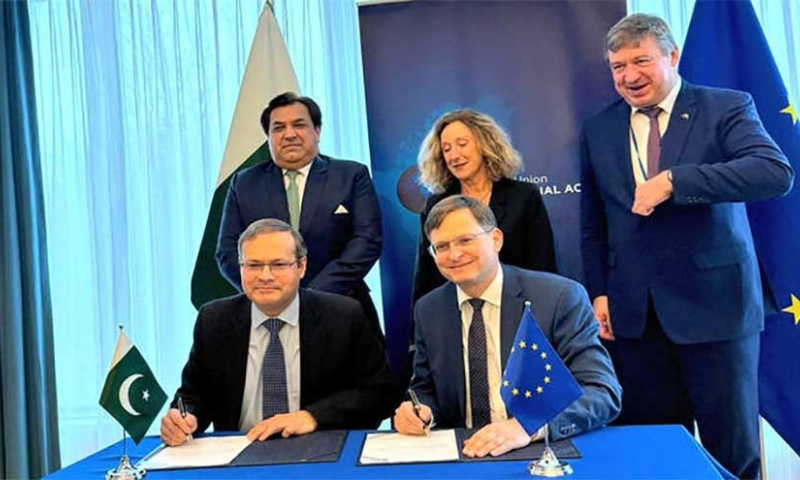
Brussels, December 2025: The 15th meeting of the European Union (EU)–Pakistan Joint Commission was held in Brussels, where both sides reviewed political and economic developments and held detailed discussions on cooperation across a wide range of areas, including democracy, governance, human rights, trade and investment, development, migration, climate and energy, science and technology, and the implementation of the EU–Pakistan Strategic Engagement Plan (SEP).
The two sides also exchanged views on regional and global developments, reaffirming the importance of their longstanding partnership, rooted in shared interests and a common commitment to regional stability.
The Joint Commission was co-chaired by Pakistan’s Secretary for Economic Affairs Muhammad Humair Karim and Paola Pampaloni, Acting Managing Director for Asia and the Pacific at the European External Action Service (EEAS). It was agreed that the next session of the Joint Commission will be held in Islamabad in 2026.
As part of the Joint Commission process, the EU–Pakistan Sub-Group meeting on Democracy, Governance, Rule of Law and Human Rights was held on December 1, 2025. Pakistan was represented by the Ministry of Foreign Affairs, while the EU side was represented by the EEAS.
Both sides stressed the importance of continued close cooperation on human rights, both bilaterally and in international fora. The EU congratulated Pakistan on its election to the United Nations Human Rights Council, noting that members are expected to uphold the highest standards in promoting and protecting human rights.
Pakistan briefed the EU on progress under its National Action Plan on Human Rights and the National Action Plan on Business and Human Rights, as well as the work of national institutions responsible for safeguarding human rights. The EU reiterated its commitment to supporting Pakistan’s efforts to protect all human rights, including the rights of women, children, minorities, labourers and migrants, as well as fundamental freedoms such as freedom of expression and opinion, including addressing the growing challenge of disinformation.
Both sides reviewed Pakistan’s implementation of the 27 international conventions required under the GSP+ framework. The EU welcomed progress in aligning Pakistan’s application of the death penalty with international standards and acknowledged initial steps to combat torture, as well as the establishment of a Commission on Minorities. The EU encouraged further short-term progress ahead of the upcoming GSP+ Monitoring Report, while stressing the need for continued reforms in the medium and long term.
Discussions also covered freedom of expression and media, enforced disappearances, judicial independence, freedom of religion or belief, anti-Muslim hatred, and the rights of minorities and vulnerable groups. On labour rights, both sides discussed strengthening labour inspections, ensuring compliance with minimum wage laws and improving women’s participation in the labour market, while also addressing EU concerns over low trade union membership.
The EU–Pakistan Sub-Group on Trade met on December 15, 2025, with Pakistan represented by the Ministry of Commerce and the EU by the European Commission’s Directorate-General for Trade.
The EU remains Pakistan’s second-largest trading partner, with Pakistan being the largest beneficiary of the EU’s Generalised Scheme of Preferences Plus (GSP+), which has significantly boosted bilateral trade. Both sides underscored the importance of a strong multilateral trading system and discussed market access challenges, bilateral trade relations and cooperation under the GSP+ framework.
The meeting reviewed follow-up actions from the GSP+ Monitoring Mission held from November 24 to December 3, 2025, as well as preparations for the upcoming GSP report and Pakistan’s re-application under the new GSP Regulation. Both sides also stressed the need to improve the overall business environment and committed to advancing this agenda, including at the upcoming High-Level EU–Pakistan Business Forum scheduled for April 28–29, 2026, in Islamabad.
The EU–Pakistan Sub-Group on Development Cooperation convened on December 16, 2025. Pakistan was represented by the Joint Secretary of the Ministry of Economic Affairs, while the EU was represented by the European Commission’s Directorate-General for International Partnerships.
Both sides reaffirmed the relevance of the priority areas under the current Multiannual Indicative Programme (MIP): green inclusive growth, human capital and technical and vocational education and training (TVET), and governance, including rule of law and human rights. These priorities were described as being well aligned with Pakistan’s national development agenda.
Pakistan welcomed the EU’s continued support for climate change resilience under a Team Europe approach. The EU outlined its planned projects for 2025–2027 and briefed Pakistan on the Global Gateway strategy. Both sides welcomed the renewed engagement of the European Investment Bank (EIB), which signed its first credit financing agreement in Pakistan’s water sector since 2015 on the margins of the Joint Commission meeting.
The Joint Commission reviewed progress under the EU–Pakistan Comprehensive Dialogue on Migration and Mobility, including cooperation on return and readmission under the EU–Pakistan Joint Readmission Agreement, as well as legal migration pathways through the EU–Pakistan Talent Partnership.
The EU welcomed Pakistan’s steps to strengthen cooperation on migration-related issues, particularly in combating irregular migration and migrant smuggling. Both sides appreciated Pakistan’s support for the Global Alliance to Counter Migrant Smuggling and the participation of Interior Minister Syed Mohsin Naqvi in the alliance’s second international conference in Brussels on December 10, 2025. They also welcomed the recent endorsement of the Talent Partnership Roadmap.
Discussions also covered cooperation on climate change and the environment, education, culture, science and technology, connectivity and digitalisation. Both sides highlighted the success of the EU–Pakistan knowledge partnership, including the growing number of Pakistani students benefiting from Erasmus Mundus scholarships, and agreed to explore research collaboration under the Horizon Europe programme.
The EU acknowledged Pakistan’s long-standing role in hosting millions of Afghan nationals and welcomed ongoing discussions between Pakistan and UNHCR to identify and protect vulnerable cases, stressing that any returns must be safe, dignified and in line with international standards.
On regional and global developments, both sides expressed support for the implementation of the Comprehensive Plan to end the Gaza conflict, emphasising the importance of upholding the ceasefire, ensuring humanitarian access and advancing steps towards a two-state solution in line with UN resolutions.
The EU reiterated its position on Russia’s war against Ukraine, while Pakistan briefed the EU on the situation in Jammu and Kashmir and concerns related to the Indus Waters Treaty. Both sides stressed the peaceful resolution of disputes in accordance with international law and the UN Charter. Discussions also covered the situation in Afghanistan, security challenges emanating from Afghan soil and the need for sustained humanitarian assistance.
Reaffirming their commitment to the 2019 Strategic Engagement Plan, the EU and Pakistan reviewed progress made over the past six years and agreed to further deepen cooperation across political, economic and people-to-people domains.