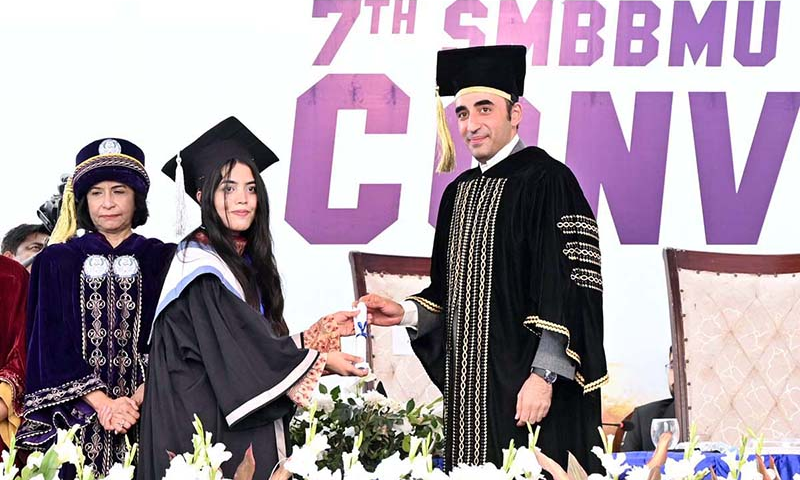
Larkana, December 29, 2025: Chairman Pakistan Peoples Party (PPP) Bilawal Bhutto Zardari on Monday reiterated his vision of establishing world-class educational and healthcare institutions in every district, stressing that access to quality health and education is a fundamental right, not a privilege.
Addressing the convocation ceremony of Shaheed Mohtarma Benazir Bhutto Medical University (SMBBMU) Larkana as chief guest, alongside Sindh Chief Minister Syed Murad Ali Shah, Bilawal emphasized the critical role of doctors and paramedics in strengthening the public healthcare system. He urged healthcare professionals to align themselves with the Sindh government’s modern public health framework and to remain at the forefront of safeguarding citizens’ right to life, dignity, and compassionate medical care.
According to a press release issued by the Media Cell Bilawal House, the PPP chairman expressed pride in visiting one of Sindh’s leading medical institutions, describing the university’s name as “not merely a memory, but a promise — a promise of courage, compassion, and an unshakable belief in the dignity of human life.” Recalling the vision of Shaheed Mohtarma Benazir Bhutto, he said she viewed healthcare as a matter of justice, noting that a society denying healthcare denies its people their most basic right to live with dignity.
Addressing graduating students, Bilawal said Larkana is not just a city but a symbol of resistance against injustice, commitment to democracy, and service to the common people. He urged young doctors to ensure their education never distances them from the poor, the anxious mother, or the forgotten child, and praised the university’s faculty and administration for shaping both professional skills and character.
Highlighting reforms after the 18th Constitutional Amendment, Bilawal said the PPP-led Sindh government made public healthcare a top priority and invested heavily to strengthen the sector. He noted that after the devolution of the National Institute of Cardiovascular Diseases (NICVD) to Sindh in 2015, it has emerged as a global example in cardiac care. Similarly, he said, partnerships with the Sindh Institute of Urology and Transplantation (SIUT) led to its expansion across multiple districts, including operational centres in Sukkur and Karachi, with further expansion planned.
Bilawal also highlighted the transformation of the National Institute of Child Health (NICH), stating that from a single federal institution, it has grown into a network of facilities, with four centres now operating in Karachi alone and paediatric care units established in Nawabshah, Jamshoro, Sukkur, and Larkana. He said that under a public–private partnership with the ChildLife Foundation, emergency paediatric services have been set up in all districts of Sindh. Paying tribute to former Sindh chief minister Syed Qaim Ali Shah, he said the hospital established during his tenure in Gambat, Khairpur, rivals modern hospitals in major cities.
Turning to education, the PPP chairman acknowledged that there is still room for improvement in Sindh’s academic institutions. He noted that before Pakistan’s creation, Sindh had only one university, while between 1947 and 2008, 16 universities were established. “Since 2008, the number of universities in Sindh has risen to 30,” he said.
Bilawal further stated that after federal funding for the Higher Education Commission was reduced in 2017–18, Sindh remained the only province to continue bearing this responsibility. He said the provincial government’s goal is to ensure that every district has at least one university campus, and ideally a full-fledged university, to provide youth in remote areas access to higher education and promote balanced regional development.