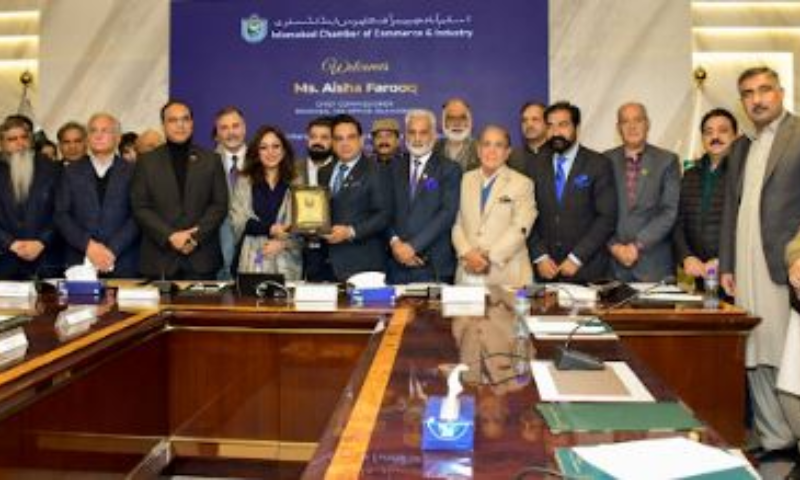
Islamabad, January 13,2026: Chief Commissioner, Regional Tax Office (RTO) Islamabad, Ms. Ayesha Farooq, along with her team, visited the Islamabad Chamber of Commerce and Industry (ICCI) and held an interactive session with members of the business community to discuss key tax-related issues, facilitation measures, and ways to strengthen cooperation between tax authorities and stakeholders.
Addressing the session, Ms. Ayesha Farooq paid tribute to the business community for its pivotal role in Pakistan’s economic development and prosperity. She emphasized that close collaboration between tax authorities and taxpayers is essential for sustainable economic growth and assured participants that RTO Islamabad is fully committed to resolving genuine issues faced by taxpayers. Stressing the importance of continuous engagement, she announced that RTO Islamabad would hold sector-wise meetings to address industry-specific challenges raised by taxpayers.
The Chief Commissioner also briefed participants on the digital transformation initiatives undertaken by the Federal Board of Revenue (FBR). She highlighted that the Point of Sale (POS) system is a key reform aimed at ensuring automatic facilitation for return filing. She further stated that the business community would be taken on board during the finalization of the Valuation Table and informed that the process for inclusion of non-residents in the Active Taxpayers List (ATL) would be expedited.
Welcoming the Chief Commissioner and her delegation, ICCI President appreciated the constructive engagement and presented several proposals to improve tax facilitation and enhance the ease of doing business. He highlighted the difficulties faced by overseas Pakistanis in obtaining non-resident certificates, claiming refunds, and filing returns to maintain ATL status. In this regard, he proposed the posting of Inland Revenue Service (IRS) attachés at Pakistani embassies in Saudi Arabia, the UAE, the UK, the USA, and key European Union countries to facilitate the large Pakistani diaspora and overseas business community.
The Chamber also strongly recommended the restoration of the office of the Commissioner (Appeals), noting that its absence has created serious challenges for taxpayers seeking timely resolution of tax disputes. ICCI stressed that reinstating this office would ensure a transparent and accessible appeal mechanism, thereby strengthening confidence in the tax system.
Additionally, ICCI proposed that the Additional Commissioner (Headquarters), RTO Islamabad, be formally designated as the focal person for grievance redressal for the business community to streamline communication and ensure swift resolution of issues.
During the interactive discussion, small traders expressed serious concerns over the integration of POS systems, urging authorities to adopt a gradual and consultative approach rather than strict enforcement. They cited practical and financial constraints and called for phased implementation.
ICCI President endorsed these concerns, emphasizing that tax reforms and enforcement measures must be business-friendly, consultative, and aligned with ground realities, particularly for small and medium enterprises. Chairman ICCI Founder Group Sheikh Tariq Sadiq also underscored the need for business-friendly policies in the national interest.
Senior Vice President Tahir Ayub and Vice President Irfan Chaudhry expressed optimism that continued engagement between RTO Islamabad and the business community would lead to improved tax facilitation, enhanced compliance, and a stronger partnership.
The Chief Commissioner’s delegation included Commissioners Maria Sharif, Rabia Yasir Durrani, Uzma Munir, Abdur Razzaq, Naveed Khan Tareen, Additional Commissioner (HQ) M. Shakil Anwer, and Assistant Commissioner Hattaf Ayub.
Former ICCI presidents Mohammad Ejaz Abbasi and Basir Dawood, executive members, industry and trade leaders, market representatives including Ajmal Baloch and Yousuf Rajput, and a large number of chamber members were also present at the session.