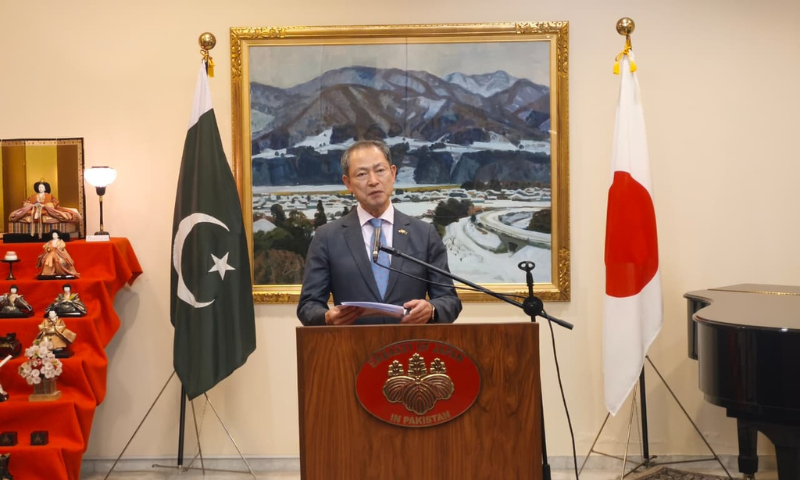
Islamabad, February 6, 2026: Japan’s Ambassador to Pakistan, Akamatsu Shuichi, has highlighted the enduring 74-year diplomatic friendship between Japan and Pakistan, outlining a forward-looking roadmap centered on people-to-people engagement, economic collaboration, and technological partnership.
The ambassador made these remarks while addressing a media networking get-together hosted at his residence on Friday.
Reflecting on his travels across Pakistan since his arrival in November 2024—from industrial centers in Punjab and Sindh to historic sites such as Mohenjo-daro and Taxila, as well as the northern regions—Ambassador Akamatsu praised the country’s cultural richness and hospitality.
“Each visit has left unforgettable memories and deep appreciation for its rich history and culture,” he said, adding that the trust and affection Pakistanis hold for Japan stem from decades of diplomatic relations, development cooperation through Official Development Assistance (ODA), the presence of Japanese companies, and confidence in Japanese products.
Ambassador Akamatsu presented an ambitious agenda for 2026 and beyond, emphasizing economic expansion, technological collaboration, and building on the legacy of the Osaka-Kansai Expo 2025.
He identified three key pillars shaping the future of bilateral relations:
- Expanding mutual understanding through human-to-human interaction
- Strengthening economic ties
- Promoting Japanese cuisine as a form of cultural diplomacy
Highlighting the growing interest among Pakistani youth in Japan, the envoy noted a sharp increase in students learning the Japanese language, with more than 1,000 candidates recently appearing for each Japanese Language Proficiency Test.
The ambassador pointed to strong potential for cooperation in artificial intelligence (AI) and information technology, citing Pakistan’s rapidly expanding IT sector and Japanese companies’ efforts to connect with skilled professionals. Nearly 80 Japanese firms currently operate in Pakistan, employing more than 100,000 people.
Following a successful AI seminar with the National University of Sciences and Technology (NUST) and the 8th Japan-Pakistan Government-Business Joint Dialogue in Tokyo, he announced a Japan-Pakistan Business Seminar scheduled for February 10 to address the concerns of Pakistani entrepreneurs.
Ambassador Akamatsu celebrated the success of the Pakistan Pavilion at the Osaka-Kansai Expo 2025, which won the Bronze Award for Exhibition Design and attracted approximately 1.8 million visitors, helping foster a stronger connection between the Japanese public and Pakistan.
Looking ahead, he invited Pakistanis to participate in the 20th Asian Games and the 5th Asian Para Games, set to take place in Nagoya, Aichi Prefecture, in September and October 2026.
The ambassador also highlighted the rising popularity of Japanese cuisine in Pakistan, linking it to Japan’s world-leading life expectancy.
“I often meet young Pakistanis who love it. While sushi and tempura are well-known, wagyu beef is gaining fans too. Sharing cuisines builds mutual understanding and friendship,” he remarked.
Speaking at the event, Prof. Dr. Yasar Ayaz, Chairman of the National Center of Artificial Intelligence (NCAI) and Head of NUST’s Robotics Department, praised Japan’s legacy of trust, quality, and reliability.
A recipient of the Japanese government’s MEXT scholarship, Dr. Ayaz earned his PhD in Robotics from Tohoku University between 2005 and 2009. He credited Japanese values such as teamwork, humility, punctuality, and respect for shaping his professional journey upon returning to Pakistan.
Dr. Ayaz highlighted ongoing collaborations with Japanese institutions, including a Frailty Assessment System with Juntendo University and the Sakura Wheelchair Project with Saito Kobo—AI-powered wheelchairs utilizing EEG brain control, eye movement, and autonomous navigation, supported by the Japan International Cooperation Agency (JICA) and experts from the University of Tokyo.
He added that AI systems developed at NCAI are being deployed across Pakistan and thanked Japan for providing scholarships that enable Pakistani students to pursue higher education, contributing to the country’s knowledge-based economy.
The event underscored the steady evolution of Japan-Pakistan relations, driven by shared priorities in innovation, education, and cultural exchange.