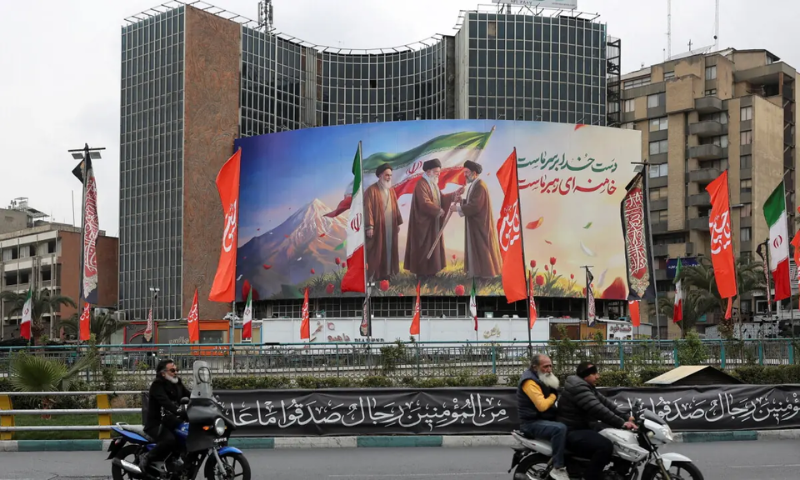
Washington/Tehran/Tel Aviv, March 10, 2026: The conflict between the United States, Israel, and Iran intensified sharply on Tuesday as Washington announced its heaviest airstrikes yet, while Tehran warned it could block oil exports from the Middle East if attacks continue.
Speaking at the Pentagon, US War Secretary Pete Hegseth said American forces would significantly escalate operations.
“Today will be yet again our most intense day of strikes inside Iran,” Hegseth told reporters, adding that the campaign launched 10 days ago was entering a more aggressive phase.
Meanwhile, the chairman of the Joint Chiefs of Staff, Dan Caine, said Iranian forces were resisting but were less formidable than initially assessed.
“I think they’re fighting, and I respect that, but I don’t think they’re more formidable than what we thought,” he said.
Iran warns of oil blockade
Tensions escalated further after Iran’s powerful Islamic Revolutionary Guard Corps (IRGC) warned that no oil shipments would be allowed from the Middle East if US and Israeli attacks continued.
“We are the ones who will determine the end of the war,” an IRGC spokesperson said, according to Iranian state media.
The warning prompted a strong response from US President Donald Trump, who threatened devastating retaliation if Iran attempted to block tanker traffic through the Strait of Hormuz—a critical shipping lane that handles roughly one-fifth of the world’s oil supply.
“If Iran does anything that stops the flow of oil within the Strait of Hormuz, they will be hit by the United States twenty times harder than they have been hit thus far,” Trump said.
Israel outlines war objective
Israel has also made clear its broader political goal in the conflict. In a statement, Israeli Prime Minister Benjamin Netanyahu said the ultimate aim of the war was to end Iran’s clerical rule.
“Our aspiration is to bring the Iranian people to cast off the yoke of tyranny,” Netanyahu said, adding that Israeli actions were weakening Tehran’s leadership.
US officials, however, have mainly stated that Washington’s military objective is to destroy Iran’s missile capabilities and its nuclear program, although Trump has suggested the war would end only if Iran has a compliant government.
Heavy casualties and leadership change in Iran
According to Iran’s ambassador to the United Nations, at least 1,332 Iranian civilians have been killed and thousands wounded since US and Israeli air and missile strikes began across Iran in late February.
The crisis deepened after the appointment of Mojtaba Khamenei as Iran’s new supreme leader following the killing of his father, Ali Khamenei. Analysts say the leadership change has complicated hopes for a rapid ceasefire.
Iranian Foreign Minister Abbas Araqchi signaled that Tehran was unlikely to resume negotiations with Washington.
“They spoke of progress after three rounds of talks, yet they attacked us. Talking to the Americans is no longer on our agenda,” he said in an interview.
Global oil and financial markets shaken
The war has severely disrupted energy markets. Tanker traffic through the Strait of Hormuz has been effectively halted for more than a week, forcing Gulf producers to reduce pumping as storage facilities fill.
Energy giant Saudi Aramco warned of “catastrophic consequences” for global oil markets if the conflict continues to disrupt shipping.
Oil prices have swung dramatically. Brent crude surged as much as 29 percent on Monday, reaching its highest level since 2022, before dropping more than 10 percent on Tuesday after Trump predicted the war could end sooner than expected. Global stock markets also fluctuated sharply amid the uncertainty.
Wider regional fallout
The conflict is increasingly spilling beyond Iran. Israel said it had launched fresh strikes in central Iran and also attacked targets in Beirut after the Iran-backed militant group Hezbollah fired rockets across the border.
Turkey reported that its NATO air defenses shot down a ballistic missile fired from Iran after it briefly entered Turkish airspace, marking the second such incident since the war began.
In Australia, five players from Iran’s national women’s football team were granted humanitarian visas after seeking asylum, while Canberra announced plans to send surveillance aircraft to the Middle East and missiles to the United Arab Emirates to bolster regional defenses.
War faces political pressure
The escalating conflict is also generating political pressure in the United States. A new Reuters/Ipsos poll found that 67 percent of Americans expect gasoline prices to rise, while only 29 percent approve of the war, as the country heads toward the November midterm elections.
Meanwhile, the head of the World Health Organization, Tedros Adhanom Ghebreyesus, warned that attacks on Iranian oil infrastructure could trigger severe environmental contamination affecting food, water, and air quality.
With both sides escalating rhetoric and military action, analysts warn that the conflict risks expanding into a broader regional war with profound implications for global energy supplies and geopolitical stability.