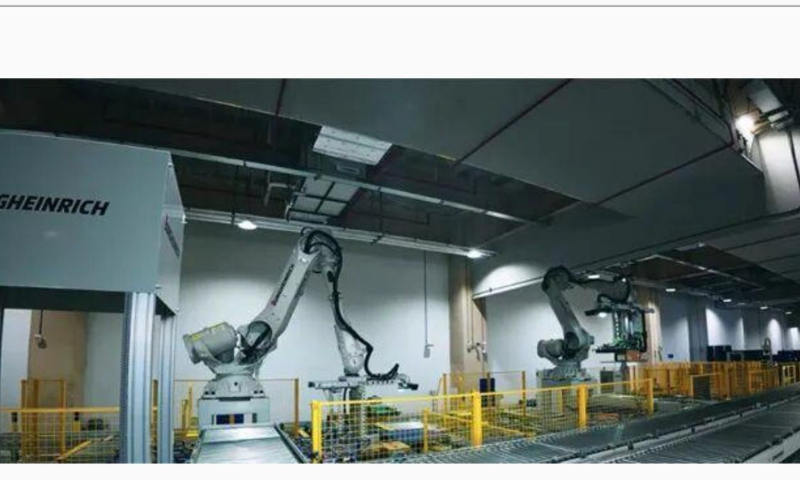
Shanghai, May 3,2026: As a delivery drone slowly set down a parcel of cosmetics, the Estee Lauder China Supply Chain Intelligent Operations Center was officially launched in east China’s Shanghai Municipality.
This smart facility supports 24/7 unmanned “lights-out factory” operations for cargo storage and retrieval, and is expected to double the coverage of the company’s next-day delivery services in China compared with 2021.
With China’s beauty market continuing to expand and consumer demand increasingly diversifying, the company is investing in such innovative facilities to open up new prospects amid changing circumstances, said Stephane de La Faverie, president and CEO of the Estee Lauder Companies.
He added that Estee Lauder aims to enhance its digital and intelligent supply chain capabilities and continue increasing infrastructure investment to provide Chinese consumers with more efficient and reliable services.
Estee Lauder has long been a steadfast investor in Shanghai.
Xi As early as 2006, the company established its first logistics center in the municipality and has since continuously stepped up investment in China’s supply chain sector.
Since the beginning of this year, many established foreign enterprises like Estee Lauder have continued to expand investment in Shanghai, underscoring international capital’s sustained confidence in the economic vitality of both this metropolis and the Chinese market.
A high-quality business environment is a key reason why ZEISS Group continues to increase its investment.
China has been ZEISS’s largest market globally since 2021, said Martin Fischer, president and CEO of ZEISS Greater China.
The company’s Greater China headquarters campus, which broke ground in February this year with a total investment of 1.2 billion yuan (about 174.86 million U.S. dollars), marks its largest infrastructure investment in China and a major milestone in its localization process.
Fischer said what impressed him most was that officials of the local government visited the company multiple times to actively solve problems and clear key bottlenecks for the construction project. Thanks to such efficient collaboration, the project has progressed smoothly and even started ahead of schedule, he added.
Fischer noted that since entering China in 1957, ZEISS has grown from a trading company into an innovation- and manufacturing-driven industry pioneer. In 2025, its revenue in Shanghai exceeded 12.3 billion yuan.
China is leading technological progress in multiple fields, which will help companies find new growth opportunities in areas like healthcare, artificial intelligence and advanced manufacturing, he added.
Latest data show that Shanghai has recognized a total of 1,091 regional headquarters of multinational corporations and 654 foreign-funded R&D centers. In the first two months of this year, 996 new foreign-invested enterprises were established in the municipality, up 14.1 percent year on year.
“We expect continued positive growth in newly established foreign investment projects, contracted foreign investment and actual utilized foreign capital this year, which fully demonstrates that Shanghai remains one of the most preferred destinations for foreign investors,” said Shen Weihua, director of the Shanghai Municipal Commission of Commerce.
China is striving to drive high-quality economic development through high-level opening up. This year’s government work report called for steadily expanding institutional opening up, promoting reinvestment of foreign capital within the country and expansion of localized production, and strengthening services for foreign-funded enterprises.
Wu Wei, executive vice mayor of Shanghai, said the metropolis is coordinating policy support to actualize these goals, including establishing a government-business roundtable mechanism and providing tailored “service packages” for key foreign-funded enterprises.
“Openness is Shanghai’s greatest strength,” Wu said. With nearly 80,000 foreign-invested enterprises, Shanghai will continue to steadily expand institutional opening up, promote more projects in newly-opened fields, and optimize business services to sustain a stable and predictable development environment, he added.
Courtesy Xinhua