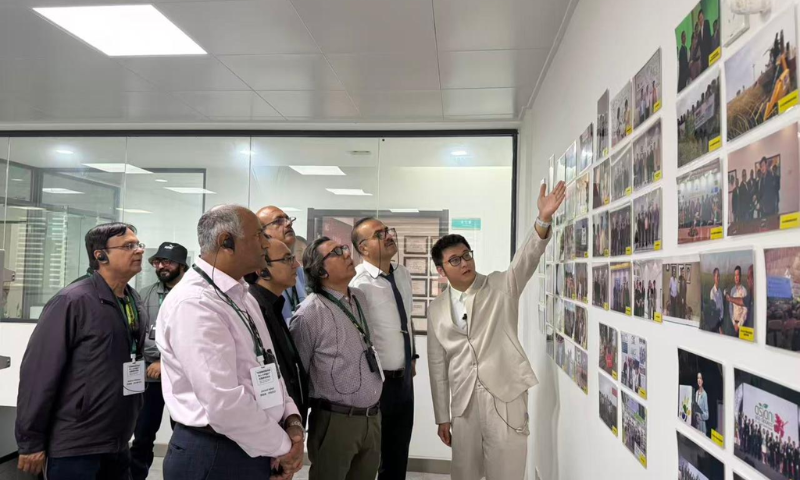
Wuhan, May 3,2026: During a trip to Wuhan, Central China’s Hubei Province, with a delegation of Pakistani media professionals and think tank representatives recently I spoke with a Pakistani journalist on the bus. I told him that I hoped to find a “small yet beautiful” story of China-Pakistan cooperation during the trip — one that could illustrate how the China-Pakistan all-weather strategic cooperative partnership has taken root in real life. After the delegation concluded its visit to the Wuhan Hi-Tech Bio-Agricultural Park, the journalist waved at me and said with a smile, “I think you’ve found the story you were looking for.”
Before entering the office building of Wuhan Qingfa Hesheng Agricultural Development Co., Ltd, few members of the delegation knew that this ordinary-looking building contained so many stories of China-Pakistan agricultural cooperation. From introducing hybrid rice and canola to Pakistan and establishing R&D farms for local variety breeding and technology transfer, to running training programs for Pakistani agricultural professionals, these cooperation projects may not be grand or eye-catching, but they are closely tied to farmers’ incomes, food security and people’s livelihoods. They are vivid examples of the “small yet beautiful” projects under the Belt and Road Initiative, especially the China-Pakistan Economic Corridor.
Hybrid rice, rapeseed, watermelon, squash, chili peppers, cauliflower… As he looked at the wide range of seeds displayed in the exhibition room, Noor Ullah, senior manager of Jang Media Group, told me that with these seeds, Pakistani farmers would be able to improve per-unit yield and agricultural income.
That is particularly important, he said, because food security will be a major challenge facing the entire world in the future.
“These are not just crop seeds,” he said emotionally. “They are seeds of hope that China-Pakistan cooperation is sowing in our land. I believe that both China and Pakistan will harvest better food and sweeter fruit from these seeds.”
From the reactions of Pakistani delegation members throughout the trip, what I sensed was far more than curiosity about new agricultural technologies. It was also Pakistan’s genuine desire to accelerate agricultural modernization. This year marks the beginning of China’s 15th Five-Year Plan period (2026-30), while Pakistan is also at a key stage of advancing its “Uraan Pakistan” vision. As developing countries and important members of the Global South, China and Pakistan share many common ideas and development priorities.
Agriculture is one of the most promising areas for bilateral cooperation.
In recent years, China-Pakistan agricultural cooperation has continued to bear fruit. According to the Embassy of China in Pakistan, bilateral agricultural trade has remained above $1 billion for three consecutive years, and rose 22.1 percent year-on-year in the first quarter of this year, demonstrating strong vitality.
Pakistan is a major agricultural country in South Asia, with vast arable land resources, diverse climate conditions and long crop-growing seasons. It is well suited not only for stable grain production, but also for the development of specialty cash crops as well as a variety of fruits and vegetables. The Indus River irrigation system provides a solid foundation for agricultural development, while abundant sunlight and heat resources give Pakistan strong potential in producing crops such as chili peppers, sesame, mangoes and cherries. Its young and dynamic population also provides ample human resources for agricultural modernization and industrial upgrading.
For China, Pakistan is a promising agricultural partner. China has accumulated rich experience in hybrid breeding, water-saving irrigation, agricultural mechanization, smart farming, e-commerce logistics and full industrial-chain integration. Pakistan, meanwhile, holds unique strengths in land resources, climate advantages, specialty agricultural products and strategic access to South Asian and Middle Eastern markets. These complementary advantages naturally create broad space for China-Pakistan agricultural cooperation.
The significance of China-Pakistan agricultural cooperation has long gone beyond the bilateral level. China-Pakistan cooperation shows other countries what truly sustainable international agricultural cooperation can look like. A single seed, a farm, a training program, or a technology transfer project – these seemingly small initiatives are often the ones that take deepest root in the soil — and make the greatest difference in people’s lives.
The Pakistani delegation’s visit partly coincided with Pakistani President Asif Ali Zardari’s five-day trip to China. According to Pakistani media reports, Zardari witnessed the signing of three memorandums of understanding to expand cooperation in desalination, agricultural technology and the tea sector. As agricultural trade grows steadily, cooperation mechanisms continue to improve, and people-to-people exchanges become closer, mutually beneficial cooperation is injecting fresh momentum into building an even closer China-Pakistan community with a shared future in the new era.
As the delegation left the park, members were still full of enthusiasm, discussing the seed research achievements they had just seen and the many possibilities for future cooperation. One Pakistani journalist held up his phone, showing a picture of a giant watermelon, and asked a company manager, “Is it possible to grow a watermelon like this in Pakistan?” Laughter immediately broke out among the group. Yet behind that laughter, what I saw was the heartfelt expectation of these Pakistani friends — a genuine hope to see more new and welcomed fruits grow from their own land for the benefit of their people.
Courtesy Global Times by Ma Ruiqian