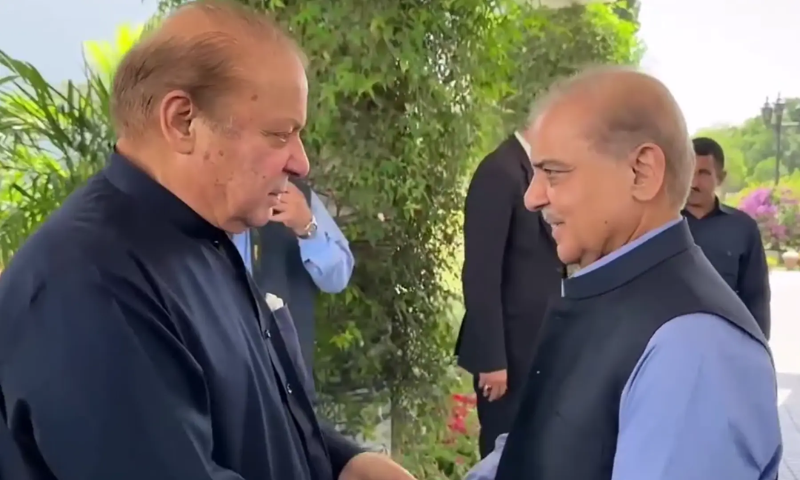
Lahore, May 3, 2026: Prime Minister Muhammad Shehbaz Sharif on Sunday called on Nawaz Sharif at the latter’s Jati Umra residence in Lahore, where the two leaders discussed the evolving situation in the Middle East and the country’s political affairs, according to a statement issued by the Prime Minister’s Office (PMO).
Punjab Chief Minister Maryam Nawaz was also present during the meeting.
The PMO said the prime minister briefed the PML-N supremo on the overall national situation and exchanged views on the prevailing political environment in Pakistan.
The premier also informed Nawaz Sharif about the latest developments in the Middle East and Pakistan’s diplomatic efforts aimed at restoring peace and stability in the region.
The ongoing Middle East conflict, which began with US-Israeli strikes on Iran on February 28, has continued to impact regional and global stability despite a Pakistan-brokered ceasefire announced on April 8 and later extended indefinitely by US President Donald Trump.
Over the past two months, Pakistan’s civil and military leadership has actively engaged in diplomatic efforts to encourage de-escalation between the parties involved.
On April 11 and 12, Pakistan hosted the first high-level contact between Iran and the United States in decades, facilitating discussions widely referred to as the “Islamabad Talks”. However, due to difficulties in arranging a second round of negotiations, Islamabad has since resumed its broader role as a facilitator.
The conflict has also led to the closure of the Strait of Hormuz, a critical global energy route through which nearly one-fifth of the world’s oil and gas supplies pass during peacetime, contributing to rising international oil prices and concerns over a global energy crisis.
According to the PMO statement, Prime Minister Muhammad Shehbaz Sharif also briefed Nawaz Sharif on fluctuations in international oil prices and the government’s measures to provide relief to the public.
Following the outbreak of the conflict, the government initially increased petrol and diesel prices by Rs55 per litre on March 6 and later introduced austerity measures on March 9 to manage the economic fallout.
In subsequent weeks, the prime minister said he had rejected recommendations for further fuel price hikes on three separate occasions despite increasing pressure from the global market.
However, on April 2, Petroleum Minister Ali Pervaiz Malik and Finance Minister Muhammad Aurangzeb announced steep increases of 43 per cent and 55 per cent in petrol and high-speed diesel prices, respectively, alongside a targeted fuel subsidy programme.
A day later, Prime Minister Muhammad Shehbaz Sharif reduced the petroleum levy by Rs80 per litre, bringing petrol prices down to Rs378 per litre. On April 10, the government further reduced diesel and petrol prices by Rs135 and Rs12 per litre, respectively.
Despite those reductions, the government later revised fuel prices upward twice, first on April 24 and again on April 30, amid continued volatility in international energy markets.