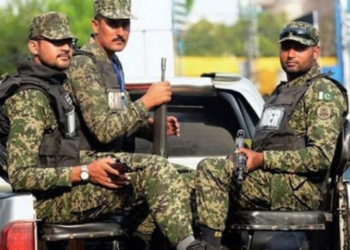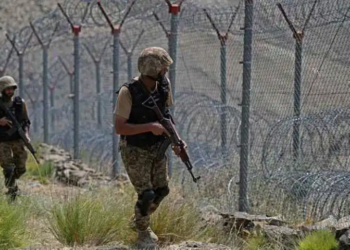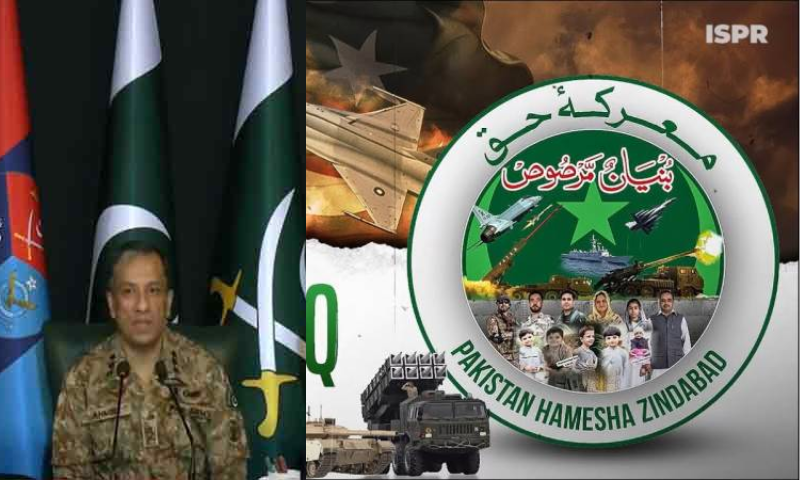
Rawalpindi, May 7, 2026: Director General of Inter-Services Public Relations (ISPR) Lt Gen Ahmed Sharif Chaudhry on Thursday declared that Pakistan’s armed forces were fully prepared to counter any future threat, highlighting the country’s rapidly expanding indigenous military capabilities and strategic readiness one year after the conflict officially termed Marka-e-Haq.
Addressing a comprehensive press conference in Islamabad alongside Deputy Chief of Naval Staff (Operations) Rear Admiral Shifaat Ali and Deputy Chief of Air Staff (Projects) Air Vice Marshal Tariq Ghazi, the military spokesperson said Pakistan had emerged stronger, more united and strategically confident following last year’s military confrontation with India.
The briefing marked the first anniversary of the conflict that began after the April 22 Pahalgam incident and culminated in Pakistan’s Operation Bunyanum Marsoos, before a ceasefire ended hostilities on May 10, 2025.
“We are prepared; if anyone wishes to test us, they are more than welcome,” Lt Gen Chaudhry said, asserting that Pakistan’s armed forces had successfully demonstrated multi-domain operational capability against a much larger adversary.
‘Strategic consequences’ of Marka-e-Haq
The DG ISPR outlined what he described as the “10 strategic consequences” of Marka-e-Haq, beginning with the collapse of India’s narrative accusing Pakistan of sponsoring terrorism.
“One year after Pahalgam, the questions Pakistan raised remain unanswered,” he said. “Where is the evidence? Nobody buys this narrative anymore.”
He argued that the conflict established Pakistan as a “net regional stabiliser” and demonstrated Islamabad’s ability to control escalation during a high-intensity confrontation.
Lt Gen Chaudhry also accused India of politicising its military leadership and militarising political discourse, warning that such trends were dangerous for regional stability.
“You are trying to make jokers out of your admirals, generals and air marshals,” he remarked while criticising statements made by Indian military officials after the conflict.
The military spokesperson further alleged that India was attempting to externalise its domestic problems, including unrest in Indian Illegally Occupied Jammu and Kashmir, by blaming Pakistan for regional instability.
“Kashmir is an internationally recognised dispute. It cannot be turned into an internal matter through demographic changes,” he stressed.
Information warfare and multi-domain conflict
The DG ISPR said Marka-e-Haq transformed the character of modern warfare, emphasising that future conflicts would not remain confined to conventional battlefields.
“War today is fought on land, at sea, in the air, in cyberspace and in the cognitive domain,” he said. “Pakistan was prepared then, and Pakistan is prepared now.”
He accused Indian media of spreading misinformation during the conflict and argued that Pakistan’s information strategy succeeded because it relied on “facts and truth”.
“The only thing that survives in today’s information domain is the truth,” he said.
Surge in terrorism after conflict
Lt Gen Chaudhry claimed that terrorist incidents inside Pakistan increased after India suffered setbacks during Marka-e-Haq, alleging that New Delhi reverted to using proxy groups operating from Afghanistan.
“We saw a surge in terrorism after Marka-e-Haq,” he said, adding that Pakistan’s counterterrorism operations and strikes on militant infrastructure in neighbouring Afghanistan had significantly reduced attacks.
He reiterated allegations that India was supporting militant violence inside Pakistan while using Afghan territory as an operational base.
Pakistan showcases indigenous military capability
A major portion of the briefing focused on Pakistan’s evolving indigenous defence capabilities.
Lt Gen Chaudhry said the military strength displayed during Marka-e-Haq represented only “10 per cent” of Pakistan’s full operational potential.
Video presentations showcased a wide range of locally developed systems, including:
- Surface-to-air missile systems
- Cruise missiles
- Army Rocket Force Command assets
- Main battle tanks
- Long-range artillery systems
- Ship-launched anti-ship missiles
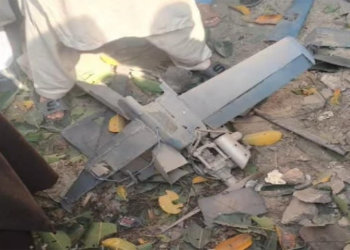
- UAVs and loitering munitions
- Anti-drone defence systems
- Electro-optical satellites
- Integrated artillery fire-control systems
“This is homegrown capability,” the DG ISPR said. “When we say Pakistan’s armed forces will defend the country’s sovereignty at all costs, we mean it.”
He stressed, however, that military capability alone was insufficient without “strategic clarity and national resolve”.
Pakistan Navy: ‘enemy could not muster courage’
Rear Admiral Shifaat Ali described Marka-e-Haq as a “historic and memorable conflict”, claiming the Pakistan Navy successfully deterred Indian naval aggression in the Arabian Sea.
He said India attempted to deploy naval assets in the northern Arabian Sea to disrupt Pakistan’s maritime trade and target strategic installations, but failed due to Pakistan Navy’s operational preparedness.
“The Indian Navy could not muster the courage against Pakistan,” he said.
According to Rear Admiral Ali, Pakistan Navy and Pakistan Air Force forces were prepared to target India’s aircraft carrier INS Vikrant if required.
“We seek peace, but peace must not be mistaken for weakness,” he stated.
PAF claims ‘8-0’ air combat advantage
Air Vice Marshal Tariq Ghazi delivered detailed remarks on the Pakistan Air Force’s role during the conflict, describing the aerial campaign as a landmark in modern warfare.
He said the PAF initially adopted a defensive posture before transitioning to offensive operations after Indian attacks.
“Our aerial sovereignty was impregnable,” he said.
AVM Ghazi claimed Pakistan achieved an “8-0” score in aerial engagements, alleging the destruction of:
- Four Rafale fighter jets
- One Su-30
- One MiG-29
- One Mirage-2000
- One unmanned aerial system
“In that intense beyond-visual-range battle, we curtailed the enemy’s capability to operate as an integrated force,” he said.
He further claimed Pakistan targeted 16 Indian air bases, key operational infrastructure, BrahMos missile sites, command centres and two S-400 air defence batteries using indigenously produced JF-17 Block III aircraft and long-range precision systems.
“The enemy’s massive offensive turned into a crippling ambush,” he said.
The senior PAF official also disclosed that more than 160 capability enhancement projects were currently under development to prepare for future warfare.
‘Pakistan preparing for future wars’
During the question-and-answer session, Lt Gen Chaudhry rejected suggestions that India’s numerical and technological superiority guaranteed military dominance.
“Their strategic miscalculation is their hubristic mindset,” he said. “They misunderstood Pakistan, its people and its armed forces.”
He stressed that Pakistan’s armed forces remained deeply connected to the population and warned against underestimating national resolve.
“There is nobody who can come between the people and the armed forces,” he said.
The DG ISPR also emphasised that Pakistan was already preparing for future forms of warfare.
“Our next war will not look like the previous one,” he remarked.
Kashmir, water security and regional diplomacy
Reiterating Pakistan’s longstanding position on Kashmir, Lt Gen Chaudhry described the disputed region as Pakistan’s “jugular vein”.
“The people of Kashmir have the right to determine their own future under UN resolutions,” he said.
On the Indus waters issue, he warned that water security was directly linked to Pakistan’s national survival.
“Water is an inalienable right. Without water, there is no life,” he stated.
The military spokesperson also reaffirmed Pakistan’s strategic partnership with Saudi Arabia, calling the protection of Harmain Shareefain intrinsically linked to Pakistan’s national security.
“Any threat to Saudi Arabia is a threat to us,” he said.
Afghanistan and counterterrorism operations
Discussing ongoing counterterrorism efforts, Lt Gen Chaudhry confirmed that Operation Ghazab lil-Haq remained active.
He maintained that Pakistan held no hostility towards the Afghan people but criticised the Afghan Taliban administration for allegedly allowing militant groups to operate from Afghan soil.
“Pakistan has one logical demand: do not allow your territory to be used against us,” he said.
He added that Pakistan remained committed to combating terrorism through a broader national strategy under the National Action Plan.
‘We seek peace, not conflict’
Despite the strong rhetoric throughout the briefing, Pakistan’s military leadership repeatedly stressed that the country was not seeking war.
“We are not seeking conflict,” Lt Gen Chaudhry concluded. “But we know how to defend ourselves with honour and dignity.”
He warned, however, that any future military adventurism against Pakistan would receive a decisive response.
“Operation Sindoor 2, 3, 4, 5 or 6 — do what you want,” he said. “Pakistan is fully prepared.”