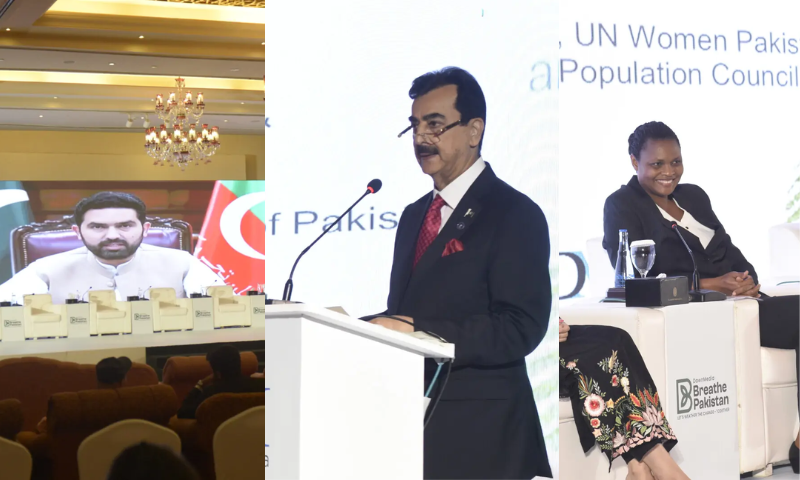
Islamabad, May 7, 2026: The second Breathe Pakistan International Climate Change Conference concluded in Islamabad on Thursday with policymakers, environmental experts, development partners and civil society representatives urging a coordinated and inclusive response to the climate crisis, while stressing the importance of involving women and youth in climate policymaking.
The two-day conference, organised by DawnMedia, brought together stakeholders from across sectors to discuss climate resilience, sustainable urbanisation, clean energy transition, climate finance, public health and regional cooperation.
Despite contributing minimally to global greenhouse gas emissions, Pakistan remains among the countries most vulnerable to climate change impacts, including floods, heatwaves, glacial melt and droughts.
Addressing the conference, Chairman Senate Yousaf Raza Gillani said Pakistan was confronting climate challenges with “resilience and resolve”, stressing that climate, food and economic security could only be achieved through “internal stability, regional calm and global cooperation”.
“Without peace, no climate agenda can succeed,” he said, adding that climate resilience must benefit ordinary citizens, particularly farmers and vulnerable communities.
Representing the United Nations in Pakistan, Pernille Ironside commended the conference for bringing together government institutions, the private sector, civil society, media and youth activists to discuss practical climate solutions.
Experts at the conference repeatedly highlighted that the world had moved from merely discussing climate change to actively adapting to its impacts.
Aban Marker Kabraji of the United Nations Environment Programme said the global community was now living in the “age of adaptation”.
“We can prevent climate change from getting worse, but many impacts are already programmed into weather and climate systems,” she said, stressing the need for disaster-risk reduction, climate adaptation and stronger coordination among institutions.
Kabraji also emphasised the importance of indigenous and locally driven climate solutions, calling climate finance fundamentally “development finance”.
Khyber Pakhtunkhwa Chief Minister Sohail Afridi said climate change was a collective national challenge and highlighted his government’s efforts to expand forest cover and invest in environmental conservation.
He claimed the province’s forest cover had increased significantly over recent years and said the provincial government had invested billions of rupees in forest preservation and expansion projects.
Special Assistant to the KP Chief Minister on Information Shafiullah Jan called for the inclusion of a climate component in the National Finance Commission Award and stressed the need for all provinces to work together on climate adaptation.
Women leaders and youth activists at the conference stressed that vulnerable communities must be included in climate decision-making processes.
Fahmida Khan warned that women and girls bore the heaviest burden of climate change despite contributing least to the crisis.
“Stop treating women, girls and youth inclusion as a favour and start treating it as a condition of survival,” she said.
Youth climate advocate Fatima Faraz urged authorities to move beyond “empty promises” and provide meaningful platforms for young people to contribute to climate solutions.
Health experts also highlighted the growing public health risks associated with climate change.
Ellen Mpangananji Thom from the World Health Organization warned that climate-driven malnutrition, malaria, diarrhoea and heat stress could contribute to millions of deaths globally between 2030 and 2050 if urgent action was not taken.
Environmental sustainability and clean energy transition remained key themes throughout the conference.
Marriyum Aurangzeb highlighted Punjab government initiatives aimed at environmental protection, including smog mitigation measures, climate data mapping and plans for a provincial climate observatory.
She said Punjab had reduced PM2.5 pollution levels by around 35 per cent over the past year and a half through various interventions.
Energy experts also discussed Pakistan’s rapid shift toward solar energy and renewable solutions.
Representatives from international organisations and energy institutes observed that Pakistan’s “solar boom” was driven by rising electricity prices, load-shedding and declining solar panel costs.
Naveed Arshad described Pakistan’s transition as a major shift from a centralised electricity grid to distributed renewable energy systems.
Urban planners and environmentalists warned that rapid and unplanned urbanisation was intensifying climate risks in major cities.
Tariq Alexander Qaiser stressed the need for sustainable urban planning, preservation of coastal ecosystems and stronger environmental laws.
He called for the protection of Karachi’s coastal islands and mangrove forests, warning against unchecked commercial development.
Climate experts also called for stronger regional cooperation among Global South countries to address shared vulnerabilities such as glacial melt, water scarcity and climate-induced migration.
Romina Khurshid Alam stressed that climate change should be treated as a regional crisis requiring collective action rather than isolated national responses.
“We are not in a state of crisis; we are in a state of war with climate change,” she said.
The conference concluded with renewed calls for climate finance reform, stronger policy implementation, investment in climate-resilient infrastructure and greater inclusion of vulnerable communities in environmental decision-making processes.