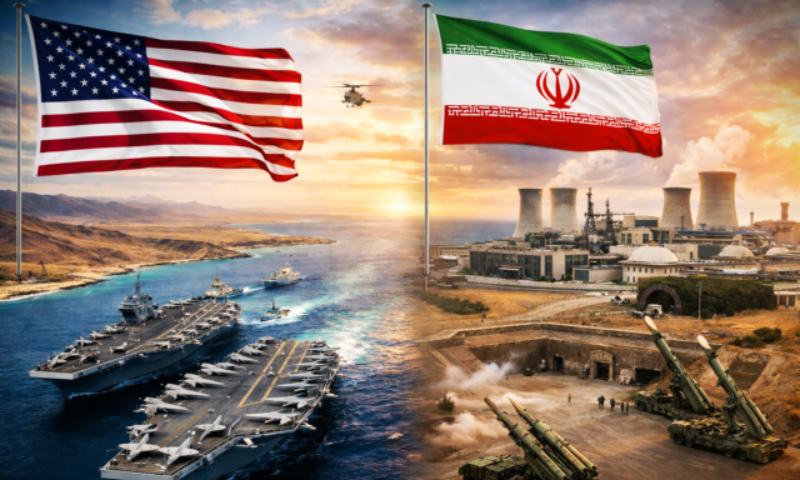
Washington / Tehran / Doha, May 19, 2026: US President Donald Trump said on Tuesday that the United States may still carry out further military action against Iran, warning that a decision on a strike had been imminent before being temporarily postponed amid ongoing diplomatic efforts.
Speaking to reporters at the White House, Trump said he was “an hour away from making the decision to go today” but held back the attack to allow space for negotiations.
He added that Iranian leadership was “begging to make a deal,” but warned that a new US strike could follow within days if an agreement is not reached.
“Two or three days, maybe Friday, Saturday, Sunday, something, maybe early next week,” Trump said, describing a “limited period of time,” and adding that Washington could not allow Iran to acquire a nuclear weapon.
The remarks came amid rapidly intensifying regional tensions and parallel diplomatic activity involving multiple countries.
In response, Iran’s military warned that it would open new fronts against the United States if hostilities resume.
“If the enemy is foolish enough to fall into the Zionist trap again and launches new aggression against our beloved Iran, we will open new fronts with new equipment and new methods,” Iranian army spokesperson Mohammad Akraminia was quoted as saying by state media.
Separately, Iranian officials reiterated that Tehran’s nuclear enrichment rights are “non-negotiable,” with Foreign Ministry spokesperson Esmaeil Baghaei stating that “enrichment is Iran’s right” and rejecting external pressure on the issue.
A parliamentary security commission spokesperson, Ebrahim Rezaei, also warned that any new attack would trigger a “stronger response,” adding that the US must choose between diplomacy or “the power of our missiles.”
Iranian state media reported that Tehran has submitted a revised peace proposal to Washington, reportedly including a broader regional framework.
According to IRNA, the proposal calls for an end to hostilities across multiple fronts, including Lebanon, the lifting of blockades, release of Iranian assets, reconstruction compensation for war damage, and the withdrawal of US forces from areas near Iran’s borders.
The plan also reiterates Iran’s demand for recognition of its “peaceful nuclear rights” and the lifting of unilateral sanctions.
Qatar said on Tuesday that US-Iran negotiations require additional time to reach an agreement, expressing support for ongoing diplomatic efforts.
“We are supportive of the diplomatic effort by Pakistan that has shown seriousness in bringing parties together and finding a solution, and we do believe it needs more time,” said Qatari Foreign Ministry spokesperson Majed al-Ansari.
The statement came shortly after reports that US President Trump had paused planned military action to allow negotiations to continue.
According to a Washington Post report, the United States and Iran exchanged multiple proposals and counterproposals last week in an effort to prevent further escalation.
The report said Washington initially pushed for long-term restrictions on Iran’s uranium enrichment programme, ranging from 20 to 25 years, while Iran rejected those proposals.
It also noted discussions on partial sanctions relief in exchange for curbing support for regional proxy groups, as well as the possibility of transferring enriched uranium stockpiles abroad—though no agreement has been reached.
Trump said he paused the planned strike after receiving Iran’s latest proposal and in light of appeals from regional leaders, including those from Qatar, Saudi Arabia, and the United Arab Emirates.
He said the US military had been instructed to stand ready for “a full, large-scale assault” if talks fail.
“There seems to be a very good chance that they can work something out,” Trump said. “If we can do that without bombing the hell out of them, I would be very happy.”
Iranian officials said their positions had been conveyed to Washington through Pakistan, though no formal details were disclosed.
Iran’s armed forces, including the Khatam al-Anbiya command, said they were “ready to pull the trigger” in case of renewed attacks, warning that any aggression would be met with a “decisive, powerful, and extensive” response.
Iranian media also reported claims of large-scale war-related costs exceeding $85 billion for the United States, though the figures could not be independently verified.
The United Nations reiterated its position on maintaining freedom of navigation, particularly in the Strait of Hormuz, stressing that no entity should restrict access to key maritime routes.
China also expressed “deep concern” over recent attacks targeting nuclear facilities in the Gulf region, including a drone incident at the Barakah Nuclear Energy Plant in the United Arab Emirates, calling for de-escalation and protection of civilian infrastructure.
The situation remains highly volatile, with a fragile ceasefire environment coexisting alongside renewed threats, drone incidents, and overlapping diplomatic initiatives.
While negotiations continue through multiple intermediaries, including regional partners, both Washington and Tehran appear to be balancing military readiness with cautious diplomatic engagement—leaving the path ahead uncertain and time-sensitive.