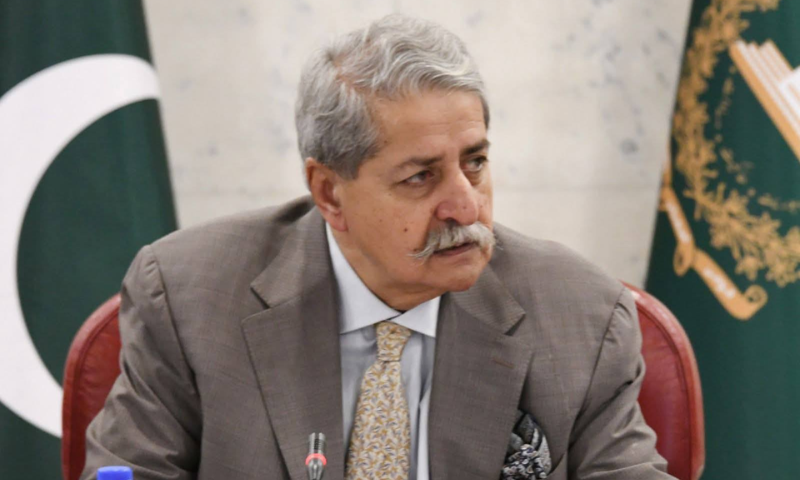
Islamabad, May 25,2026: Chairman Standing Committee on Finance and Revenue, Syed Naveed Qamar, has expressed concern over continued reliance on indirect taxation and petroleum levies instead of expanding the country’s sustainable tax base.
Chairing a meeting of the Standing Committee on Finance and Revenue at the Parliament House in Islamabad, he also raised alarm over rising circular debt, slow reforms in state-owned enterprises, and increasing socioeconomic pressures driven by inflation, unemployment, and poverty.
The meeting conducted a detailed review of Pakistan’s macroeconomic outlook and fiscal priorities for Budget FY2026–27, with particular focus on emerging economic risks, IMF programme performance, and structural reform requirements.
The Chairman noted delays in the circulation of the Budget Strategy Paper and stressed that the Ministry of Finance is legally bound under the Public Finance Management Act, 2019, to ensure timely submission for meaningful parliamentary scrutiny ahead of the budget session.
During the briefing, the Committee was informed that Pakistan remains on a “fragile stabilization path” despite gradual economic recovery. GDP growth for FY2026–27 is projected between 3.5% and 4.5%, while inflation has again entered double digits, recorded at 10.9% year-on-year in April 2026.
Independent experts told the Committee that Pakistan’s foreign exchange reserves stand at $22.58 billion, providing about 2.58 months of import cover. The State Bank of Pakistan’s policy rate currently stands at 11.5% after cumulative cuts of 1,200 basis points since June 2024.
It was further informed that Federal Board of Revenue (FBR) tax collection in Q3 reached Rs9.304 trillion, showing a shortfall of Rs611 billion against targets. Gross public debt stands at Rs83.28 trillion, while external debt has reached $137.56 billion. Circular debt across the power and gas sectors has climbed to nearly Rs5 trillion.
The trade deficit widened to $32.19 billion during July–April FY2025–26, driven by weak exports and rising imports, while remittances remained strong at $33.86 billion during July 2025–April 2026, with projections of $41.2 billion for FY2026.
The Committee was also informed that Pakistan sources nearly 90% of its energy imports from the Middle East, making the economy vulnerable to geopolitical instability and oil price shocks, which could further increase inflation and pressure the exchange rate.
Members observed that the Federal Board of Revenue has repeatedly failed to meet revenue targets despite additional taxation measures imposed on existing taxpayers. They stressed the urgent need for broadening the tax base through sustainable and equitable reforms instead of increasing the burden on already compliant sectors.
They also noted that provincial fiscal surpluses are disproportionately contributing to federal IMF compliance targets, while development spending remains compressed in favour of current expenditure and debt servicing. Concerns were also raised over continued underperformance of the export sector compared to regional economies.
The Committee highlighted that excessive taxation on digital services and telecom connectivity is restricting digital inclusion, freelancing opportunities, and broader participation of youth and low-income groups in the economy.
Lawmakers called for stronger action against illicit trade, counterfeit markets, and undocumented economic activity, alongside increased investment in renewable energy, climate resilience, and energy efficiency initiatives.
The Committee stressed that Budget FY2026–27 must go beyond short-term stabilization measures and instead focus on sustainable reform, fiscal transparency, improved governance, and inclusive growth.
The meeting also approved the minutes of its previous session held on May 14, 2026. Members of the Committee including Ms. Shahida Begum, Mirza Ikhtiar Baig, Muhammad Javed Hanif Khan, Ali Zahid, Nafisa Shah, and Sharmila Faruqui attended the meeting, along with senior officials from the Finance Division and independent economists.