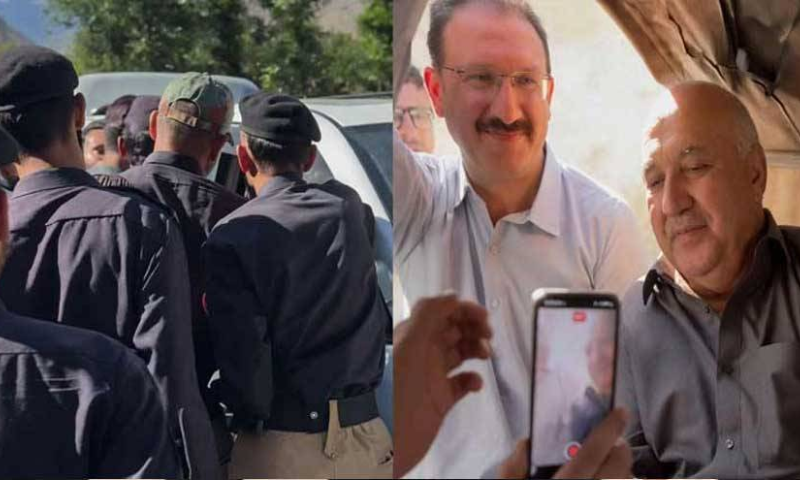
Gilgit, May 29, 2026: Pakistan Tehreek-e-Insaf (PTI) Khyber Pakhtunkhwa chapter President Junaid Akbar and several other party leaders were expelled from Gilgit-Baltistan (GB) on Friday after being detained by local police over alleged violations of the election code of conduct.
The development comes amid intensified political campaigning in the region ahead of the June 7 elections for the Gilgit-Baltistan Legislative Assembly.
According to GB police officials, Junaid Akbar and six of his associates were taken into custody from the Hanzel area. Those detained included Mehboob Shah, Salimur Rehman, Dr Amjad Ali Khan, Muhammad Naeem Khan, Ziauddin and Arshad Meer.
Speaking to a private television channel, Gilgit-Baltistan Home Minister Sajid Ali Baig said the PTI leaders had violated the election code of conduct by holding political gatherings without official permission.
The minister said Akbar addressed a rally in the Jaglot area and also organized a public gathering in Gilgit without obtaining a no-objection certificate (NOC).
“Indiscriminate action will be taken against violations of the election code of conduct,” Baig stated.
Reacting to the arrests and expulsion, PTI Chairman Barrister Gohar Ali Khan strongly condemned the action against party workers and leaders.
He said restricting political activity in Gilgit-Baltistan would damage democratic norms in the country and described preventing political workers from participating in election campaigns as “tantamount to rigging.”
Gilgit-Baltistan is scheduled to hold elections on June 7 to elect members of its 4th Legislative Assembly. The region was granted a measure of self-governance under the Gilgit-Baltistan (Empowerment and Self-Governance) Order issued in 2009 during the presidency of Asif Ali Zardari.
According to election officials, Gilgit-Baltistan currently has 963,034 registered voters, including 506,097 male and 456,937 female voters, reflecting a 29 percent increase since the 2020 elections. The gender gap between male and female voters has narrowed to 4 percent from 8 percent recorded in 2020.
Despite the rise in population and voter registration, no fresh delimitation of constituencies has been carried out in the region since 1994. Election Commission sources attributed the delay to the continued confidentiality of census data.
Female representation in the elections remains limited. Out of nearly 400 candidates contesting across 24 constituencies, only eight are women, while only three female candidates are contesting on party tickets from the PPP, IPP and Pakistan Nazriyati Party.
Among the major political parties, the Pakistan Peoples Party (PPP) has fielded 23 candidates, followed by the Pakistan Muslim League-Nawaz (PML-N) with 22 and the Istehkam-e-Pakistan Party (IPP) with 15 candidates.
The Pakistan Nazriyati Party and Islami Tehreek Pakistan have fielded 10 candidates each, while Jamiat Ulema-e-Islam-Fazl (JUI-F) has fielded nine candidates. Majlis Wahdat-e-Muslimeen (MWM) has seven candidates in the race, while Jamaat-e-Islami (JI) and Muttahida Qaumi Movement (MQM) have fielded six candidates each.
Officials said nearly 68 percent of candidates are contesting the elections as independents.
PTI, through a seat adjustment arrangement with Majlis Wahdat-e-Muslimeen on four seats, has fielded candidates in 23 out of the region’s 24 constituencies.