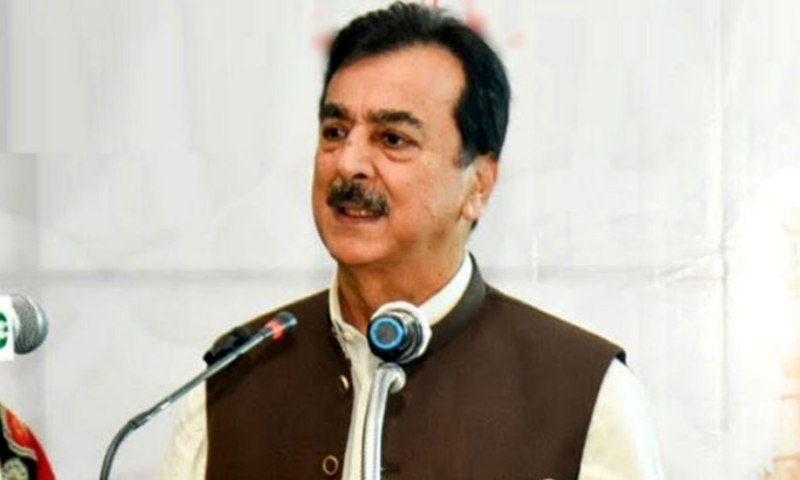
Rawalpindi, June 8, 2026: Chairman Senate Syed Yousaf Raza Gilani on Monday said that the teachings of Seerat-un-Nabi (Peace Be Upon Him) and Awliya-e-Kiram offer a comprehensive framework for addressing contemporary national and global challenges, including economic inequality, social unrest, conflict, and climate-related crises.
Addressing a distinguished gathering at the annual Urs ceremony at Eidgah Sharif in Rawalpindi, the Chairman Senate described Eidgah Sharif as not only a spiritual center but also a historic institution that has played a vital role in promoting Islamic teachings, societal reform, and moral guidance for nearly one and a half centuries.
Gilani paid tribute to the founder of Eidgah Sharif, Hazrat Khawaja Hafiz Abdul Karim (RA), and his successors, acknowledging their enduring contributions to the promotion of Islam and spiritual development. He also praised the services of the current Sajjada Nasheen, Hazrat Pir Muhammad Naqeeb ur Rehman, and his successor, Hazrat Pir Muhammad Hassan Haseeb ur Rehman.
The Chairman Senate noted that millions of followers around the world remain connected to the Silsila-e-Aliya Siddiqia Naqshbandia, adding that its spiritual outreach extends beyond Pakistan to the United Kingdom, the United States, Europe, and the Gulf region. He said these efforts have played a significant role in spreading Islamic teachings and guiding people towards the faith.
Highlighting the message of Awliya-e-Kiram, Gilani said their lives demonstrated that the teachings of the Holy Prophet Muhammad (PBUH) transcend geographical boundaries and continue to serve as a timeless source of guidance for humanity. He noted that they promoted compassion, tolerance, service to mankind, and peaceful coexistence.
He said Seerat-un-Nabi (PBUH) teaches that authority should be exercised in the service of justice rather than domination, differences should be resolved through dialogue instead of hostility, and progress should be measured by human dignity and collective welfare alongside economic growth.
Referring to the State of Madinah, Gilani described its constitution as a practical model based on justice, equality, religious freedom, protection of minorities, and collective responsibility.
The Chairman Senate said Pakistan’s current challenges, including economic pressures, unemployment, and social disparities, could be effectively addressed through the principles of transparency, integrity, justice, hard work, and equitable distribution of resources as embodied in Seerat-e-Tayyiba.
Commenting on global developments, he noted that humanity faces wars, humanitarian crises, forced displacement, poverty, growing inequalities, religious intolerance, and climate-related threats. In such circumstances, he said, Seerat-un-Nabi (PBUH) offers a roadmap for sustainable peace, human welfare, and global harmony.
Gilani emphasized that Pakistan, being a land of saints and spiritual traditions, has a responsibility to instill values of tolerance, moderation, respect for humanity, and service to society among younger generations to build a progressive and morally strong nation.
He urged participants to incorporate the universal teachings of the Holy Prophet (PBUH) into their personal and collective lives by promoting love over hatred, unity over division, and hope over despair.
Concluding his address, the Chairman Senate prayed for guidance to follow the teachings of Seerat-e-Tayyiba and Awliya-e-Kiram and to contribute towards building a society founded on justice, compassion, brotherhood, and the highest ideals of humanity.