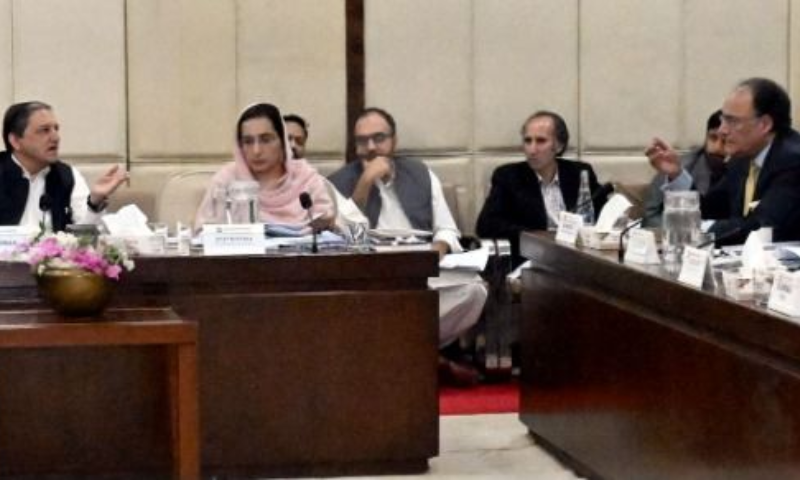
Islamabad, August 13, 2026: The Senate Standing Committee on Finance and Revenue, chaired by Senator Saleem Mandviwala, convened at Parliament House to finalise its recommendations on the Finance Bill 2026–27, which was laid before the House on June 12 under Article 73 of the Constitution.
The meeting undertook a detailed clause-by-clause review of the Customs Act, 1969, seeking members’ input on proposed amendments. Throughout the day, the Committee continued deliberations on key provisions of the Finance Bill, including customs reforms and sales tax measures.
The session was attended by Federal Minister for Finance and Revenue Senator Muhammad Aurangzeb, Minister of State for Finance Bilal Azhar Kayani, and Senators Sherry Rehman, Abdul Qadir, Syed Faisal Ali Sabzwari, Shahzaib Durrani, while Senator Anusha Rehman Ahmad Khan joined virtually.
During the discussion, Chairman Committee Senator Saleem Mandviwala remarked that the federal budget has seen “frequent experimentation” over the past decade, with several measures introduced annually later being withdrawn. He questioned the effectiveness and consistency of such policy changes.
Officials of the Federal Board of Revenue (FBR) informed the Committee that the Prime Minister had established a Tax Policy Office to separate tax policy formulation from tax administration.
Senator Abdul Qadir raised concerns that the super tax was discouraging investment, while Senator Sherry Rehman noted that provincial tax performance had shown improvement in some areas, at times surpassing the FBR. She also questioned whether the FBR would meet its annual revenue targets.
The Committee also discussed a proposal granting the FBR authority to impose fines for customs violations. Senator Anusha Rehman opposed the proposal, arguing that such powers should remain with the government rather than the FBR board, later noting that the authority had instead been placed with the Federal Finance Minister.
Members approved a proposal to outsource the auction of seized goods to the private sector, with officials arguing that it would improve efficiency and transparency compared to customs-managed auctions.
A key point of discussion was delays in customs clearance. Members proposed establishing a fixed timeline for import clearance procedures, a suggestion supported by the Chairman and other members. Senator Mandviwala stressed that delays in customs processing cause significant losses to importers and called for accountability measures against unnecessary delays. He directed the Ministry of Law and Justice to incorporate defined timelines into the relevant legal framework.
Federal Minister for Finance and Revenue Senator Muhammad Aurangzeb later joined the meeting, emphasizing the need for policy predictability and consistency to attract investment. He said economic consultations would now continue throughout the year instead of ending with the annual budget cycle.
The Committee also examined proposed amendments to the Sales Tax Act, 1990, including the introduction of an Advance Receipt Invoice system. The Chairman questioned its necessity, noting that tax deductions were already being made under existing mechanisms.
FBR officials explained that the new system aimed to improve invoicing accuracy and strengthen monitoring through digital mechanisms, including the National Faceless Center and a Production Monitoring System for tracking production and sales activity.
Minister of State Bilal Azhar Kayani said electronic invoicing would enhance business transparency and was broadly welcomed by the business community, adding that penalties would apply to entities that opted out or failed to comply with the system.
Finance Minister Aurangzeb reiterated that the government’s focus was shifting from stabilization to sustainable economic growth. He said the creation of the Tax Policy Office marked a major structural reform aimed at ensuring policy consistency and continuous stakeholder engagement, including consultations with traders and business representatives throughout the year.
The Committee will continue its clause-by-clause scrutiny of the Finance Bill 2026–27 in its next sitting at 2:00 pm and will finalize recommendations for submission before the Senate.