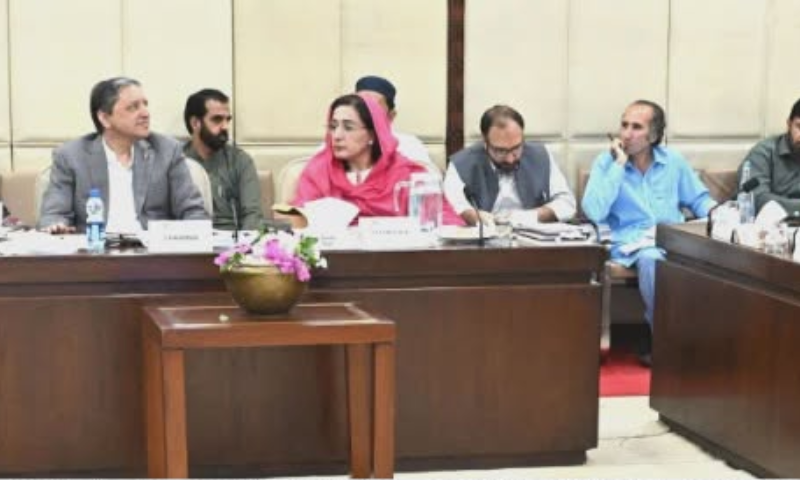
Islamabad, June 14, 2027: The Senate Standing Committee on Finance and Revenue on Sunday continued its detailed clause-by-clause scrutiny of the Finance Bill 2026-27 during an extended session at Parliament House, approving key tax reforms, digitalisation measures, and enforcement mechanisms aimed at broadening the revenue base and improving compliance.
The meeting, chaired by Senator Saleem Mandviwala, was attended by Finance Minister Muhammad Aurangzeb, Minister of State for Finance Bilal Azhar Kayani, and Senators Sherry Rehman, Talha Mahmood, Shahzaib Durrani, along with senior officials of the Federal Board of Revenue (FBR), the Finance Division, and other relevant departments.
The committee reviewed sales tax provisions in detail, focusing on proposals to enhance tax compliance, expand the tax net, and increase revenue collection through digital systems.
A major development was the approval of a framework empowering the Federal Board of Revenue to conduct re-audits of business records under specific conditions. Under the approved mechanism, a Commissioner may order a re-audit in suspected irregularity cases with prior approval from the Chief Commissioner, while ensuring the taxpayer is given full opportunity to present their stance.
The committee also approved provisions for revaluation of inventory held by registered businesses. Stock valuation will be carried out by certified cost accountants, while re-audits will be conducted by accountants selected from an approved FBR panel.
Deliberations also focused on the proposed establishment of a National Faceless Centre, designed to digitise audit and assessment processes. Under the system, taxpayer cases will be allocated through automated algorithms, significantly reducing direct interaction between tax officers and taxpayers.
FBR officials informed the committee that the initiative aims to separate audit and assessment functions, reduce corruption risks, and ensure that transactions are conducted electronically, with officer identities kept confidential within the system.
However, Senators raised concerns over implementation challenges. Senator Sherry Rehman questioned the feasibility of the system amid connectivity limitations, while Senator Talha Mahmood asked about the effectiveness of replacing traditional enforcement mechanisms with automated processes.
Finance Minister Muhammad Aurangzeb told the committee that the government’s objective was to minimise human intervention while maintaining strong oversight and improving efficiency.
Following detailed discussion, the committee approved the establishment of the National Faceless Centre.
The committee also endorsed stringent enforcement measures against non-compliant businesses, particularly regarding integration with the digital tax system and elimination of fake invoicing practices.
Under the approved framework, businesses failing to integrate within the stipulated timeframe may face financial penalties, repeated violations could lead to additional fines, and in severe cases, sealing of business premises.
Strict penalties were also approved for issuance of fake invoices. Offenders may be fined equal to the invoice value, placed on a public blacklist, and have related tax credits automatically cancelled. Additional penalties include a 20 percent surcharge in cases of discrepancies between input and output tax declarations.
Amendments were also approved regarding seized goods, including a recommendation that vehicles transporting confiscated goods should not be automatically seized. The committee further endorsed the introduction of e-auction mechanisms for disposal of seized assets.
In another key decision, the committee reviewed and expanded tax and customs concessions for the import and lease of aircraft, spare parts, and operational equipment for Pakistan International Airlines (PIA), extending the same facility to all eligible airlines upon committee recommendation.
The committee also approved sales tax exemptions for bulletproof vehicles required for the upcoming SCO Summit and counter-terrorism operations, subject to clearance from the Ministries of Foreign Affairs and Interior, along with limits on import quantities based on operational requirements.
The meeting further approved an increase in sales tax to 12 percent on retail-packed products, a move expected to affect a range of consumer goods including food items, beverages, edible oils, confectionery, footwear, clothing, and agricultural inputs.
Officials said the measure aims to broaden the tax base, strengthen documentation, and improve overall revenue collection.
Proceedings were briefly adjourned earlier in the day due to the absence of the Finance Minister and Minister of State, before resuming upon their arrival.
The committee will continue its scrutiny of the Finance Bill 2026-27 and related budget proposals on Monday at Parliament House.