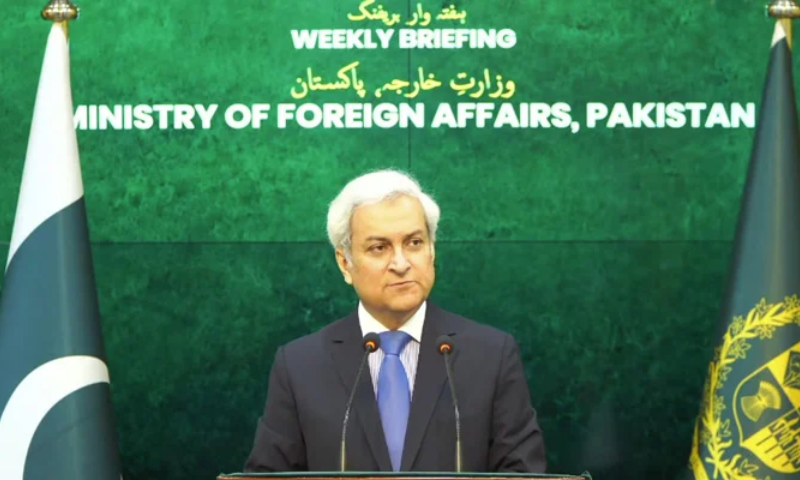
Islamabad, July 30, 2026: Pakistan on Thursday said negotiations between the United States and Iran remained the only viable path to de-escalating tensions in the Gulf, reaffirming that the Islamabad Memorandum of Understanding (MoU) and the Pakistan-Qatar joint statement continue to provide the principal framework for a durable peace process.
Addressing the weekly media briefing, Foreign Office Spokesperson Tahir Hussain Andrabi said Pakistan remained actively engaged in diplomatic efforts to help restore dialogue between Washington and Tehran amid the fragile regional security situation.
“Amid the prevailing tensions and hostilities, Pakistan reiterates that dialogue and diplomacy remain the only viable path forward. We are doing our utmost to bring the parties back to the Islamabad MoU,” the spokesperson said.
He urged all parties to exercise maximum restraint and honour their commitment to resume technical-level negotiations, expressing hope that diplomatic engagement would ultimately prevail over military confrontation.
While noting that relative calm had prevailed over the past few days, Andrabi cautioned that the security environment in the Gulf and the Strait of Hormuz remained highly volatile. He strongly condemned attacks by non-state actors against Saudi Arabia, describing them as unacceptable and detrimental to regional stability.
The spokesperson said Pakistan remained optimistic that both sides would return to technical-level talks aimed at finding a lasting political settlement.
He highlighted that under the leadership of Prime Minister Shehbaz Sharif, Field Marshal Syed Asim Munir, and Deputy Prime Minister and Foreign Minister Senator Mohammad Ishaq Dar, Pakistan’s diplomatic institutions were fully engaged and prepared to contribute constructively to regional peace efforts.
Pakistan had earlier played a key role in facilitating dialogue between the United States and Iran, helping broker an initial understanding that laid the groundwork for negotiations on a permanent resolution to the conflict.
The spokesperson’s remarks came as hostilities continued across the region. Previous negotiations following an April truce collapsed earlier this month, with Iran again closing the Strait of Hormuz, a critical route for global oil and gas shipments.
Meanwhile, Iran’s Revolutionary Guards claimed that two oil tankers attempting to transit the strait with US support were forced to turn back after one of the vessels caught fire.
The United States military also announced that it had carried out a fresh wave of strikes targeting dozens of Revolutionary Guard facilities, including military command centres across Iran.
Iranian authorities reported casualties in Zanjan province following the strikes, while state media said attacks also targeted several cities in Khuzestan province and Qeshm Island in the Gulf.
Jordan’s military reported intercepting five Iranian missiles launched towards its territory on Thursday morning, stating that no casualties or damage had been recorded.
In a separate development, Kuwait’s Defence Ministry condemned what it described as a “heinous” Iranian attack on a building belonging to a Chinese company in northern Kuwait, saying one worker was killed and significant material damage was caused.
Pakistan reiterated that sustained dialogue, restraint and diplomacy remained indispensable for preventing further escalation and restoring peace and stability across the Gulf region.