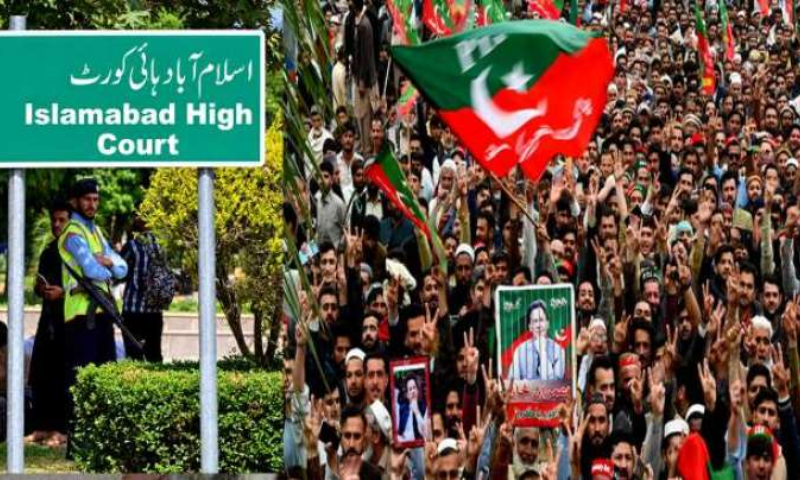
Islamabad, September 14, 2026: The Islamabad High Court (IHC) on Monday directed chief ministers of all provinces to ensure that government resources, official machinery and public funds are not used for the Pakistan Tehreek-e-Insaf’s (PTI) planned long march towards Islamabad on September 27.
A larger bench headed by IHC Chief Justice Sardar Muhammad Sarfraz Dogar and comprising Justice Muhammad Azam Khan and Justice Muhammad Asif disposed of a petition challenging the proposed protest, while directing authorities to protect citizens’ constitutional rights during marches, rallies and demonstrations.
The court ruled that no political party or leader had any lawful right to occupy public roads, highways, interchanges, toll plazas or public buildings in a manner that obstructed citizens’ movement or access to educational and medical facilities.
It further directed provincial governments to ensure that public funds, government vehicles, machinery and other official equipment were not used to facilitate any march, procession or rally.
The court also ruled that no public servant could be compelled to participate in a political protest. Any public office holder or other person violating these directions would be deemed to have acted against the Constitution, according to the order.
The IHC directed the Islamabad administration and the Ministry of Interior to ensure protection of citizens’ fundamental rights, while chief secretaries and provincial police chiefs were ordered to ensure implementation of the court’s directives. The federal interior secretary, Islamabad chief commissioner and inspector general were also directed to ensure compliance.
The petition was filed by citizen Waqas Ahmed, who had expressed concerns that the PTI’s planned protest could disrupt routine life, traffic, businesses and other activities in the federal capital.
The PTI has announced nationwide protests, including a long march towards Islamabad on September 27, demanding the release of party founder Imran Khan and calling for the supremacy of the Constitution.
Government raises security concerns
During the hearing, Islamabad Advocate General Naveed Hayat Malik argued that previous PTI protests had involved the use of government machinery and that there was no guarantee the proposed march would remain peaceful.
The law officer sought permission to screen footage of PTI protests in 2022 and 2024, along with statements by party leaders regarding the planned march. Although Justice Dogar initially observed that routinely playing videos was not the practice of the IHC, the bench later allowed the footage to be shown once.
The videos included scenes of police preparations, removal of containers, fires at D-Chowk and the Green Belt, damage to public property and alleged attacks on law-enforcement personnel. Footage showing Rangers personnel being run over by a vehicle was also presented before the court.
The advocate general argued that the incidents demonstrated the potential risks associated with a large gathering in the capital.
He said anyone seeking to hold a protest or organise a long march in Islamabad was required to approach the district magistrate and provide details to enable the administration to make security arrangements. The magistrate, he added, could reject an application if security arrangements were considered inadequate.
The law officer also maintained that the government had the authority to place containers and declare areas of Islamabad as a Red Zone, as well as impose restrictions under Section 144 of the Code of Criminal Procedure when required to maintain law and order.
He claimed that the PTI had not submitted an application to the magistrate seeking permission for the proposed protest.
The advocate general further argued that the PTI’s stated objectives included seeking the release of Imran Khan and the removal of the government, describing these as matters that could not be achieved through street protests. He said the release of a convicted prisoner could only be sought through legal remedies before the courts, while a government could be changed through constitutional parliamentary procedures.
He stressed, however, that the government was not opposed to any political party or leader and that protests should be conducted within the framework of the law.
Court questions government statements
During the proceedings, Chief Justice Dogar also questioned whether government representatives had the right to provoke citizens through their statements.
“Can chief ministers or government representatives make such speeches?” the chief justice asked.
The advocate general replied that no one had such a right and that provoking citizens did not fall within the protection of freedom of expression.
The law officer also said the administration did not have the physical capacity to stop a massive crowd if the PTI brought its full resources to Islamabad. He said authorities could only take precautionary measures, including imposing restrictions and placing containers, stressing that the state could not use lethal force against its own citizens.
KP police assure court
During the hearing, the bench also summoned Khyber Pakhtunkhwa Inspector General of Police Zulfiqar Hameed and asked him to read out an affidavit submitted to the court.
Justice Dogar questioned what steps the provincial police would take to prevent an illegal protest.
The chief justice observed that the undertaking should clearly state that illegal and unconstitutional activities would not be permitted and that such gatherings would be stopped.
The KP police chief assured the court that any illegal activity would be prevented and protesters would be dispersed if they engaged in unlawful conduct.
The court recorded his sworn undertaking and subsequently reserved its verdict before disposing of the petition.
However, KP Advocate General Shah Faisal Utmankhel distanced himself from the undertaking, saying he would “not own” it and that the provincial government was working on the restructuring of the bureaucracy free from the Centre’s influence.
The court’s order ultimately placed responsibility on provincial governments and law-enforcement authorities to prevent the use of state resources for political protests while safeguarding citizens’ constitutional rights and freedom of movement.