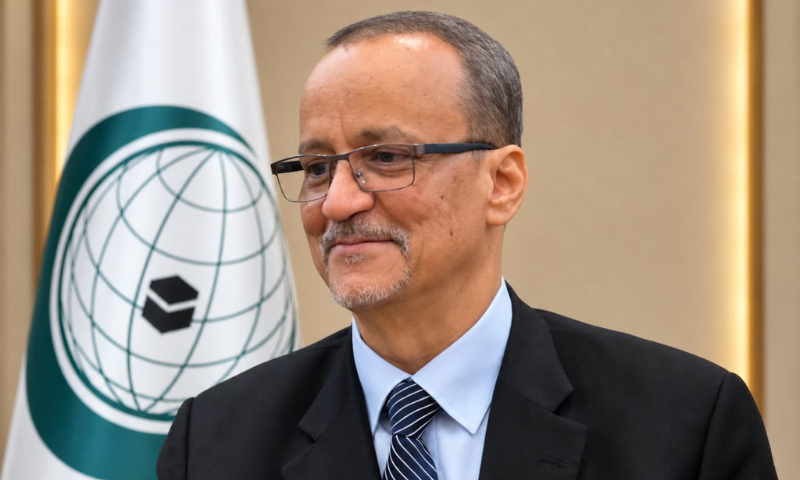
By Ismail Ould Cheikh Ahmed, Secretary-General of the Organization of Islamic Cooperation
Fifty-seven years have passed since the founding of the Organization of Islamic Cooperation (OIC) whose journey began in Rabat, Kingdom of Morocco, on 12 Rajab 1389 AH, corresponding to 25 September 1969 under the name “Organization of the Islamic Conference.”
This anniversary that is dear to the heart of every Muslim coincides with my assumption of office as Secretary General of the Organization of Islamic Cooperation a few weeks ago. This convergence carries a profound symbolic meaning that heightens my sense of the magnitude of the trust placed in me and the determination to fulfil the Organization’s mission and responsibility in which the peoples of our Ummah pin their hopes.
On this anniversary we recall the birth of the OIC when the arson attack on the blessed Al-Aqsa Mosque shook the conscience of the Muslim Ummah and awakened its will to close its ranks and safeguard its holy sites. Our Organization has, by the Grace of Allah, and through the resolve of its founders, succeeded in keeping the flame of the Palestinian cause alight and upholding its terms of reference: to safeguard the rights of the Palestinian people and support them in achieving an independent and sovereign State within the borders of 4 June 1967, with Al-Quds Al-Sharif as its capital.
While this issue remains at the core of the OIC’s mission, the horizons of its collective responsibility have expanded to include, alongside political action, areas of economic, cultural, social and scientific cooperation.
Anyone who looks back at the history of the OIC which began as an idea and grew through the efforts of its founders and the support of its Member States, will observe that the Organization has remained faithful to its highest purpose: deepening Islamic solidarity and maintaining a unified position on the various issues of the Muslim world, guided by its Charter, principles and objectives, relying on the justness of its demands, standing on the side of truth and equality, and its commitment to understanding and respecting others. This approach has been embodied through accomplishments recorded in many fields – supporting development, reinforcing social solidarity, fighting poverty, combating exclusion and marginalization, and promoting family values. In this context, the OIC played a pivotal role in responding to humanitarian needs, supporting dignified livelihoods for refugees and displaced persons in many parts of the Muslim world and beyond. It followed up the affairs of Muslim communities in non-Member States and contributed in confronting the wave of extremism and radicalism that has swept through many of our countries.
In confronting Islamophobia, the OIC has established its presence as an active interlocutor in Western circles and countries. It has earned recognition for the justness of its demands which, on many occasions, has been demonstrated in action taken in response to the Organization’s demands to create an environment more conducive to coexistence and the rejection of hatred.
For decades, these issues have given the OIC a distinctive position, making it the exclusive body and the ideal forum for coming together, addressing crises and seeking appropriate solutions within the shared identity derived from the noble teachings of Islam and its values founded on moderation.
This understanding of the OIC’s historic role deepens my awareness the weight of the responsibility I now carry. It propels me to articulate a new vision for the Organization that will respond to the demands of its role in confronting global and regional challenges while holding fast to its sound principles and authentic points of reference. Through them, the OIC can put its capabilities and expertise to work for the good and benefit of the Muslim Ummah and foster solidarity among its Member States.
The OIC today faces a very difficult test amid international polarizations aggravated by deep regional tensions, growing economic complexities that accumulate year after year, and acute humanitarian and environmental crises whose price is paid by poorer countries and by the most vulnerable and fragile groups. The burdens of this responsibility is made greater still by the rapid and unprecedented transformations taking place around the world, as new technologies enter our daily lives and their attendant interconnected challenges that are difficult to confront by the major powers, not to talk of the Muslim world, which has been weighed down by accumulated crises that drain its resources and limit its ability to keep pace with these transformations.
The Organization of Islamic Cooperation comprising fifty-seven countries across four continents and representing nearly two billion Muslims, including Muslim communities in non-Member States, finds itself obliged to keep pace with the accelerating global transformations unfolding today. It does so carrying accumulated historical legacies that cannot be overlooked: civil wars, political fragility, unrest and weak economic structures.
The OIC, by the Grace of Allah, has the institutional, human and material wherewithal to take on this responsibility. For its work, it relies on forty-four entities operating under its umbrella including subsidiary, affiliated, specialized and independent organizations, as well as the eight offices of the General Secretariat in New York, Geneva, Brussels, Ramallah, Baghdad, Mogadishu, Niamey and Kabul. This institutional network provides the OIC with many arms enhancing its presence in all parts of the world. Being an overarching framework, and given the wealth of the OIC’s Member States and their vast human potential, the network constitutes a basis for confidence in the Organization’s ability to keep pace with new developments. We must, in turn, dispel the doubts in its effectiveness created by the growing crises.
Against this backdrop, the objective I aspire to realize during the next five years is defined. I seek to build a leading and influential organization that is leading in performance, grounded in efficiency, governance, transparency, innovation and initiatives, such that it can contribute in finding solutions rather than merely following events. The Organization will be influential in serving the Member States, defending their causes, enhancing their international presence and building effective partnerships that contribute to consolidating security, peace and development.
Today, we are called upon to press ahead with the implementation of the plans and directives of the Member States and their urgent demand for the reform of the Organization, building on its past successes in many fields and its proven record on several occasions. The Palestinian cause and the rights of the Palestinian people will remain one of the central pillars around which the Organization’s work will revolve. Islamophobia and hate speech, proactive diplomacy and conflict mediation, support for digital and technological transformation, leveraging the Artificial Intelligence revolution, as well as combating poverty and deprivation will also be at the top of the OIC’s priorities in the coming years.
At the core of these priorities lies investment in human capital as the most effective entry point to building a more prosperous future. This will be done by paying due attention to education, scientific research, innovation, knowledge economy and by expanding opportunities for the youth and women to contribute to development, thereby transforming the human weight of the Muslim world to productive and influential force.
Related to this is the economic and development dimension because our collective benefit from the human, natural and financial potential of our counties is below the desired level. Hence, in consultation with Member States, we shall work to convene an OIC economic summit, to articulate practical vision for enhancing integration, trade, intra-OIC investments, and public-private sector partnerships, thereby transforming the abundant resources of our countries into opportunities that support growth and sustainable development and bring direct benefit to our peoples.
Achieving these priorities and translating the reform into practical reality requires the solidarity of Member States under the OIC umbrella. It requires adherence to the Organization’s principles and fundamental tenets, and exemplifying the spirit of unity in a common vision and coordinated positions that enhance the clout of the Islamic group at international forums and give it an audible and influential voice.
In order to support this collective action and expand its international horizons, for my part, I commit to deploying the experiences I have accumulated through a range of responsibilities in my country, at the United Nations and elsewhere to strengthen international partnerships and foster integration with counterpart organizations at the regional and global levels, through a range of diplomatic and developmental mechanisms.
This commitment stems from my firm belief that openness to others, exchange of expertise and prioritization of dialogue are essential factors for success that is not confined to the geographical boundaries of the Muslim world, but which extends beyond them to become a model of global success that can be built upon and leveraged. Such a model can demonstrate to the world that the Muslim world possesses the weight and strength needed to make a distinctive contribution to sustainable development at the global level.
There is no doubt that this commitment requires a political and media discourse that highlights the Organization’s work and message and conveys the true image of Muslims and the Muslim world, which has long faced defamation campaigns and incitement to hatred.
I cannot fail to express my gratitude to the leaders of the OIC Member States for the trust and support they have bestowed upon me, and I look forward to their further support in carrying this trust. I am determined to build on the achievements of our Organization, mobilize its energies, in loyalty to a journey spanning decades full of achievements and lessons from challenges. The greatness of a journey does not only lie in achievements recorded, but also in the ability to overcome obstacles, seize opportunities and renew determination, so that we can create for our Ummah a befitting future in a world that is being reshaped.