Islamabad, October 27,2026: Cuba has called on the international community to support a United Nations General Assembly resolution demanding an end to the decades-long United States economic blockade, warning that intensified sanctions have caused record economic losses and severe humanitarian consequences for the Cuban population.
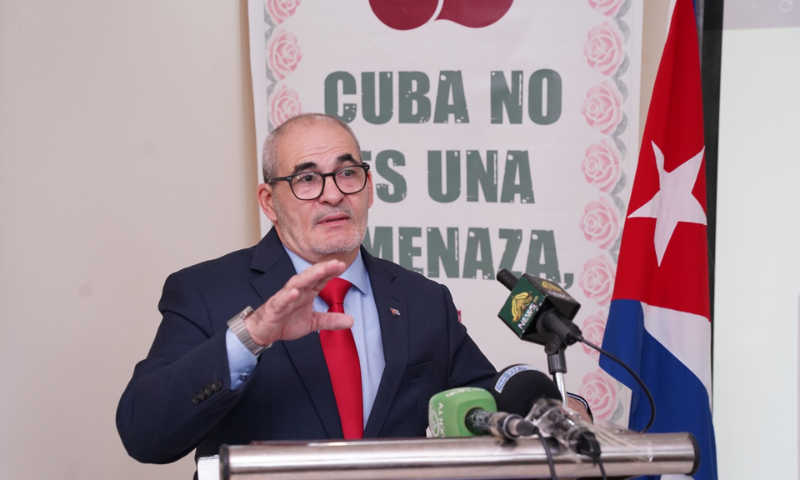
Addressing a press conference at the Embassy of the Republic of Cuba in Islamabad on Tuesday, Cuban Ambassador Damián Cordero Torres highlighted the human and economic costs of the blockade and urged countries to uphold international law, respect national sovereignty and support Cuba’s right to self-determination.
The press conference, titled “The Human and Economic Cost: Why the World Must Vote to End the U.S. Blockade on Cuba,” came as Cuba prepared to present its traditional draft resolution at the UN General Assembly on October 27 and 28, calling for the immediate lifting of the restrictions.
According to figures presented by the ambassador, the economic damage caused by the blockade between March 1, 2025, and February 28, 2026, reached a record $8.083 billion.
Ambassador Cordero Torres said recent US measures had further intensified economic pressure on Cuba, particularly through restrictions affecting energy supplies and the imposition of tariffs on third countries supplying oil to the island.
He referred to US Executive Order 14380, issued on January 29, 2026, and Executive Order 14404, dated May 1, 2026, which, according to the Cuban Embassy, expanded restrictions and secondary sanctions affecting key sectors, including energy, mining, finance, security and defence.
The ambassador warned that the worsening economic and energy situation was placing additional pressure on Cuba’s healthcare system and essential public services.
Figures shared by the Embassy indicated that more than 100,000 surgical procedures had been postponed or cancelled because of power outages and shortages of fuel for backup generators.
The restrictions were also said to have affected access to essential cancer treatments, with more than 118,000 cancer patients, including 1,200 children, reportedly unable to obtain first-line treatments because of supply-chain constraints.
The Embassy further reported that Cuba’s infant mortality rate had risen to 9.3 deaths per 1,000 live births, with 1,780 preventable newborn deaths attributed to the prevailing conditions.
The ambassador warned that shortages of fuel and medicines were threatening the continuity of healthcare, food supplies and water services across the country.
Cuba maintains that the intensified restrictions violate international law, the United Nations Charter and humanitarian principles, describing their impact on the population as a form of collective punishment.
The press conference also focused on Cuba’s continued inclusion on the United States’ list of State Sponsors of Terrorism.
The Cuban Embassy said the designation severely restricted the country’s access to international banking services and increased financial costs, further complicating trade and economic activity.
Cuba rejected the designation as unjustified, maintaining that it had consistently fulfilled its international counterterrorism commitments and describing itself as a victim, rather than a sponsor, of terrorism.
Ambassador Cordero Torres reiterated Cuba’s willingness to engage in respectful dialogue and bilateral negotiations with the United States on the basis of equality, reciprocity and respect for national sovereignty.
However, he stressed that Cuba would not compromise on its independence or its right to self-determination.
The Cuban Embassy called on the international community to support the forthcoming UN General Assembly resolution seeking an end to the US blockade, arguing that opposition to the restrictions was essential to protecting international law and the rights of the Cuban people.
“Supporting Cuba today is an act of courage, justice, and historical responsibility, and an act in favour of the principles of international law,” the Embassy stated.
The diplomatic initiative forms part of Cuba’s longstanding campaign at the United Nations to secure international support for ending the US economic, commercial and financial blockade.