
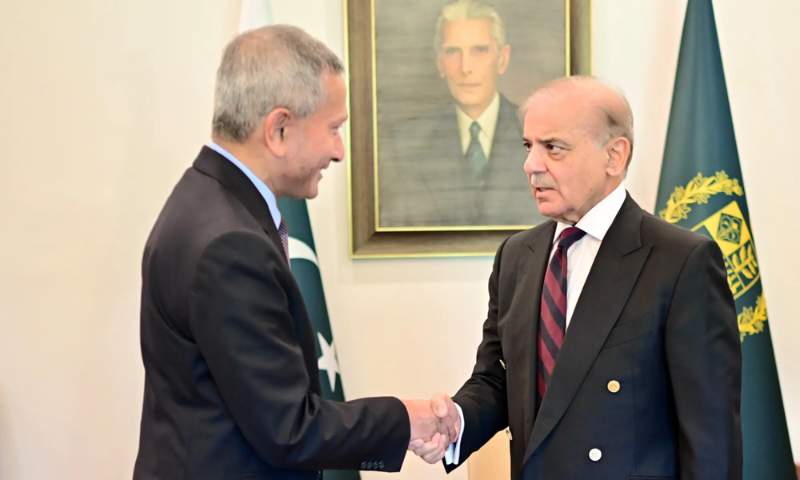
Islamabad, October 30, 2026: Prime Minister Shehbaz Sharif on Friday expressed admiration for Singapore’s remarkable economic transformation and achievements in innovation and development, reaffirming Pakistan’s commitment to further strengthening bilateral relations and expanding cooperation in trade, investment and emerging technologies.
The prime minister made these remarks during a meeting with Singaporean Foreign Minister Dr Vivian Balakrishnan, who is visiting Pakistan on an official trip. The visit coincides with the 60th anniversary of the establishment of diplomatic relations between the two countries.
According to the Prime Minister’s Office (PMO), the two sides discussed ways to enhance bilateral trade and investment and expand cooperation in priority areas, including the digital economy, financial technology, infrastructure development, logistics, small and medium enterprises (SMEs) and the services sector.
They also explored new opportunities for mutually beneficial economic cooperation and greater people-to-people exchanges.
The prime minister underscored the importance Pakistan attaches to its partnership with Singapore, both bilaterally and multilaterally, particularly within the Association of Southeast Asian Nations (ASEAN).
Earlier, Deputy Prime Minister and Foreign Minister Senator Ishaq Dar held delegation-level talks and a separate meeting with his Singaporean counterpart at the Ministry of Foreign Affairs.
Addressing a joint press conference, Dar said Pakistan and Singapore enjoyed longstanding and friendly relations based on mutual respect and goodwill, recalling that Pakistan was among the first countries to recognise Singapore following its independence in 1965.
He described Balakrishnan’s visit as particularly significant, noting that it was the first visit by a Singaporean foreign minister to Pakistan in more than two decades.
Dar said the discussions focused on strengthening political and economic relations, expanding cooperation in technology and education, and promoting cultural and people-to-people exchanges.
He noted that considerable untapped potential existed in bilateral relations and emphasised the need for regular political consultations and high-level exchanges to strengthen cooperation between the two governments and institutions.
On economic relations, Dar welcomed the growth in bilateral trade and said both sides had agreed to encourage closer engagement between business communities through business delegations and stronger links between their chambers of commerce.
He also highlighted the reopening of the Pakistan Trade and Investment Office at Pakistan’s High Commission in Singapore, describing it as a demonstration of Islamabad’s commitment to promoting business-to-business ties.
The two countries also discussed cooperation in education, research, innovation, digital technologies and artificial intelligence, alongside opportunities to strengthen links between universities and research institutions. Cooperation in human resource development, agriculture and climate-related initiatives also featured in the discussions.
Dar said Pakistani professionals working in Singapore were making valuable contributions to its economy and society and serving as an important bridge between the two nations.
He added that both sides had discussed the possible resumption of direct flights between Pakistan and Singapore to facilitate business travel and closer people-to-people contacts.
Singapore sees significant potential in trade and investment
Speaking at the joint press conference, Balakrishnan said Singapore valued its longstanding relationship with Pakistan and had never forgotten Pakistan’s early recognition of its independence.
He described diplomatic relations between the two countries as excellent but observed that their economic and trade ties had yet to reach their full potential.
He stressed the need to facilitate greater trade and investment flows, particularly by strengthening connections between small and medium enterprises and business communities in South Asia and Southeast Asia.
Balakrishnan said governments should play a facilitative role in bringing businesses together and identifying new opportunities for mutually beneficial cooperation.
He also identified carbon markets as a promising area of collaboration, saying they could attract investment into projects in Pakistan aimed at reducing emissions while supporting sustainable development.
Pakistan, Singapore agree to strengthen disaster management cooperation
During the visit, Dar and Balakrishnan exchanged a memorandum of understanding (MoU) on cooperation in disaster management between Pakistan’s National Disaster Management Authority (NDMA) and the Singapore Civil Defence Force.
The agreement aims to strengthen cooperation in disaster preparedness and response, including early warning systems, sharing best practices, improving search and rescue capabilities, and conducting joint training and exercises.
Balakrishnan said climate change had made natural disasters an increasingly serious and immediate threat, making preparedness and international cooperation essential.
He acknowledged Pakistan’s extensive experience in responding to large-scale natural disasters and said Singapore could also learn from Pakistan’s experience in building resilience and managing emergencies.
He stressed that disasters respected no national boundaries and that closer cooperation would help both countries improve their preparedness and response capabilities.
The Singaporean foreign minister also welcomed opportunities to deepen academic cooperation between higher education institutions, including Singapore’s Nanyang Technological University and National University of Singapore and Pakistan’s National University of Sciences and Technology (NUST).
Regional and international issues discussed
The two foreign ministers also exchanged views on regional and international developments, with particular attention to maritime security, regional tensions and their impact on international trade and supply chains.
Dar emphasised that secure maritime routes and uninterrupted supply chains were essential for economic stability and international commerce.
He reiterated Pakistan’s commitment to dialogue, diplomacy, international law and the principles of the United Nations Charter as the most effective means of resolving regional and global disputes.
He also briefed his counterpart on Pakistan’s efforts to encourage diplomatic engagement with key regional and international partners.
On Palestine, Dar expressed concern over the continued expansion of illegal Israeli settlements and attempts to alter the status of the West Bank and Al-Quds Al-Sharif. He called for unhindered humanitarian assistance to Gaza and reiterated Pakistan’s support for an independent, sovereign, viable and contiguous Palestinian state based on pre-June 1967 borders, with Al-Quds Al-Sharif as its capital.
Regarding South Asia, he underscored the need for a just, durable and peaceful settlement of the Jammu and Kashmir dispute in accordance with relevant UN Security Council resolutions.
Balakrishnan, meanwhile, appreciated Pakistan’s constructive diplomatic role in addressing regional challenges and promoting peace and stability.
He highlighted the importance of international law and freedom of navigation, particularly under the United Nations Convention on the Law of the Sea (UNCLOS) 1982, noting that maritime connectivity was vital for Singapore as a major trading nation.
He also welcomed Pakistan’s position on these principles, saying both countries shared an interest in maintaining secure and open international shipping routes.
Pakistan-Singapore cooperation through ASEAN
The two ministers also discussed cooperation at multilateral forums, particularly Pakistan’s engagement with ASEAN.
Dar conveyed Pakistan’s best wishes to Singapore as it prepares to assume the ASEAN chairmanship in 2027, expressing Islamabad’s desire to work closely with Singapore in support of its priorities.
Balakrishnan noted that Singapore’s upcoming ASEAN chairmanship and Pakistan’s chairmanship of the Shanghai Cooperation Organisation (SCO) offered opportunities to explore cooperation between the two regional organisations.
Both sides agreed to build on the momentum generated by the visit, ensure timely follow-up on the understandings reached and maintain regular engagement to advance their partnership.
The visit is being viewed as an important opportunity to translate six decades of friendly diplomatic relations into stronger economic, institutional and people-to-people cooperation.