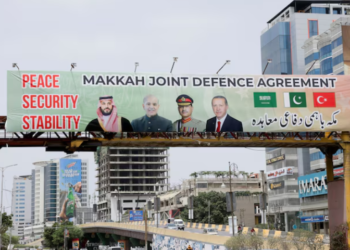

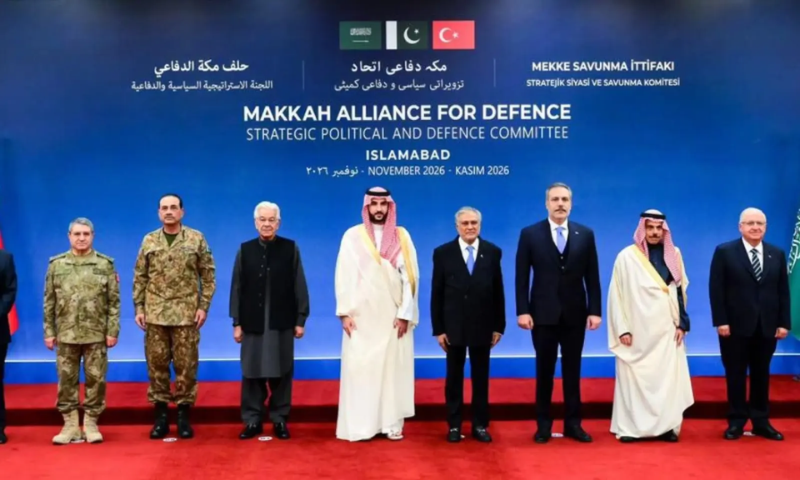
Islamabad, November 27,2026: Pakistan, Saudi Arabia and Türkiye have reaffirmed their commitment to collective defence, mutual solidarity and regional stability during the second meeting of the Strategic Political and Defence Committee (SPDC) of the Makkah Joint Defence Agreement, held in Islamabad on Friday.
The meeting reviewed the evolving regional security situation and condemned what the three countries described as “persistent and heinous” Houthi attacks on civilians and civilian infrastructure in Saudi Arabia.
Addressing the media after the meeting, Deputy Prime Minister and Foreign Minister Senator Mohammad Ishaq Dar said the three countries had reiterated their commitment to the agreement, including collective defence and respect for each other’s sovereignty and territorial integrity.
Dar said the SPDC brought together the foreign and defence ministers and chiefs of defence forces and general staff of the three countries. Pakistan was represented by Dar, Defence Minister Khawaja Asif and Chief of Defence Forces and Chief of Army Staff Field Marshal Asim Munir.
The Saudi delegation included Defence Minister Prince Khalid bin Salman bin Abdulaziz Al Saud, Foreign Minister Prince Faisal bin Farhan and Chief of General Staff General Fayyadh bin Hamed Al-Ruwaili. Türkiye was represented by Foreign Minister Hakan Fidan, Defence Minister Yaşar Güler and Chief of General Staff General Selçuk Bayraktaroğlu.
Dar said the meeting reviewed progress on decisions taken at the previous gathering and expressed satisfaction over efforts to establish and operationalise the alliance’s secretariat in Saudi Arabia.
The three sides agreed to continue consultations to strengthen cooperation and coordination in areas of mutual interest, support efforts to de-escalate regional tensions and encourage peaceful resolution of disputes.
They also pledged to expand cooperation in defence industries, joint technological development, training and capacity building to enhance the capabilities and cohesion of their armed forces.
Dar said the meeting reflected the longstanding friendship and solidarity among the three countries and represented Pakistan’s continued efforts to promote regional and international peace and security.
Houthi attacks on Saudi Arabia condemned
The participating countries condemned repeated Houthi attacks on civilians and civilian infrastructure in Saudi Arabia and reaffirmed their collective resolve to safeguard the kingdom’s security, sovereignty and territorial integrity under the agreement’s collective defence provisions.
The meeting took place amid heightened regional security concerns, particularly following repeated attacks by Yemen’s Ansar Allah movement, commonly known as the Houthis, targeting Saudi cities, oil facilities and shipping.
Defence Minister Khawaja Asif had said on Thursday that the continuing turmoil south of Saudi Arabia would be among the key issues discussed by the three countries.
“Any threat to Saudi Arabia is a threat to Pakistan and Türkiye according to the pact, which is absolutely clear,” he said.
Dar, Fidan discuss bilateral cooperation
On the sidelines of the SPDC meeting, Dar held talks with Turkish Foreign Minister Hakan Fidan. Both sides expressed satisfaction over the growing momentum in bilateral cooperation, particularly in trade, investment, defence and energy.
The two leaders reaffirmed mutual support on matters of shared interest and agreed to translate their strong political ties into tangible economic benefits.
They also agreed to maintain close coordination under the Makkah Agreement for Joint Defence to promote dialogue and de-escalation. Fidan thanked Pakistan for its hospitality and appreciated its diplomatic efforts to advance regional peace and stability.
Alliance moves towards operational framework
Pakistan, Saudi Arabia and Türkiye signed the Makkah Joint Defence Agreement on August 7. Under the pact, an armed attack against any one member is to be considered an attack against all, obliging the other two to provide assistance through available means, including military support.
The SPDC serves as the alliance’s principal decision-making forum, bringing together the foreign and defence ministers and senior military leadership of the three countries.
A permanent secretariat has been established in Riyadh, with Pakistan’s retired Lieutenant General Nauman Mahmood appointed as its first secretary general for a three-year term. A working committee comprising officials from the member states is also functioning.
Türkiye’s ratification of the agreement completed the accession process for all three members. However, the alliance’s institutional and operational framework remains at an early stage, with its doctrine, force composition, command arrangements and procedures for a collective military response yet to be publicly defined.
An emergency SPDC meeting in Riyadh on October 5 called for practical implementation of collective defence commitments, including arrangements for the rapid deployment of agreed forces and capabilities, subject to national laws.
Regional tensions and Iran in focus
The alliance’s development comes amid wider regional tensions involving Iran, the United States and Israel, with the three members seeking to strengthen security cooperation while maintaining their respective diplomatic and strategic priorities.
Asif identified Israel as a potential source of regional aggression and called for countries in the region to strengthen their coordination. He declined to comment on how the alliance would respond to a direct Iranian attack on Saudi Arabia.
Pakistan has sought to maintain diplomatic engagement with Tehran while deepening defence cooperation with Saudi Arabia and Türkiye. A meeting involving representatives of the three countries and Iranian officials in Tehran, held on Pakistan’s initiative, was part of efforts to keep communication channels open.
Asif said Pakistan had played a constructive role in facilitating engagement between Washington and Tehran, although the outcome of mediation efforts remained fragile.
A security source said recent Pakistani military deployments, including JF-17 aircraft, drones and HQ-9 air defence systems, had been made under bilateral arrangements predating the trilateral agreement. The source added that existing cooperation could now form part of the wider framework.
Türkiye, meanwhile, has emphasised the defensive character of the agreement and remained cautious about involvement in combat operations in Yemen.