Birmingham, July 4, 2025: Jamie Smith and Harry Brook staged a spirited England comeback on the third day of the second Test at Edgbaston, but India maintained firm control of the match with a dominant all-round performance.
Smith counter-attacked brilliantly after the early loss of Joe Root and Ben Stokes, reaching a superb 184* in an innings of remarkable poise and aggression. His 80-ball century was England’s fastest in recent memory, and the highest score by an English wicketkeeper in men’s Test history—surpassing Alec Stewart’s 173 against New Zealand in 1997.
He was ably supported by Brook, whose composed 158 anchored England’s resistance. Together, the pair shared a record-breaking 303-run stand for the sixth wicket, rescuing their side from a perilous 85-5 to a more respectable 385-6.
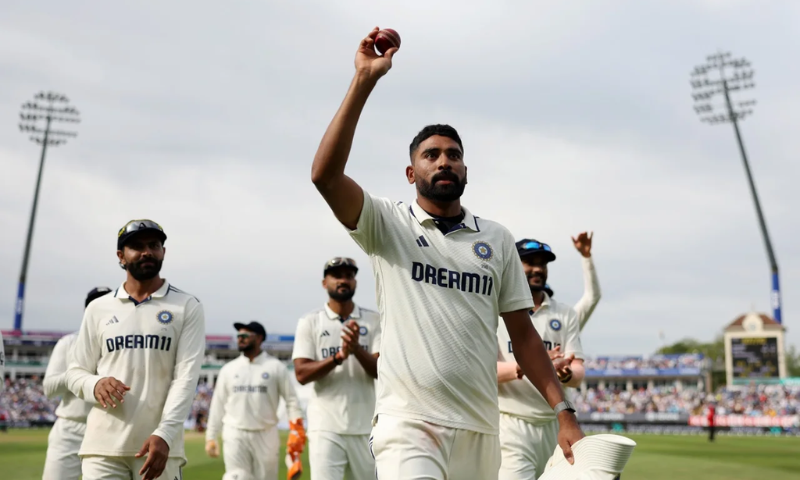
However, India struck back decisively with the second new ball. Led by an inspired Mohammed Siraj, who claimed 6-70, the tourists dismissed the final five English wickets for just 20 runs. Chris Woakes, Brydon Carse, Josh Tongue, and Shoaib Bashir all fell in quick succession as England were bundled out for 407—still trailing by 180 runs.
India’s openers extended their advantage before stumps, reaching 64-1 in 13 overs, pushing their lead to 244 and putting them in a commanding position heading into the final two days.
The day’s play was nothing short of electrifying. England added 172 runs in the first session alone, with Smith nearly eclipsing Gilbert Jessop’s 123-year-old record for England’s fastest Test century (76 balls). Although he fell short, Smith’s knock will be remembered as one of the great counter-attacking innings in recent English cricket.
India, to their credit, showed remarkable composure. Akash Deep’s prodigious seam movement accounted for Brook, while Siraj cleaned up the tail with precision and venom—his short-pitched assault particularly effective.
Despite England’s fiery resurgence, the odds remain firmly in India’s favour. With the pitch offering uneven bounce and signs of turn, a successful fourth-innings chase exceeding the 371 achieved at Headingley last week would be a tall order.
Still, England’s reputation for dramatic fourth-innings pursuits adds intrigue to the match. India, mindful of England’s 378-run chase against them in 2022, may face a strategic dilemma: how long to bat before declaring, balancing caution with aggression.
The day began disastrously for England. Root was caught down the leg side and Stokes fell to a vicious Siraj bouncer off consecutive balls, leaving the hosts reeling at 77-5. But Smith responded with fearless intent, crashing his first ball—a hat-trick delivery—through mid-off for four.
He went on to dominate the Indian attack, smashing Prasidh Krishna for 23 in one over and launching Ravindra Jadeja into the stands to reach 84 off 61. Although the scoring rate slowed post-lunch due to India’s disciplined line outside off-stump, Smith and Brook added 106 runs in the session to keep England afloat.
The turning point came with the second new ball. Brook, uncharacteristically aggressive, fell to a jagging delivery from Deep, sparking a rapid collapse. Bashir’s dismissal capped an extraordinary scorecard that featured six ducks—the most ever in a single Test innings for England.
In reply, India’s openers capitalized on a wayward start from England’s bowlers. Yashasvi Jaiswal and KL Rahul added 51 runs in just 48 balls before Jaiswal was controversially adjudged lbw on review—a decision met with boos from the Birmingham crowd after a delayed DRS appeal.
With two days remaining and England needing early wickets, the stage is set for a potentially dramatic finish. But for now, India remain well ahead, looking to press for a series-levelling victory.