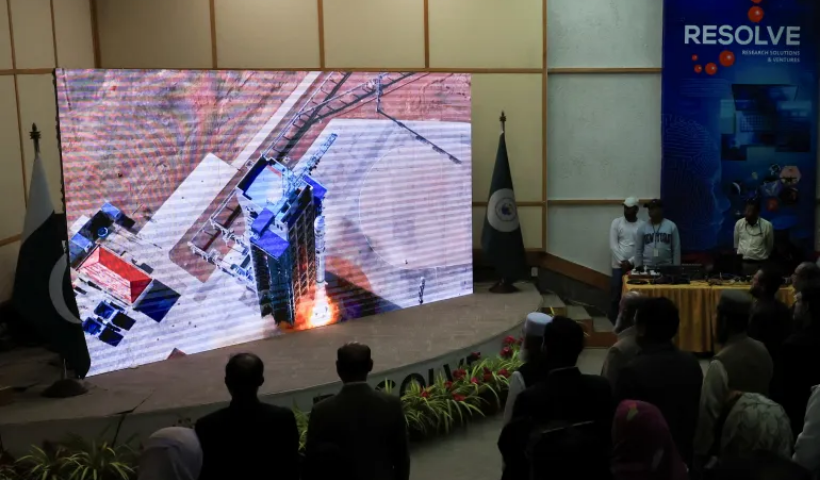
Islamabad/Beijing, October 19, 2025: Pakistan on Sunday successfully launched its first-ever hyperspectral satellite, marking what officials described as a “major milestone” in the country’s space and technological advancement efforts.
The H1 satellite, developed under the supervision of the Space and Upper Atmosphere Research Commission (SUPARCO), was launched from China’s Jiuquan Satellite Launch Centre in the northwestern Gansu province, according to a statement issued by the Pakistani space agency.
Hyperspectral satellites can capture highly detailed spectral images across hundreds of narrow wavelength bands, allowing them to detect subtle chemical and material variations on the Earth’s surface that conventional satellites cannot. Such capabilities make them invaluable for precision agriculture, water resource management, environmental monitoring, and disaster response.
“The data from the Hyperspectral Satellite is poised to revolutionise agricultural productivity, bolster climate resilience, and enable optimised management of the country’s vital natural resources,” SUPARCO Chairman Muhammad Yousuf Khan said.
Pakistan’s Ministry of Foreign Affairs said the new satellite would “significantly enhance national capacities” in multiple sectors — including urban planning, environmental protection, and disaster management — while also aiding development projects such as the China-Pakistan Economic Corridor (CPEC).
By providing real-time, high-resolution data, the H1 satellite will strengthen Pakistan’s ability to monitor geohazard risks and ensure sustainable development across industrial and agricultural zones linked to CPEC.
The Foreign Ministry hailed the launch as a “pivotal step forward” in Pakistan’s space programme and a symbol of its deep-rooted partnership with China in peaceful space exploration.
“The mission reflects the ever-growing strategic partnership and deep-rooted friendship between the two nations, who continue to cooperate in advancing peaceful space exploration and harnessing its benefits for socioeconomic development,” the ministry said.
The H1 satellite is the third launched by Pakistan this year, following the successful deployment of EO-1 and KS-1, both of which are now fully operational in orbit, according to SUPARCO.
A SUPARCO spokesperson told local media that it will take about two months to calibrate the H1’s systems before it becomes fully functional. Once operational, the satellite is expected to transform data-driven decision-making across Pakistan’s agriculture, environment, and infrastructure sectors.
Experts view the mission as a significant stride toward strengthening Pakistan’s indigenous space technology, deepening scientific collaboration with China, and enhancing the country’s capacity to address emerging challenges linked to climate change, food security, and urban growth.