Islamabad, April 28, 2026: The Judicial Commission of Pakistan (JCP), chaired by Chief Justice of Pakistan Yahya Afridi, on Tuesday approved the transfer of three judges from the Islamabad High Court (IHC) to other high courts, according to an official statement.
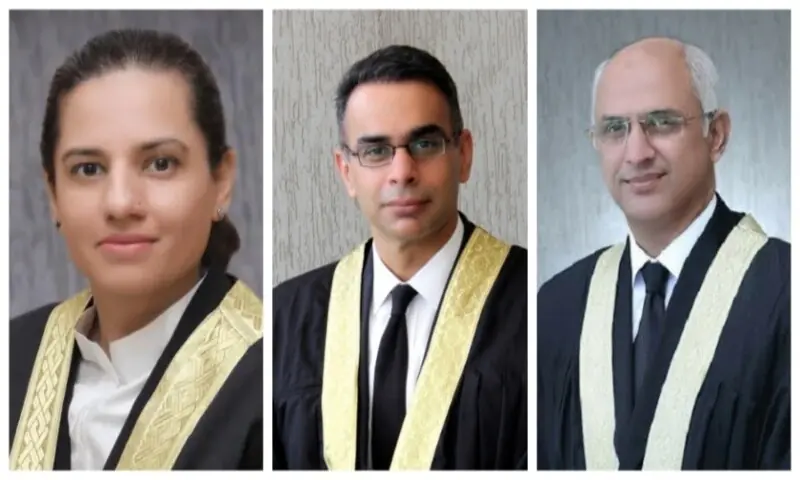
The commission endorsed, by majority, the transfer of Justice Mohsin Akhtar Kiani to the Lahore High Court, Justice Babar Sattar to the Peshawar High Court, and Justice Saman Rafat Imtiaz to the Sindh High Court.
The meeting, held at the Supreme Court, was convened by the JCP secretary under Article 175A(22) of the Constitution after the chairman initially declined to call the session on a requisition submitted by one-third of the commission’s members.
The commission also ruled that vacancies arising from such transfers would be filled through further transfers only and would not be treated as fresh slots for new appointments.
Meanwhile, proposals to transfer Justice Arbab M. Tahir to the Balochistan High Court and Justice Khadim Hussain Soomro to the Sindh High Court were withdrawn by the member who had requisitioned the meetings.
Appointments under consideration
The transfers come as deliberations continue over the induction of new judges to the IHC. Several prominent lawyers are being considered for elevation, including Ayyaz Shaukat, Usman G. Rashid Cheema, Umair Majeed Malik, and Sultan Mazhar Sher Khan.
Additionally, serving district and sessions judges Shahrukh Arjumand and Humayun Dilawar are also among leading candidates for elevation.
CJP raises constitutional concerns
Prior to the meeting, CJP Yahya Afridi had expressed serious constitutional reservations regarding the transfer of judges from the IHC.
In response to informal requests by IHC Chief Justice Sardar Mohammad Sarfraz Dogar, the CJP warned that such moves could undermine federalism and equitable representation, potentially reducing judicial appointments to temporary administrative decisions.
He also cautioned that transferring a significant number of judges without immediate replacements could create institutional instability within the court.
Raising concerns over the absence of clear reasons, the CJP noted that such transfers could appear punitive in nature, effectively amounting to removal without due process. He emphasized that Article 209 of the Constitution provides a proper mechanism through the Supreme Judicial Council to address allegations against judges.
Legal and institutional context
The transfers follow recent amendments to Article 200 of the Constitution, empowering the JCP to recommend transfers without requiring the consent of judges. Previously, such consent was mandatory under the law.
The revised provision also allows proceedings under Article 209 if a judge refuses to comply with a transfer.
Notably, the judges being transferred were among those who had previously raised concerns about alleged interference in judicial affairs and had opposed certain administrative decisions within the IHC.
The developments come against the backdrop of ongoing institutional changes within the Islamabad High Court, including administrative restructuring and internal differences among senior judges.