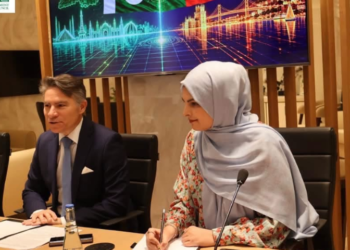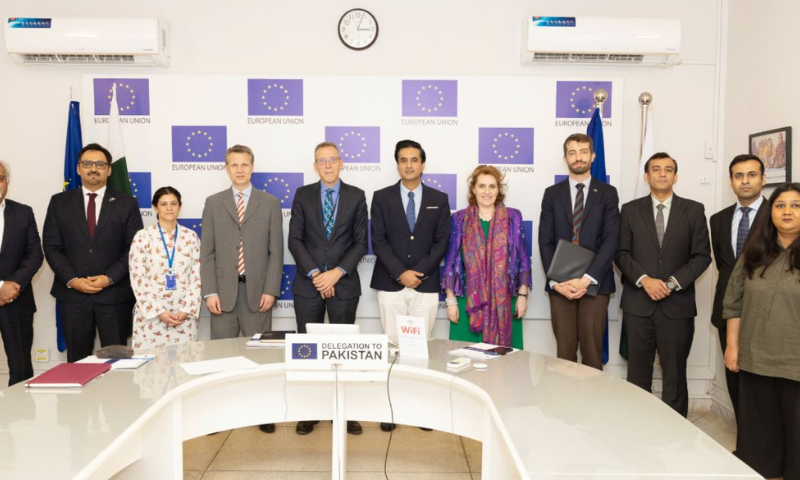
Quetta, May 7, 2026: The Government of Balochistan, in collaboration with the European Union Delegation to Pakistan and the United Nations Office on Drugs and Crime, convened the 9th and final Provincial Steering Committee (PSC) meeting in Quetta to review progress on the implementation of the province’s Rule of Law Roadmap.
The roadmap has been supported through the European Union-funded Deliver Justice Project with technical assistance from United Nations Development Programme and UN Women.
The meeting aimed to assess progress made in justice sector reforms and discuss future priorities for strengthening rule of law institutions in the province. The Deliver Justice Project focused on improving institutional performance, enhancing public access to justice and reinforcing accountability mechanisms across Balochistan.
The session was chaired by Additional Chief Secretary of the Home and Tribal Affairs Department Hamza Shafqaat and attended by representatives of the European Union, provincial departments and implementing partners.
Participants reviewed progress achieved since the previous PSC meeting and agreed on coordinated priorities to further strengthen institutional capacity and promote citizen-centric justice delivery across the province.
Officials highlighted several legislative achievements in the criminal justice sector aimed at modernising legal processes, improving accountability and enhancing accessibility of justice services.
During the meeting, UNODC presented key progress updates, including the operationalisation of the Prison Management Information System (PMIS), establishment of Smart Police Stations in Quetta and other districts, and the creation of Court Annexed Mediation Centres.
Participants observed that these reforms had contributed to improving public confidence in policing and prison management services. The meeting also reviewed strengthened case management systems and the use of digital tools to improve efficiency across the criminal justice chain.
Capacity-building initiatives for prosecutors, judges, prison officials and police personnel were also discussed, alongside efforts to integrate human rights standards into institutional practices.
Speaking on the occasion, Jeroen Willems appreciated the progress achieved through the five-year programme in strengthening justice sector institutions and promoting people-centred services in the province.
He reaffirmed the European Union’s commitment to supporting further reforms aimed at enhancing rule of law and access to justice, particularly for vulnerable communities.
Troels Vester acknowledged the support provided by the European Union and praised the continued commitment of the Government of Balochistan towards evidence-based reforms in the justice sector.
In his concluding remarks, Hamza Shafqaat thanked the European Union for its financial assistance and UNODC for its technical leadership, while also appreciating the complementary roles played by UNDP and UN Women. He reiterated the provincial government’s commitment to strengthening rule of law as a foundation for peace, justice and sustainable development.
The meeting concluded with an agreement on immediate reform priorities and a request for continued support from the European Union and UNODC under a new programme expected to be launched in August 2026.
The Deliver Justice Project, funded by the European Union from 2021 to 2026 with an investment of 20 million euros, aimed to strengthen criminal justice institutions and improve access to justice in Pakistan, particularly in Balochistan and Khyber Pakhtunkhwa, through institutional reforms, digitalisation and governance improvements.