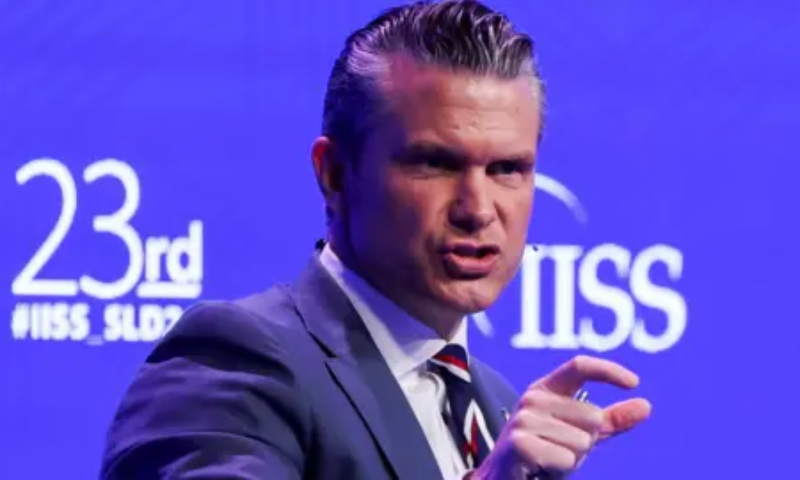
Singapore, May 30,2026: United States Defence Secretary Pete Hegseth has described Pakistan as a “true friend” of the United States, commending Islamabad’s efforts to help bring a lasting end to the Middle East conflict and facilitate dialogue between Washington and Tehran.
Speaking at the Shangri-La Dialogue in Singapore on Saturday, Hegseth praised Prime Minister Shehbaz Sharif and Chief of Defence Forces Field Marshal Syed Asim Munir for their role in ongoing diplomatic efforts aimed at reviving peace negotiations with Iran.
“Pakistan is a true friend of the US,” Hegseth said, adding that Prime Minister Shehbaz and Field Marshal Munir were playing an “outstanding” role in the continuing peace process.
The remarks come amid Pakistan’s diplomatic efforts to encourage renewed engagement between Tehran and Washington following six weeks of conflict that heightened tensions across the Middle East.
Despite ongoing mediation efforts, a final agreement remains out of reach. A White House official told AFP that President Donald Trump would only approve a peace deal if Iran accepted all US conditions.
The White House has indicated that President Trump is close to making a decision on a potential agreement, although Iranian officials maintain that no final deal has yet been reached. Iranian state media also challenged several aspects of Trump’s characterization of the negotiations, describing his comments as a “mixture of truth and lies.”
Trump has repeatedly insisted that any agreement must include Iran’s commitment not to develop nuclear weapons and the reopening of the Strait of Hormuz, among other conditions. The US president reiterated those demands on Friday before attending a two-hour meeting in the White House Situation Room, which reportedly ended without a final decision.
Conflict and mediation
Regional hostilities erupted on February 28 when the United States and Israel launched coordinated attacks on Iran. Tehran responded by targeting US military installations in the region and effectively closing the Strait of Hormuz, disrupting global energy markets and raising fears of a broader conflict.
The fighting subsided after Pakistan helped broker a two-week ceasefire on April 8. Islamabad subsequently hosted delegations from both Tehran and Washington for direct talks, marking the first such dialogue between the two countries in nearly five decades.
However, negotiations ended without a breakthrough as the two sides remained divided on key issues, including the future of the Strait of Hormuz and Iran’s nuclear and missile programmes.
Despite the deadlock, Pakistan continued diplomatic engagement with both capitals and played a role in securing an extension of the ceasefire.
On Friday, Iranian President Masoud Pezeshkian publicly thanked Pakistan for its efforts to facilitate an agreement with the United States. In a post on his official X account following separate telephone conversations with Prime Minister Shehbaz Sharif and Malaysian Prime Minister Anwar Ibrahim, Pezeshkian praised Islamabad’s “initiative and effective efforts” in the peace process.
US officials have also repeatedly acknowledged Pakistan’s role as a key intermediary in discussions with Tehran, highlighting Islamabad’s growing diplomatic influence in efforts to reduce tensions in the Middle East.