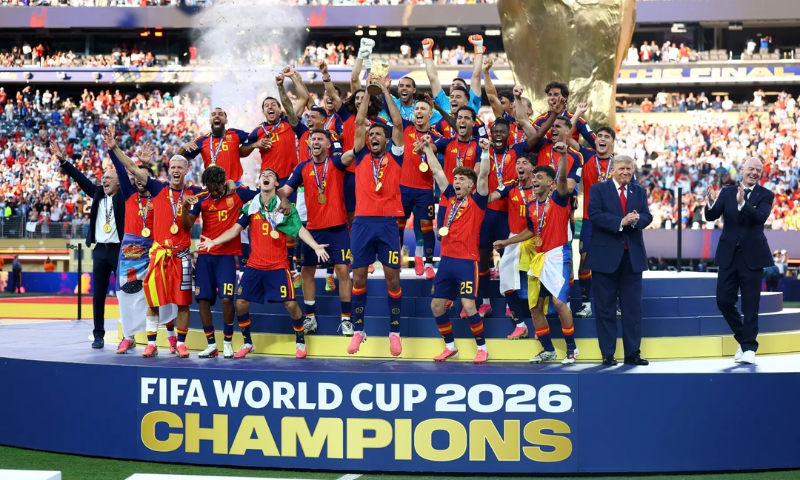
New Jersey, July 22, 2026: Nearly 63 million Americans watched Spain defeat Argentina in the FIFA World Cup 2026 final, setting a new US viewership record and highlighting football’s surging popularity in the country.
The final, played in New Jersey on Sunday, remained goalless until Spain scored in the 106th minute to secure a 1-0 victory over Argentina.
According to broadcasters, Fox’s English-language coverage attracted 38.9 million viewers, while Comcast’s Telemundo and its Peacock streaming platform drew another 23.9 million viewers for Spanish-language coverage. The combined audience of almost 63 million more than doubled the 22.3 million Americans who watched the 2022 FIFA World Cup final in Qatar.
The record-breaking audience capped a successful tournament for broadcasters Fox and Comcast, which reportedly paid about $485 million and $600 million, respectively, for broadcasting rights packages that included the World Cup.
Several knockout-stage matches also surpassed viewership figures for recent championship games in other major American sports. The Round of 16 clash between England and Mexico attracted nearly 45 million viewers, exceeding the audiences for Game 7 of Major League Baseball’s World Series and Game 5 of the NBA Finals.
Although the figures remained well below the approximately 126 million viewers who watched Super Bowl LX, analysts described the tournament as a landmark moment for football in the United States, where the sport has traditionally trailed American football, basketball and baseball in popularity.
The tournament, jointly hosted by the United States, Canada and Mexico, benefited from prime-time kick-off schedules for North American audiences. Interest was also boosted by what could be the final FIFA World Cup appearances of global football icons Lionel Messi and Cristiano Ronaldo.
Fox One, which held the English-language streaming rights, recorded 2.8 million new subscriptions in June, its strongest monthly performance since the platform’s launch and more than double the subscriptions generated during the NFL playoffs in January.
The tournament also proved highly profitable for broadcasters. Marketing experts said advertising demand exceeded expectations, with a 30-second commercial during knockout-stage matches reportedly selling for as much as $1 million, more than twice the rate charged during the 2018 FIFA World Cup.
Major advertisers included PepsiCo, Home Depot, Anheuser-Busch and Coca-Cola.
Industry analysts also pointed to newly introduced hydration breaks as a significant commercial success, creating additional advertising inventory during matches. Reports suggest Fox alone could generate at least $250 million in advertising revenue from hydration-break commercials.
Despite the tournament’s commercial success, analysts said it remains uncertain whether innovations such as the extended 27-minute halftime entertainment show and championship rings for winners—introduced in line with American sporting traditions—will become permanent features of future FIFA World Cups.
The next FIFA World Cup will be jointly hosted by Spain, Portugal and Morocco in 2030, followed by Saudi Arabia in 2034, where less favourable kick-off times for North American audiences could affect future television ratings.