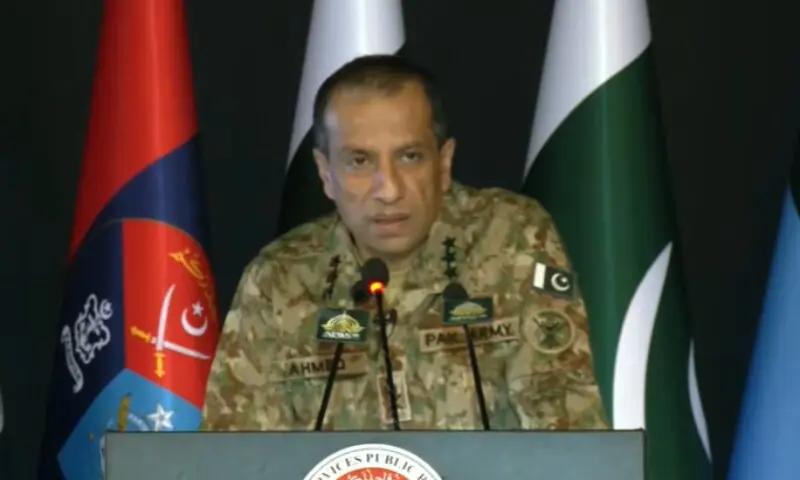
Rawalpindi, July 31, 2026: Director General of Inter-Services Public Relations (ISPR) Lieutenant General Ahmed Sharif Chaudhry on Friday said good governance was indispensable for Pakistan’s security and long-term stability, stressing that major national challenges, including terrorism and governance issues, could only be addressed through constitutional, political and administrative reforms.
Addressing a wide-ranging press conference on the country’s security situation, with a particular focus on Balochistan, the military spokesperson said the National Action Plan (NAP) and its 14-point agenda could only be effectively implemented through sound governance.
Commenting on recent remarks by Interior Minister Mohsin Naqvi regarding the creaion of new administrative units, the DG ISPR said the armed forces had consistently maintained that effective governance was central to national security.
“We have been saying this for a long time as a primary stakeholder in security that good governance is essential for the security and stability of Pakistan,” he said.
He noted that Pakistan’s population had grown to around 250 million while the country continued to function with only four provinces, saying political leaders should hold a serious debate on whether the existing administrative structure was sufficient to ensure effective governance.
“The will of the people of Pakistan is supreme. If good governance requires an administrative reset, it must be undertaken through constitutional methods, legal procedures and political representatives,” he added.
Over 40,000 intelligence-based operations conducted
Sharing details of counterterrorism operations, Lt Gen Ahmed Sharif said security forces had conducted 40,348 intelligence-based operations (IBOs) across Pakistan so far in 2026, averaging nearly 200 operations daily. More than 31,000 operations were carried out in Balochistan alone.
He said 3,145 terrorism-related incidents had been recorded this year, including 1,971 in Khyber Pakhtunkhwa, 1,148 in Balochistan, and 26 in other parts of the country.
According to the DG ISPR, 2,084 confirmed terrorists had been killed during these operations, averaging 10 terrorists eliminated every day, which he described as the highest rate in Pakistan’s history.
He added that 819 Pakistanis had lost their lives in terrorist incidents this year, including 303 military personnel, 194 members of police and other law enforcement agencies, and 322 civilians.
The military spokesperson further said 28 suicide bombings had occurred in 2026, alleging that most of the attackers were Afghan nationals or linked to elements associated with Afghanistan’s security apparatus.
Comparing the current situation with previous years, he said Pakistan’s counterterrorism operations had become increasingly effective.
“In 2025, for every martyr we neutralised at least two terrorists. This year, the ratio has improved to approximately 2.5 terrorists for every martyr,” he said.
‘Hard state’ means rule of law
The DG ISPR described Pakistan’s principal challenge as becoming what he termed a “hard state,” clarifying that the concept did not imply military rule but rather the strict and equal implementation of the Constitution and the law.
“A hard state is one where the Constitution and law apply equally to everyone. It does not mean a military-run state,” he said.
He argued that citizens must fulfil their constitutional obligations before demanding their rights, citing Article 5 of the Constitution, which requires loyalty to the state and obedience to the Constitution and the law.
“Our first and foremost identity must be Pakistani. If there is the state, there is politics, development and life,” he remarked.
Balochistan’s challenge rooted in governance, terrorism
Focusing on Balochistan, Lt Gen Ahmed Sharif identified terrorism, entrenched elitism, tribal power structures, external interference and cross-border support for militant groups as the province’s major challenges.
He alleged that certain influential elites sought to preserve the status quo to maintain political and economic control, while terrorist organisations exploited governance gaps to destabilise the province.
He also accused external actors of supporting terrorist organisations operating in Balochistan, alleging that India-backed groups and militant networks based in Afghanistan were working in coordination to undermine Pakistan’s stability.
The DG ISPR claimed that terrorist organisations were using sophisticated propaganda campaigns, supported by hundreds of websites and thousands of social media accounts, to spread misinformation and create the perception that Balochistan’s security situation was deteriorating.
Missing persons commission resolved majority of cases
Addressing the issue of missing persons, the military spokesperson said the government-established Commission of Inquiry on Enforced Disappearances had received 10,901 complaints, of which 9,372 cases had been disposed of.
According to the data shared, 4,896 missing persons had returned home, 1,030 were traced to prisons, 308 were found dead, while around 2,400 complaints were determined to be misreported cases.
Of the 2,933 complaints received from Balochistan, he said 2,767 had already been resolved.
Security measures intensified in Balochistan
Providing an overview of the security situation in Balochistan, Lt Gen Ahmed Sharif said terrorists had killed 178 civilians this year, abducted 55 people, damaged roads and bridges at 24 locations, set property ablaze at 60 sites, and carried out 47 incidents of looting.
Police and Levies personnel were targeted in 105 separate attacks, he added.
He said security forces were continuing Operation Al-Azm, previously known as Operation Shaban, against terrorist organisations, while Operation Ghazab lil-Haq was being conducted against militants operating from Afghanistan.
The DG ISPR also announced that 2.6 million Afghan nationals had returned to Afghanistan from Pakistan, including 600,000 repatriated during 2026.
To strengthen security in Balochistan, he said the government was establishing Frontier Corps (FC) West Command in Chaghi, enhancing police capabilities through new recruitments, deploying newly trained Assistant Superintendents of Police (ASPs), and providing modern equipment, including bulletproof vehicles.
He added that Rs70 billion had been allocated for socioeconomic development projects in Balochistan, while Rs24 billion had been earmarked under the Balochistan Special Development Initiative to improve infrastructure, road connectivity, information technology training and human resource development.
Expressing optimism about the province’s future, the DG ISPR said Balochistan possessed immense economic and strategic potential.
“In the words of the Field Marshal, within the next five to ten years Balochistan is going to be the richest province and a game changer. The greater the potential, the greater the threats, but the people of Pakistan and Balochistan will overcome them,” he said.
Reaffirms Pakistan’s position on Kashmir
Responding to a question on the situation in Azad Jammu and Kashmir (AJK), Lt Gen Ahmed Sharif reiterated Pakistan’s longstanding position on the Kashmir dispute.
“Kashmir was, is and will remain the jugular vein of Pakistan,” he said.
Commenting on the protests organised by the Joint Awami Action Committee (JAAC), he said the state had encouraged the group to pursue its objectives through constitutional and legal means rather than through confrontation.
“The state alone has the monopoly over the use of force,” he added.