Tehran, September 13, 2026: Iran has linked the reopening of the Strait of Hormuz to the United States returning to its commitments under the Islamabad Memorandum of Understanding (MoU), as tensions continued to escalate across the region amid attacks on shipping and energy infrastructure.
Iranian Foreign Minister Abbas Araghchi, speaking to The New Arab, said a meeting in Oman on Monday would focus on establishing a new maritime route through the Strait of Hormuz.
He said participating countries would be provided details of the agreement with Oman and maps relating to the proposed route, while stressing that the agreement did not mean the strategic waterway was being reopened.
“Iran’s condition for reopening the Strait of Hormuz is for the US to return to its commitments under the Islamabad MoU,” Araghchi said.
He added that Iran believed ensuring regional security and stability was primarily the responsibility of countries in the region and expressed hope that the Oman talks would pave the way for further consultations.
Iranian President Masoud Pezeshkian, meanwhile, said Tehran had no dispute with Gulf countries but objected to the presence of US military bases in the region, which he alleged were being used to launch attacks against Iran.
“We have no problem with the UAE. We have no problem with any of the countries in the region,” Pezeshkian said in an interview with India Today.
“Our problem is with the US bases in regional countries, which are being used to launch aggression against our country,” he added.
Pezeshkian said Iran had never initiated a war and had only defended itself against what he described as US and Israeli aggression. He said Iran did not seek war but would not surrender under sanctions or restrictions affecting the supply of food and medicine.
“The only way forward is to end US aggression and unilateralism,” he said.
Addressing the 18th BRICS Plus Summit in New Delhi, Pezeshkian said recent US and Israeli attacks had demonstrated that economic resilience could not be sustained without security.
He warned that attacks on economic, energy and development infrastructure could have consequences beyond national borders, with regional and global repercussions.
Pezeshkian said Iranian civilians, including women and children, had paid a heavy price in the attacks and that infrastructure built over decades for national development had been damaged.
He also urged BRICS to play a greater role in defending national sovereignty and territorial integrity and upholding the prohibition on the use of force.
On economic cooperation, the Iranian president called for greater trade in national currencies and stronger support for the New Development Bank to enhance the resilience of BRICS members against political and economic pressure.
The expanded 11-member BRICS grouping comprises Brazil, Russia, India, China, South Africa, Egypt, Ethiopia, Indonesia, Iran, Saudi Arabia and the United Arab Emirates.
Meanwhile, a fire broke out aboard a vessel after it was reportedly struck by an unidentified projectile while transiting the Strait of Hormuz, according to the UK Maritime Trade Operations (UKMTO).
UKMTO said it received a report of the incident at 2300 GMT on Saturday. In an initial statement, it said the status of the crew, damage to the vessel and any environmental impact were unknown.
In a subsequent update, the maritime authority said a fire had broken out aboard the vessel following the reported attack and that local authorities were assisting in evacuating crew members.
UKMTO advised vessels operating in the area to exercise caution and report suspicious activity as investigations continued.
A senior Iranian Revolutionary Guard Navy official also warned US naval vessels against approaching the Strait of Hormuz, challenging US President Donald Trump’s assertion that Washington controlled the strategic waterway.
The official said US forces were aware that vessels approaching the area could face a response from Iranian forces.
Iranian authorities also reported that one person was killed and three others injured in what they described as a US attack on an Iranian commercial vessel near Qeshm Island in the southern Gulf.
Iranian state broadcaster IRIB, citing Qeshm Governor Amir Teymouri, said the vessel was struck at around 5am local time near Hengam Island and the Shib Deraz coast of Qeshm Island.
No further details were immediately available regarding the vessel or circumstances surrounding the reported incident.
Pezeshkian later said in a post on X that Iranians could not be “bullied into submission”, questioning why civilian infrastructure, food supplies and livelihoods were being targeted.
He reiterated that Iran would not surrender.
Arab League Secretary-General Nabil Fahmy said the Gulf crisis could not be resolved through military intervention and warned that the crisis was likely to continue.
Fahmy called on Arab countries to establish clear foundations for their future relations with Iran while urging Tehran to change what he described as highly negative policies towards some Arab states.
In a related development, Iraqi authorities announced plans to gradually reopen three border crossings with Iran after shutting them following a drone attack near the shared border.
The Friday night attack reportedly targeted the East-West pipeline. Baghdad subsequently dismissed the military commander in Missan province after authorities determined that the drones had been launched from the area.
The Iraqi government closed three crossings to reorganise operations and strengthen intelligence measures aimed at preventing further violations.
The Shalamsheh crossing in Basra and al-Shib in Missan reopened to passengers on Sunday but remained closed to trade. The al-Mandali crossing in Diyala is also expected to reopen gradually.
The latest attacks have added to concerns over global energy supplies at a time when oil prices have already risen sharply amid disruptions in the Middle East.
Saudi Arabia recently temporarily shut its 1,200-kilometre East-West oil pipeline as a precaution following a drone attack that Baghdad and Riyadh said originated in Iraq.
The pipeline had been carrying an estimated four to five million barrels of oil per day, equivalent to around four to five per cent of global supply, and had provided Saudi Arabia with an alternative export route while shipping through the Strait of Hormuz was severely disrupted.
There was no immediate claim of responsibility for the pipeline attack. Saudi authorities said the incident caused injuries and damage that was still being assessed.
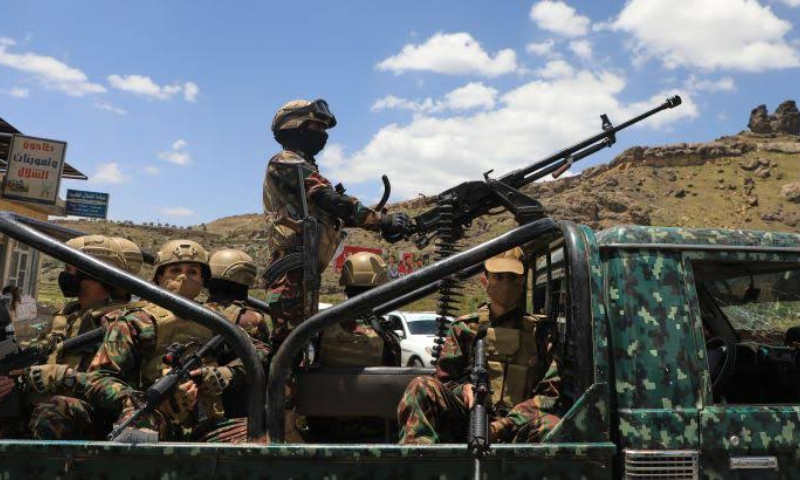
US President Donald Trump said Iran was probably responsible, while Saudi Civil Defence separately reported that a Houthi-fired projectile had injured two people and damaged several buildings, including a mosque, in the Jazan region.
The escalating attacks have raised fears of further disruption to oil and gas shipments through both the Strait of Hormuz and the Red Sea, potentially putting additional pressure on global energy prices.
Iran has said it will attend Monday’s meeting in Oman with Gulf Arab states to discuss the future of the Strait of Hormuz.
However, an Iranian official told Reuters that the meeting, initiated by Oman, was primarily intended to discuss the strait and other regional issues and was not expected to immediately produce a signed agreement.
Iranian officials have indicated that the waterway will not reopen unless conditions conveyed to the United States are met.
Iran also wants recognition of its control over the Strait of Hormuz and the right to collect fees from vessels using the waterway, a demand rejected by Washington.
Oman, which controls the opposite bank of the strait, has been facilitating regional consultations as concerns grow over the impact of the conflict on global energy supplies and maritime trade.