
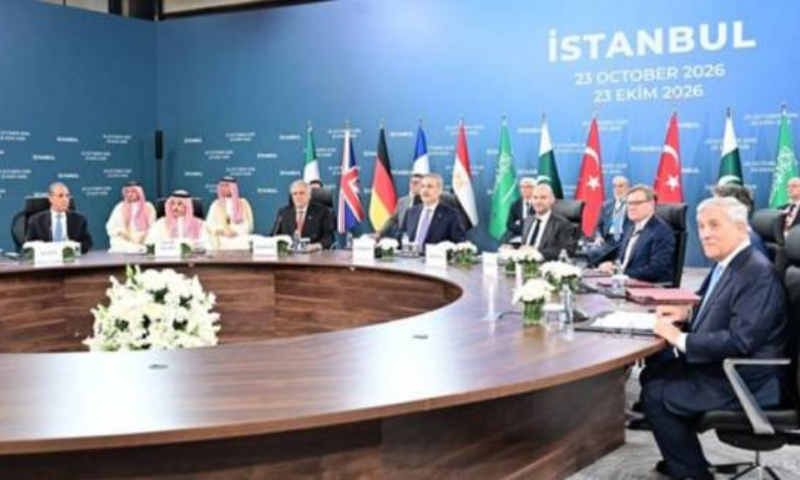
Istanbul, October 24, 2026: Foreign ministers from eight countries have urged the United States and Iran to exercise restraint and avoid further escalation after meeting in Turkiye to discuss the Strait of Hormuz and other regional developments.
Foreign ministers from the United Kingdom, France and Germany, collectively known as the E3, met their counterparts from Turkiye, Saudi Arabia, Pakistan and Egypt, known as the R4, along with Italy in Istanbul on Friday.
Speaking after the meeting, Turkish Foreign Minister Hakan Fidan said none of the participating countries supported another military intervention or attack on Iran, warning that such a move would exacerbate tensions and widen the conflict.
He said diplomacy and dialogue remained the only way to end the war.
French Foreign Minister Jean-Noel Barrot warned that further escalation between Iran and the United States would produce no winners and have serious consequences for hydrocarbon prices.
The eight-country group would call on both sides to exercise the utmost restraint because the region could not afford another escalation, he said.
Italian Foreign Minister Antonio Tajani said the objective was to promote de-escalation and guarantee freedom of navigation.
“I do not believe the problem can be solved from a purely military standpoint,” he said, stressing the need for dialogue to reopen the Strait of Hormuz.
The diplomatic push came as US Ambassador to Turkiye Tom Barrack said Washington could “absolutely” launch strikes against Iran over the weekend.
Speaking to X podcast host Mario Nawfal, Barrack said US President Donald Trump remained open to a deal but had also made his demands clear.
Barrack claimed any potential US military action would not aim at regime change, saying Trump was interested in rebalancing the situation to eliminate threats and allow the world to return to calm.
Reporting from Istanbul, Al Jazeera correspondent Sinem Koseoglu described the eight-nation summit as a first-of-its-kind effort to discuss the parameters of regional conflicts and possible solutions.
She noted that although the participating countries had different national interests, particularly regarding the Gulf crisis, developments in the region were affecting countries far beyond it.
The ministers also discussed Israel’s war on Gaza, escalating fighting in Yemen and prospects for ending the Russia-Ukraine war.
The meeting took place as Turkiye seeks to strengthen its diplomatic and security role in the region, including through the Mecca Joint Defence Agreement, a trilateral pact launched with Pakistan and Saudi Arabia in August.
Turkiye has maintained that the agreement is not directed against any particular country and remains open to other participants, including Egypt.
Fidan said the pact offered several advantages because it was informal, flexible and focused on addressing shared challenges.
He added that Ankara was well positioned to play a constructive role in bringing together countries with different geographical and political backgrounds.
Egypt has yet to decide whether to join the agreement. President Abdel Fattah el-Sisi recently said Cairo would take any necessary measure to protect Saudi Arabia.
Meanwhile, Yemen remains a source of regional tension, with Iran-backed Houthi forces fighting the Saudi-backed internationally recognised government. The Houthis have also launched a series of attacks on Saudi Arabia, adding to concerns about the widening regional conflict.
The eight-nation meeting highlighted growing diplomatic efforts to prevent further escalation, protect maritime navigation and pursue political solutions to conflicts across the Middle East.