Islamabad, April 10, 2025: The Supreme Court of Pakistan on Thursday raised critical constitutional and legal questions over the trial of civilians in military courts during proceedings of intra-court appeals challenging such jurisdiction.
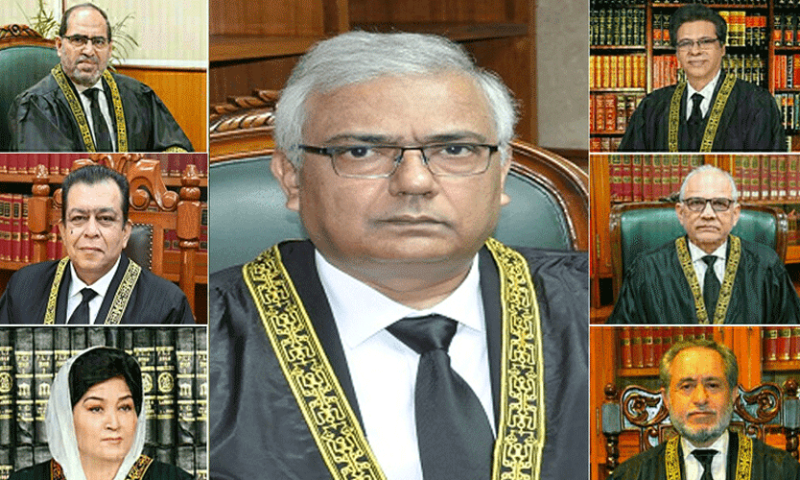
A seven-member larger bench, headed by Justice Aminuddin Khan, scrutinized the legality of extending military court jurisdiction to civilians, especially in light of fundamental rights guaranteed under the Constitution.
Justice Naeem Akhtar Afghan, during the hearing, posed a pointed question: “Are shopping malls built in cantonment areas? If I enter by force, does that mean I should face a military trial?” His remark underscored growing judicial concerns over the potential overreach of military courts.
Echoing this sentiment, Justice Jamal Khan Mandokhel warned that invoking military trials for entering prohibited areas could open the door to trying civilians arbitrarily. “If this becomes the norm, anyone could end up in a military court,” he said.
A recurring concern among the bench was the lack of an independent appellate forum in the military justice system. Justice Mandokhel questioned whether the military courts’ harsher punishments were a factor behind channeling civilian cases to them. He recalled the unresolved deficiencies pointed out in the historic FB Ali case and highlighted that the addition of Article 10A to the Constitution had further emphasized the need for fair trial protections — protections not readily available in military courts.
“Why is there still no independent forum for military trials?” he asked, reinforcing the constitutional obligation to ensure due process and access to justice.
Khawaja Haris, representing the Ministry of Defence, argued that trials under military law should be interpreted within the framework of constitutional provisions that recognize military jurisdiction. He maintained that these trials are distinct from civilian judicial processes and are not subject to the same guarantees under fundamental rights.
However, Justice Mandokhel countered that since Article 10A — which ensures the right to a fair trial — was incorporated into the Constitution, previous legal positions justifying military courts require reevaluation.
The bench also examined prior Supreme Court judgments such as Muharram Ali and Liaquat Hussain, which have been cited to support the constitutionality of military trials for civilians. Yet, questions remained over whether those precedents hold in today’s legal context.
Justice Muhammad Ali Mazhar brought attention to the ambiguity surrounding cantonment boundaries in major cities like Karachi and Quetta, complicating the enforcement of military restrictions. He emphasized the importance of clearly defining what constitutes a “prohibited area” to avoid misuse of military jurisdiction.
Justice Hassan Azhar Rizvi noted the practical implications of such jurisdictional ambiguity, pointing out that many civilians — including judges — live in military-administered areas like Clifton Cantonment in Karachi, where restricted zones are not always clearly marked.
Justice Mazhar also distinguished between “defence services” and the broader concept of national defence, suggesting that only crimes directly affecting the armed forces should fall under military court jurisdiction.
The bench reaffirmed the constitutional validity of the Pakistan Army Act but questioned its compatibility with fundamental rights, especially in civilian cases. Khawaja Haris maintained that the Army Act remains a lawful statute governing military matters and should not be constrained by civilian constitutional protections.
The court adjourned the hearing until April 15, 2025, when Khawaja Haris is expected to continue his arguments on the scope and limitations of military trials for civilians.
The case is poised to have far-reaching implications for the balance between national security and constitutional rights in Pakistan’s justice system.