Islamabad, June 19, 2025: As Pakistan’s telecom user base crosses the 200 million mark, the government has unveiled a series of digital inclusion initiatives aimed at expanding broadband access, empowering youth, and reducing the digital gender gap.
Speaking at a celebratory event on Thursday, Federal Minister for IT and Telecommunication Shaza Fatima Khawaja reaffirmed the government’s commitment to universal internet access and digital transformation. Among the key announcements were 2GB of free data and 200 on-net minutes for all telecom users, valid for 24 hours, as a symbolic gesture to mark the historic milestone.
“This is not just about connectivity — it’s about opportunity,” said Shaza Fatima. “Mobile phones and the internet are no longer luxuries; they are essential tools for education, healthcare, employment, and entrepreneurship.”
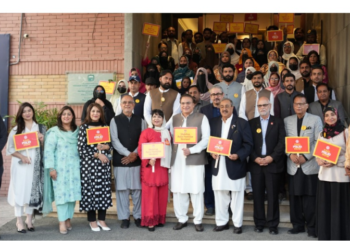
To promote women’s digital empowerment, the minister announced that 200 smartphones will be distributed to female SIM owners, part of broader efforts to ensure gender-inclusive access to technology. She emphasized that the initiative seeks to bridge the digital gender divide and enhance women’s participation in the digital economy.
The minister revealed that the government is formulating a smartphone installment policy to make devices more affordable, especially for low-income citizens. She also confirmed preparations for an early auction of mobile broadband spectrum, describing it as a critical step under the National Fibration Policy to strengthen Pakistan’s digital infrastructure.
In a boost to student connectivity, free Wi-Fi hotspots will be installed at selected universities for six months, ensuring uninterrupted access to online learning and research tools.
Recalling past initiatives, Shaza Fatima highlighted that the PML-N government had distributed 1.2 million laptops to students on merit, empowering a new generation of digitally literate youth.
Pakistan now boasts 150 million broadband users and 2 million fiber optic users, reflecting the country’s growing reliance on digital platforms for daily life.
“Our future lies with our children and young girls,” the minister said. “We envision a Pakistan where high-speed internet reaches every home, enabling us to transition toward a cashless, knowledge-driven economy.”
The announcement was widely welcomed by digital rights advocates and education stakeholders, who see it as a step toward greater digital equity and economic modernization.