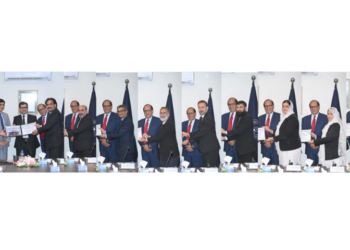
Islamabad, June 20, 2025: In a major move to ease the burden of its spiraling power sector debt, the government has signed term sheets with 18 commercial banks to secure a Rs1.275 trillion ($4.5 billion) Islamic finance facility, officials confirmed on Friday.
The financing arrangement aims to address Pakistan’s mounting “circular debt” — a long-standing issue of unpaid bills, subsidies, and financial inefficiencies that has severely hampered the power sector and strained the broader economy.
The liquidity crunch in the sector has disrupted electricity supply, discouraged private investment, and contributed to growing fiscal pressure — all key concerns under Pakistan’s ongoing $7 billion International Monetary Fund (IMF) programme.
“This facility will be provided by 18 commercial banks through Islamic financing,” said Khurram Schehzad, adviser to the finance minister. The structure adheres to Islamic finance principles and has been secured at a concessional rate of 3-month KIBOR minus 0.9%, in line with an agreement with the IMF.
Power Minister Awais Leghari noted that the loan would be repaid in 24 quarterly installments over six years and would not be recorded as part of the country’s public debt.
The newly secured financing offers a significantly lower cost compared to the existing liabilities, which often include surcharges as high as KIBOR plus 4.5% owed to Independent Power Producers (IPPs), as well as legacy debt with above-benchmark interest rates.
Leading banks involved in the transaction include Meezan Bank, Habib Bank Limited (HBL), National Bank of Pakistan (NBP), and United Bank Limited (UBL).
The government plans to allocate approximately Rs323 billion annually for repayment, with total payments capped at Rs1.938 trillion over the six-year term.
This initiative also aligns with Pakistan’s broader objective of phasing out interest-based banking by 2028, a goal outlined by the State Bank of Pakistan. Islamic finance now accounts for roughly 25% of the country’s total banking assets.
Officials have expressed hope that this strategic financial restructuring will provide the breathing room needed to stabilize the power sector and unlock future investment.