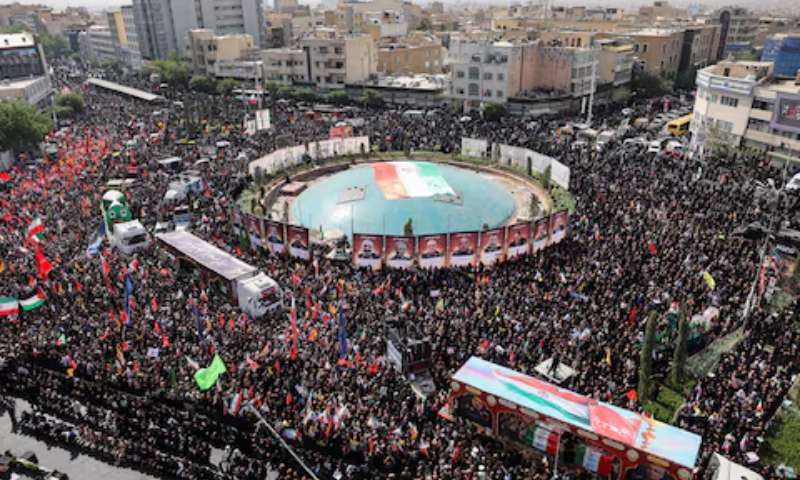
Tehran, June 28, 2025: Iran held a state funeral on Saturday for approximately 60 individuals — including senior military commanders, nuclear scientists, and civilians — who were killed during the country’s recent 12-day war with Israel. The ceremony, marked by national mourning and military symbolism, comes amid heightened rhetoric from Iranian leadership and a diplomatic backlash over remarks by former U.S. President Donald Trump.
The funeral began at 8:00 am local time in Tehran’s Enghelab Square, attended by President Masoud Pezeshkian and other high-ranking officials. Images from the ceremony showed rows of flag-draped coffins adorned with portraits of fallen commanders in full military attire. A funeral procession was scheduled to proceed toward Azadi Square, roughly 11 kilometers away.
“This is a historic day for Islamic Iran and the revolution,” said Mohsen Mahmoudi, head of Tehran’s Islamic Development Coordination Council.
Among the prominent figures laid to rest was Major General Mohammad Bagheri, Iran’s second-highest-ranking military officer after Supreme Leader Ayatollah Ali Khamenei. He was buried alongside his wife and daughter, a journalist, all killed in an Israeli airstrike. Also buried was nuclear scientist Mohammad Mehdi Tehranchi and his wife. Revolutionary Guards commander Hossein Salami, one of the first casualties of the conflict, was also honored during the ceremony.
Iranian state media reported that the funeral was held for 60 individuals, including over 30 senior commanders, four women, and four children. Government offices were closed nationwide to allow public servants to attend the ceremonies.
The solemn event follows a 12-day conflict that erupted earlier this month and concluded with a ceasefire on Tuesday. During the fighting, Israel claimed it had killed around 30 Iranian commanders, 11 nuclear scientists, and struck eight nuclear-related facilities along with more than 720 military targets. According to the Washington-based Human Rights Activists group, more than 1,000 people were killed, including at least 417 civilians.
Iran retaliated by launching over 550 ballistic missiles at Israel. While the majority were intercepted, those that penetrated air defenses caused significant damage and resulted in 28 Israeli deaths.
In a pre-recorded video message released Thursday — his first since the end of the war — Supreme Leader Khamenei issued fresh threats against both Israel and the United States, downplaying the impact of U.S. strikes on Iranian nuclear facilities. “They achieved nothing significant,” he said, framing the outcome as a strategic victory for Iran.
However, the head of the UN nuclear watchdog, Rafael Grossi, contradicted that narrative, describing the damage inflicted on Iran’s Fordo nuclear site — built into a mountain — as “very, very, very considerable.”
The funeral also follows a diplomatic row after Donald Trump criticized Khamenei in a recent statement. Iran’s foreign minister condemned the remarks as “unacceptable,” further straining post-conflict international tensions.
Iran continues to assert that its nuclear program is solely for peaceful purposes, while Israel maintains it poses an existential threat and insists its military campaign was necessary to prevent Tehran from developing a nuclear weapon.